
What is the most atrocious or gory scene we have read in a horror novel? Whoever signs is pursued by that of on the prowl (JP Libros, 2009), from the ineffable Jack Ketchum (no jokes with Ketchup allowed), in which one of the girls on vacation in a house in Maine besieged by a group of depraved cannibals is hung naked from a tree by her feet, cut open and devoured before the eyes of her horrified friends, including her boyfriend. Whatever scene we choose from the genre’s repertoire, we must now add to the most chilling part at least a couple of those that appear in the tremendous The devil takes you home (The Carfax Library, 2025), by Gabino Iglesias. In one of them, an individual is cut open next to a tank with crocodiles belonging to a drug dealer in Ciudad Juárez so that the intestines fall into the water and the reptiles pull them while the victim is still alive and watches as they eat his insides. In another, a Mexican boy who lies in a bed and who is called El Milagrito and considered a saint, has pieces cut off that are sold as talismans: the protagonists of the novel take a toe to face the dangers that await them.
Why read horrors like that? Why does the macabre and bloodthirsty attract us? A very interesting recent book, Morbidly curious, a scientist explains why we can’t look away (Penguin, 2025), by behavioral scholar, fear psychology specialist, and horror film producer Coltan Scrivner, points out the evolutionary benefits of “morbid curiosity,” which allows us to explore threatening issues and situations (primarily death and things related to it) in a way that can be useful to preserve our lives. Scrivner, who also counts on his resume to be the director of the Eureka Springs Zombie Crawl, one of the most important zombie (amateur) gatherings in the world (with permission from the Sitges Festival), emphasizes that horror fans are in no way rare or insane individuals but rather our peers and advances, and that what they do is openly express an interest that we all have, which is rooted in the heritage of the species and which provides psychological benefits. Morbid curiosity, he believes, is a common and healthy aspect of our psychology and also manifests itself in animals as a way of acquiring information about potential dangers, such as the behavior of predators (in which our monsters and murderers are reflected). The fact that human beings have the ability to imagine makes this curiosity even more relevant. The interest of horror stories is not only that they are entertainment but that they help prepare us for real threats, something that Wes Craven, the creator of that icon that is Freddy Krueger, already said.
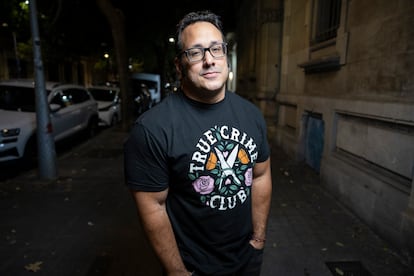
To the aforementioned Jack Ketchum (an author highly valued by Stephen King and who has been classified in the subgenre of splatterpunkterror with a very graphic representation of extreme violence), it is no longer possible to ask him for his opinion on the subject, since he is dead (in 2018, at the age of 71), but Gabino Iglesias can. The writer (Río Piedras district, San Juan de Puerto Rico, 41 years old) has been in Barcelona to present the aforementioned The devil takes you homehis fifth novel, an unusual and violent but extraordinarily effective and astonishing story that mixes a narco plot on the border between the United States and Mexico with supernatural elements, including a zombie named Rodolfo. In the novel, an unemployed Latino immigrant who lives in Austin (Texas)—like the author—and has lost his young daughter due to being unable to pay for a medical policy, joins a drug trafficking lord’s operation to steal money from a rival cartel. With two other desperate hitmen he lives a furious and amazing adventure that includes crossing the Ciudad Juárez-El Paso border through nightmarish clandestine tunnels in which terrifying creatures of Lovecraftian ascription reside and coming face to face with Chamuco himself, the devil.
“Scenes like the one with the crocodiles and the one with the mutilated child capture the reader’s attention and allow me to convey what interests me especially, which are social and political considerations and critical ideas about migration, racism, misogyny, injustice, otherness or religious syncretism,” says Gabino Iglesias in the Gigamesh bookstore (where else) Gabino Iglesias, “ideas that are much more difficult for anyone to read if you place them in a work of non-fiction.” The writer compares his novels with a birthday cake: “The decoration, what makes you notice, is what is on the outside and the substance, the cake, is what is inside. If you want to talk about things that say something serious you have to entertain. In my novels, the more I take the reader to absolute brutality, the more I make the message unforgettable, I release everything there that I cannot shout.”
You have to accept that on the other side of the black pond there are many things, that we live in a weird world as hell.”
Iglesias, a short but strong man (he lifts weights) and with a resemblance to Elvis Presley due to his sideburns and hairstyle, points out that his novels are somewhere between horror and detective fiction, “two genres that are good dance partners: guns are scary, and so are demons”, and he declares himself a fan of Horacio Quiroga – with whose work, he says, he discovered literature at the age of 13 –, Stephen King, Poe and Lovecraft; of this, “despite his racism.” He emphasizes that what he is trying to do, and that has been defined as “neighborhood noir”is “creating something of my own, bringing my Latin culture, my people, my neighborhood and its problems, to the criminal story with the lens of darkness.” In The devil takes you home (translation from English by Miguel Sanz Jiménez, the novel is filled with phrases and expressions in Spanish) there are many references to systemic racism and militant anti-Trumpism. “When you are Latino and you move to the United States, even if you are from Puerto Rico, you become a brown, a generic Mexican, and, like Mario, the protagonist of The devil takes you home, object of racism and xenophobia.” The novel is permeated by a deep sadness and an existentialist feeling. The protagonist utters some phrase worthy of Clint Eastwood from Unforgiven: “Blowing a man’s brains out is spreading pieces of his past around the world with violence.”
Of the references in his novel to voodoo, Santeria, palo mayombe or the cult of Santa Muerte, he says that he comes “from the epicenter of syncretism that is the Caribbean and I have lived surrounded by all of this, in an environment of saints, religion and witchcraft; the spiritual world is very interesting.” He decided to put a witch in the novel as a way to balance the power of the drug traffickers in the story, who are all men, and as for the crocodiles of Don Vázquez, the boss of the Júarez cartel in the book, “I heard that they have them as pets, and I liked the idea: Escobar’s hippos are very visible and I love reptiles, and if they are the kind that can kill you, the better.”
Iglesias, who aligns himself with horror and dark fiction authors such as Eric LaRocca or Paul G. Tremblay, reflects that the world is very strange. “I have a friend who says that if nothing supernatural has happened to you yet, it will already happen to you; there are many things that we do not understand or have no explanation, look at everything about quantum, or cryptozoology; you have to accept that on the other side of the black pond there are many things, that we live in a weird world as hell.” When asking the Puerto Rican writer what he thinks we fear most, he answers: “What we don’t understand, chaos, cancer, the illness of our loved ones, not having a home or losing a job. And bad people. We live surrounded by fear and we often face terror.” In his novel, continually. “Thank you very much, I never impose limits on myself, and if there is a line, a passage that makes the reader feel something they had not felt before, mission accomplished. If you don’t like it, read James Patterson. In reality, for me, it is humanity itself that has no limits to violence. When I bring readers closer to that extreme violence, I don’t invent anything: it was Escobar who came up with the Colombian tie —sticking out the victim’s tongue through a cut on the neck—to sign his crimes. Or look at everything Trump is doing: what a problem Venezuelans are going to be when he is arresting babysitters! Or look at the Bible: many more people die in the Bible than in my novels. The horror genre does not offer a happy ending, true, but isn’t what happens in Ukraine or Gaza much more brutal?
Regarding the excessive violence of drug traffickers, which he portrays in his novel, he says that drug traffickers “have created a world in which violence is the message, all its horrors are a means to an end. It is performative violence, which has to clearly transmit a warning: we are the baddest, be careful with us!” Ultimately, he says, the drug traffickers are “brutal capitalism,” and the violence of the cartels is ultimately the fault of “the United States, which buys drugs, sells weapons and washes its hands of it.”
Writing horror is work, mental work. “You write horrible things and then you go to pick up the child from school.”
He meditates that the horror genre “is necessary, because it is the only chaos you can control: at a point that seems unbearable, you can close the book and go to the park.” He considers that for a dark novel to work “there must be empathy, if there isn’t, you can kill six hundred characters, like in the John Wick movies, and nothing happens.” Iglesias insists that being an author of the genre, like being a reader, does not presuppose any perversion: “I am surrounded by writers who do the same thing and they are all beautiful people. Writing horror is a job, a mental job. You write horrible things and then you go pick up your child from school, you take the dog for a walk or you call your mother. We are affable people.” Furthermore, he believes, “everyone can be violent, we all have that inside us, there is a point from which we explode; fiction allows the characters to reach that point more quickly.”
Gabino Iglesias explains that he has been a journalist, public school teacher, insurance salesman, and personal trainer before becoming a full-time writer. When he was a journalist he interviewed, precisely, Ketchum. “He told me such interesting things as that the difference between a story and a novel is that the first is a one-night stand and the other a marriage. I don’t think I’m like him, although I recognize his voice at some point in my literary DNA. But Ketchum didn’t use the supernatural like I do. That we’ve both written unbearable scenes? Look, in this life there is nothing unbearable.”
As to whether it is more than Dracula o Frankensteinan obligatory question for an author of fantastic literature and even more so these days when new film productions of both works coincide, Iglesias leans towards the second. “It has more emotional depth than Bram Stoker’s novel and it has always bothered me that there are those who look for the father of science fiction when it is clear that she is a mother and that her name is Mary Shelley.” He says of Guillermo del Toro’s film that he liked it as a work of art “and from there, it seems very good to me that he do whatever he wants.”