
In Kuimbundu, a Bantu language, the word Kilombo It means “war camp.” In Brazil, its translation, quilombodesignates an autonomous rebel territory founded by enslaved people who managed to escape their condition—it is estimated that Portugal forced 5.8 million Africans to move to Brazil against their will. The Brazilian playwright and academic Abdías do Nascimiento defined “quilombismo” as a worldview that “integrates a practice of liberation and assumes control of one’s own history.” This Wednesday, in the room of the Museu d’Art Contemporani de Barcelona (Macba) dedicated to this fight for self-sufficiency in a sea of oppression, its director, Elvira Dyangani Ose, has claimed “the beauty and optimism” of a beautiful acrylic painting titled The handsome ones, by Los Angeles-based Nigerian painter Njideka Akunyili Crosby. That painting showing a smiling Nigerian boy is part of a series that Akunyili Crosby painted on his trips to Nigeria to reunite with his family. The work is inspired by the 1968 novel by Ghanaian writer Ayi Kwei Armah, The handsome ones haven’t been born yetwhere he saw in the new generations the possibility of breaking with the loss of idealism of a generation that stopped longing for a better Africa after independence. Looking at that child illuminated by a smile, Akunyili Crosby glimpses hope in a new possible world.
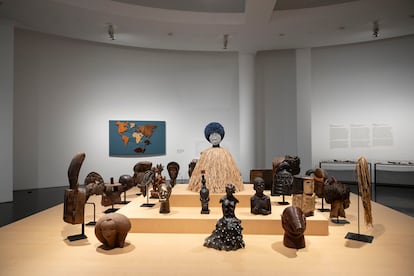
The handsome ones It is one of the more than 500 works exhibited in Project a black planet. The art and culture of Panafrica. The exhibition, which opens to the public this Thursday until April 6 at the Macba and is the one that inaugurates the museum’s thirtieth anniversary year, has been the most anticipated exhibition since Elvira Dyangani Ose took over the management of the contemporary art museum in July 2021. This is its long-awaited good quilombothe culmination of the decolonial process that began to integrate inside and outside the emblematic Raval building the cultural and political debates that challenge us. “This is not only a magnificent and contemporary exhibition, it is also a commitment to a polyphonic and global aesthetic,” defended the director of Macba when presenting an ambitious exhibition with an international spirit. The exhibition seeks to break with the reductionist and uniform vision that had been given of Pan-Africanism, the political, cultural, social and ideological movement that was born after the colonial plunder and that sought to form a new consciousness to achieve social rights and transform the planet. This vision of the “new world” is what structures the entire exhibition, although Dyangani Ose clarified that it does not seek to offer a complete and immovable history. “The idea is to develop episodes and movements so that they continue to be explored in the future,” said the director of Macba, appealing to that collaborative spirit of Pan-Africanism, one that transcends the work to the social debates that may occur in the future.
Curated by Dyangani Ose herself along with Antawan I. Byrd, Adom Getachew and Matthew S. Witkovsky, present this Wednesday at the museum, Project a black planet It brings together a hundred artists and intellectuals from Africa, Europe, North America and South America over a century, from 1920 to the present, when the debate on Pan-Africanism began. The exhibition is the first that explores with a breadth of vision and an extensive documentary archive a utopian movement that has explored multiple aesthetics and political debates. After passing through the Art Institute of Chicago, the exhibition will travel after the Macba to the Barbican Center in London and has also had the support of the Kanal Kanal Center Pompidou in Brussels.
That of Barcelona is structured in nine areas that question, among others, the conventions of the time, the ideal of progress, Western national sovereignty, the Western invention of Africa (as if it had been a desert or inhospitable before the arrival of the white man), the idea of blackness, social unrest or reverence for ancestors. In addition to quilombismo, it also explores other movements such as the philosophical and poetic movement of Négritude, which claimed freedom from the African point of view, or the Garveyism of Marcus Garvey, which called for global racial solidarity of people of African descent.
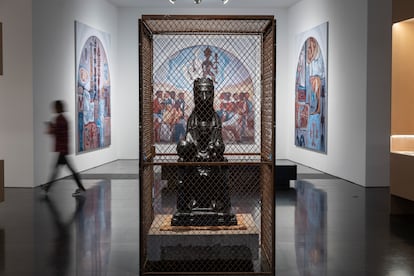
An added value of this international cultural alliance, a project that the curators began with different dialogues before the pandemic, is that it will never travel in the same way. Only 300 works will move between countries. The objective is for the debates raised by each exhibition to leave the confines of the museum, permeating the territory and providing in each exhibition different works and archival material that address the social problems and debates of each enclave. Along these lines, for the Barcelona public the black virgin exhibited in All’s my life I has to fight (All My Life I Have Had to Fight), the 2019 sculpture by Theaster Gates that the public will not be able to help but connect with the Mare de Déu de Montserrat, the Moreneta. The sculpture, placed in a protective cage, recovers from the popular imagination of the film The color purple the phrase that Oprah Winfrey said in the film adaptation of Alice Walker’s novel, recently claimed by Kendrick Lamar in the notes of Alright. The work presides over one of the rooms in which what blackness is is explored and in which black madonna asks to be protected against the high rates of incarceration of the black population. In that cell-altar, the bars are taken from a school on the south side of Chicago and the floor is the same as that of a magazine editor Ebony y Jetwhose specimens are also exhibited in an exhibition in which there is no distance in what is considered high and low culture.
For Barcelona, the exhibition of the The Pan-African Orogenya research and documentation work by Tania Safura Adam that navigates between archives of thought, popular culture and Pan-African policies of the 20th century. XX in the history of Catalonia and Spain. The documentation reveals the presence of black activists in working-class Barcelona in the last century and of combatants in the Civil War on the Republican side. There you can learn about the history of Salaria Kea, the black international brigade that saved lives in the Civil War and that left Harlem to embark to Portbou and offer health care in the Lincoln Battalion for Spain or read some of the literary journalism of the poet Langston Hughes while he covered the Civil War. “With this exhibition, Macba positions itself as a figure of thought beyond the artistic project to call for social cohesion, breaking with the discourses of extreme right and racism that confront us,” Dyangani Ose emphasized.