
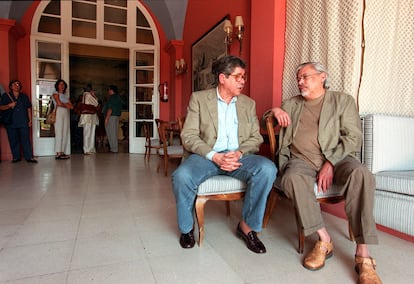
The Peruvian writer Alfredo Bryce Echenique has died at the age of 87, as confirmed by sources close to the author. Bryce Echenique is one of the greats of Latin American letters of recent decades. He was one of the great references of the generation post-boom of Latin American narrative. His first novel, A world for Julius, where he portrays the appearances of the Lima high bourgeoisie from the perspective of an orphan child who lived in a mansion, it was also his great work. With it he won the Peruvian National Prize for Literature in 1972 and was awarded the prize for Best Novel in France in 1974. He was the writer who portrayed the rich from within, something unpublished in the seventies.
His friend, also the writer Jorge Eduardo Benavides, has mourned his death on social networks. “Not only was he a great writer, with an absolutely personal, accurate, fine style, full of delicious finds (…) he was also a great person and a loyal, loving friend full of details and attention,” reads his Facebook page. Álvaro Vargas Llosa, son of Mario Vargas Llosa, the late Peruvian Nobel Prize winner, also expressed his regret at the death of Bryce Echenique, “one of the great Peruvian and Spanish writers.” “His work will survive,” he wrote.
Among his stories and novels are A world for Julius(1970); Happiness, ha ha (1974); (1977) all the stories (1979); The exaggerated life of Martín Romaña(1981); Magdalena and other stories(1986); Personal chronicles (1987); y The last move of Felipe Carrillo(1988). Then, in 1990,Two ladies talk; Permission to live (Antimemories) (1993); Don’t wait for me in April (1995); Complete Stories(1995); Prisoner of night (1997); Tarzan’s tonsillitis(1999); y Sad guide to Paris(1999).
His friends have always highlighted his inexhaustible humor and mischief. “He asked for permission to live and even to retire. A crazy novelist, nostalgic by trade, the last of a lineage that learned to write like someone confessing a sin in a bar about to close,” wrote his biographer Daniel Titinger on his last birthday. Bryce Echenique had no other intentions than to write, he never wanted to be the author of the total novel. He was one of the disorderly writers—the antithesis of Vargas Llosa—whose life was an eternal party.
“We deeply regret the departure of the Peruvian writer Alfredo Bryce Echenique, one of the most representative voices of contemporary Peruvian literature. His work, which includes novels, short stories, essays and memoirs, left a significant mark on several generations of readers,” the government agency Casa de la Literatura Peruana wrote in X. The Presidency and Congress of Peru also expressed their deepest condolences for the death of the famous author.
Alfredo Bryce Echenique was born on February 19, 1939 in Lima (Peru), into a family of bankers. He attended primary school at the Inmaculada Corazón School until he entered, at the age of 15, the English boarding school San Pablo. He then began Law at the National University of San Marcos in his country, where he also studied Literature, a course in which he received a doctorate years later from the Sorbonne in Paris.
In 1975 he obtained a scholarship from the Guggenheim Foundation and went to the United States. There he wrote various chronicles about the Deep South for a Mexican newspaper that were collected in the volume A flight of good cubero and other chronicles(1977). He traveled to Europe, pursuing the dream of the Latin American writer who had to cross the pond to consecrate himself. In 1985 he moved to Madrid, where he remained until February 1999, to return to his native Peru after what he himself described as “voluntary exile of 34 years in Europe.” He later returned to Spain to, among other reasons, participate in summer courses at the Menéndez Pelayo University of Santander. In 1989 he married the Asturian Pilar de Vega in Spain. Before that, he contracted his first marriage in Paris with Maggie Revilla in 1968.
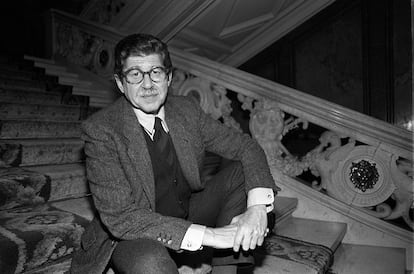
In an interview for EL PAÍS in 2021, he was asked “Your literature is about love, friendship and memory”, and he responded: “Love is the past. In Lima I see my first wife; in Madrid I meet my second wife and my friends from the past, links that were maintained over the years. This book brings echoes of things that have happened and that are now present. The bottom line is what I have always said: I write so that my friends love me more. Memory is my way of not forget. And the book is a goodbye to all that, the final farewell.”