
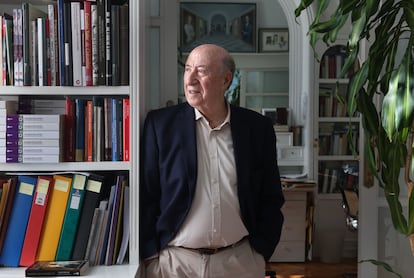
Peridis has another name (José María Pérez) but this is his identifying mark. A cartoonist (his entire life in EL PAÍS) and an artist of other subjects (the Romanesque, restoration, cultural heritage, friendship), he is like Kim of India, the friend of the whole world… He is from Aguilar de Campoo and all the geography that he has managed to bring together, for example, in the Romanesque Encyclopediawhose volumes are his pride. That encyclopedia, the memory of his parents, the passion he has for the newspaper of his life, make Peridis a national hero of the joy of telling. Here he talks about all this, as if he were drawing it, following the release of his fictionalized memoirs. (The treasure of the Fallen Convent, Espasa), which also coincides with the broadcast of the episode dedicated to him by the program In scoop, series about the great Spanish journalists (made by RTVE together with LACOproductora, audiovisual production company of PRISA, publishing company of EL PAÍS). In the first years of this newspaper, Peridis gave cookies to the editors. That is why it becomes difficult to treat you as the Stylebook from EL PAÍS…
Ask. He is a benefactor. But he fought with the boys. Once he felt that he had hurt someone badly.
Answer. Carlitos. We were playing and to say goodbye we insulted each other. So I took one cachoteja that fell on his temple.
P. Do you remember so many things?
R. Childhood is awesome. And I have lived a lot outside of that area. Everything was stored there. Here are all the sensations, the atmosphere. The book tells everything. It is an absolutely Proustian childhood. I have returned to it to restore it and, in a way, to live it again. And to tell it. In other words, I am twice a Proustian.
P. He wrote it to meet that child.
R. Yes, yes. You always look in life for the child you were.
P. And the look he had.
R. The key in life is to keep the heart and look of the child you were. He is the boy who was looking for friendship. I lived on the outskirts of town, we were the last house; I was looking for friends, which was like breathing. Wherever you go, the saying goes, make friends.
P. The father also explained to him how important dealing with relatives was.
R. Yes, with my uncle Laureano. That I should be grateful, my father wrote to me. My uncle was a very severe priest. He had suffered a lot in the war, in Santander. He was about to be shot. And that changed his character. My mother told me that when my uncle arrived in town he was in the chassis. It was after Franco conquered Santander. My mother almost didn’t recognize him, without a cassock and in a skeleton. As a young man he was very jovial, but the war changed his character.
P. His father told him to take care of him. Is it a warning that you carried all your life?
R. He told me to be grateful, that he had helped us a lot. He was the benefactor of the family. I arrived in Madrid and needed a stern father. I had to make a future for myself and help get ahead, like so many emigrants. Whoever goes first is the bridgehead.
P. In Madrid, clueless, he found a group of friends who saved his future.
R. I was already leaving my uncle’s house, I had found a job and suddenly, lost, I found myself on Arenal Street with two companions from the Marists of Palencia. They yelled at me “Pérez, Pérez, Pérez!” I got lost, I told them. They took me to the Employee’s Home, on Cadarso Street. It had a chapel, a movie club, a gym, a teacher. The teacher was José Ramón, the one who created the caricatures years after the campaign that brought Felipe González to the presidency of the Government.
P. How did you find yourself in this city?
R. I arrived in Madrid when the two millionth girl was born. The moment I added a little, she added more. We were two million inhabitants. An immense city. Just come from town. The furthest he had been was in Palencia. Madrid was big and gray, and seemed ugly, sad. It was a sad city, of survivors.
P. How did it evolve? What is Madrid now for you?
R. Now it is a fantastic city, a city that has grown. But then it had something that it still maintains now: the life of the neighborhoods and the neighborhood. People are called don and doña. And it was a place of opportunity. It was also the time of Madrid of the Five Cups. The stadium was next to my uncle’s house and I saw Di Stéfano like here now, at this distance. In Palencia I had broadcast the matches for the Maristas, and they gave me a pass here to attend the training sessions. I went to typing, to accounting, to find a job as a pen-sucker.
P. And he found work.
R. In a fantastic place. In the Literary neighborhood, Quevedo street corner Cervantes, in front of Lope de Vega’s house. But I wanted to be a cartoonist. And then I was also an architect. Architecture has been a very important part of my life.
P. And why a caricaturist?
R. Because since I was a child I was good at drawing. I loved cartoons. A tailor in my town had one that Córdoba, famous at the time, made for him. With a mask and without a mask called his drawings. Bernabéu, Celia Gámez, Panizo, Chicote appeared there. All the famous people of the time.
P. That passion forced him to look.
R. What I’ve done all my life. And I started making albums of footballers. I fell in love with the line with Cronos, who was a cartoonist from Mark, continuous line. The continuous line captivated me since I was a child.
P. Many years in the cartoon and no one ever felt offended.
R. Not so much. Tierno Galván got angry, and said so in a book that I invited him to write. He gave him a beard if he was Galván and Tierno if he wasn’t. He didn’t like to go out with a beard, so I killed Galván and only did Tierno, I didn’t want to upset him. When there is a window like the cartoon in a national newspaper, especially if it is EL PAÍS, what weighs the most is not going out. If you leave you are in the first division.
P. By the way, which was the cutest caricature?
R. Felipe González. In the Transition it was the closest. He was a social democrat, a European, a co-religionist of Olof Palme… Olof Palme, who was the one with the piggy bank in favor of the freedom fighters in Spain, was the one for whom I had the most devotion. They killed him soon, a fanatic killed him.
P. EL PAÍS opened the door immediately…
R. From the first issue. Until today. That was my luck. Being there, also, when the Transition began. When Franco died I had already prepared myself to appear in a newspaper, because I had never stopped making cartoons. They accepted me in Information, where Jesús de la Serna, Juan Luis Cebrián, Martín Prieto were… They liked my drawings because of their novelty. And I saw that EL PAÍS, a progressive liberal newspaper, would come out. “This is my newspaper,” I told myself.
P. And he became friends with the entire COUNTRY. He went in the afternoons with gifts…
R. What better could I do than hand out Aguilar de Campoo cookies like the one who distributes communion? I liked going to the newsroom, I was interested in what was done. I was a fan of the newspaper, as I was of Information… It was the largest newspaper at that time. He was conquering freedom of expression at forced marches.
P. How did your idea of journalists change?
R. I looked at them with admiration. We were a group that was fighting at that time to conquer areas of freedom. And journalism had to conquer that place, which is that of freedom of thought. Then I saw myself on a ship that was going to conquer some Americas that were freedom. And also those who were there were from my age.
P. How do you identify this moment in your country?
R. It is a dangerous moment because it can open a dark retracement. Apparently, not violent, but violating the rights and freedoms that have been achieved. It is a time that does not help politics. We live in a moment of dismantling, disheartening, because scandals demoralize society and are now quite widespread. This moment reminds me of what Ortega y Gasset said: “It is not this, it is not this.”
P. The future?
R. We already made the Transition. It’s up to the young people. They don’t have many opportunities and many are left behind. They do not have access to housing. Economic well-being does not reach them. There is uncertainty. We now live in uncertain times.
P. At the end of his book he has a phrase that attracts a title by Knut Hamsun, The last joy. What, Peridis, is the last joy?
R. There is no last joy… I am open to any joy that comes to me. The last joy is the first joy.