
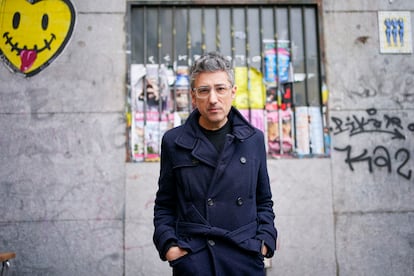
In a passage by Patricio Pron (Rosario, Argentina, 50 years old) the narrator is in New York during the brief time interval between the death of former President Jimmy Carter and the second inauguration of President Donald Trump. In addition to noticing the contrast between the two—for example, the commitment to Human Rights of the former; the contempt of the second—, he thinks: “A cruel country tends to make its inhabitants cruel.”
Is that what explains the current civilizational crossroads? “This has not only happened in the United States,” Pron responds in a cafeteria in the Madrid neighborhood of Malasaña, where he is a neighbor, “the multiple crises we are going through lead to the radicalization of sad emotions: cruelty, anger, hatred… We may not be condemned yet, since we can still exercise our right to be free. I exercise that right by writing these kinds of books.”
His new novel belongs to this class of books, In everything there is a crack and the light enters through it —Pron is in favor of long titles—, which is published today by Anagrama and tonight is presented at the Espacio Fundación Telefónica in Madrid, with the presence of the author and the writer Raquel Taranilla. What is it about? It is difficult to specify: there are multiple issues, but it could be said that, since his is such a particular prose, the book is about the experience of reading itself, which prevails over everything else. The theme is literature becoming evident before the eyes of the reader. “I think all the books of importance in our lives have that theme. They all tell us that the way we read is contingent and provisional. And that it can be completed and displaced by other ways of seeing,” confirms the author.
Patricio Pron was invited, between 2024 and 2025, to write a book at the Cullman Center of the New York Public Library about Benjamin Fondane, a French poet and filmmaker of Romanian origin, a man who had an existence that went beyond the limits of the usual, according to Pron: he broke André Breton’s nose in a bar fight, he filmed a film so immoral that the producer destroyed it upon first viewing, he warned of the danger of fascism of the in his thirties and ended up choosing to die in the gas chamber of Auschwitz-Birkenau, even though he had the opportunity to escape, to accompany the one he loved – his sister Lina -. “He could seem like an imaginary character, because his life was made of the stuff that biographies are made of, more than the best fictions,” observes Pron, who, while drinking coffee and sparkling water, takes long pauses in his speech to reorganize his ideas, as if he thinks the same as he writes (which he probably does). “He was someone who exercised absolute freedom in times very similar to ours,” he adds.
But, despite the depth of the character, Pron did not end up writing the book about Fondane during that year, but instead wrote this other book. That’s the plot: the story of a writer who travels to New York to write a book about Fondane and doesn’t write it and ends up writing another one (which is this one). Then, in Pron’s prose it is difficult to find a concrete direction, it gets tangled like the convolutions of a brain, because it is very cerebral, although it leaves constant room for poetic discoveries and the phrases that one ends up writing down in the notes application on the mobile phone. In some passage of the book, Pron speaks of a writer who “does not want to be read by all readers, but only by the best, by those who are willing to go further.” It could refer to itself.
Sometimes, the dilation of time (while the protagonists have a coffee they can turn many pages and many things) is reminiscent of the texts of Javier Marías, whose influence Pron does not reject, although he points out others: “I am an Argentine writer, at least in part, and we have that tradition of blurring the limits of fiction and non-fiction, of essay and narrative, like Borges. I belong to that tradition,” says Pron. Thus, small essays are woven into the story, long footnotes, and footnotes to footnotes (and even footnotes to footnotes to footnotes, as in a game of Russian dolls), numerous observations on the city of New York, dissertations on art, or on pain, stories of notorious New Yorkers, such as Homer and Langley Collyer – the first deceased, in Harlem, crushed by the tons of objects they collected obsessively; the second by starvation shortly after—or like the Fox sisters, pioneers of spiritualism.
Family stories, like the last one, that of Pron’s paternal grandfather, a migrant in Argentina, who once came across a fox that would always accompany him and that would give him the supernatural ability to “heal the fields.” “But, apart from stories, what matters most to me is creating texts that engender their own thinking, something like novels of ideas,” says Pron. “I like to read, and I aspire to write, the kind of story that continues to live when you have finished it, because its ideas have become important to you.”
The constant presence of New York leads us to wonder about the relationship between the heavy mythology around the city that accompanies every Westerner from birth and the reality of the city that is then presented to the visitor (see, for example, the New York of the documentaries How to with John Wilson). Pron recognizes his privilege, as a guest writer: for example, in the headquarters of the New York Public Library alone, to which the author had full access, there are six million objects, from Toscanini’s shoes to the stuffed animal that inspired Winnie The Pooh. For Pron, the important thing was to be able to frequent some fundamental items of the Anglo-Saxon literary tradition, which he also feels as his own: manuscripts of WH Auden, first editions of Fitzgerald or Shakespeare, diaries of Virginia Woolf. Or the first attempt at binding to the lighthouseof the latter, when she was launching the Hogarth Press publishing house with her husband Leopold.
He assures that, despite everything, he did not have much of a fetish around the city. “I was rather interested in some aspects that we do not usually talk about: the political message in the homilies of the African-American community, the forms of resistance to the concentration of capital that are manifested in urban space, orchards, cemeteries,” says Pron. “They are places where I saw a lot of life.”
At that time Trump was not yet unleashed nor was the fury against immigration, embodied in ICE, sweeping the country. “But I did find alarming signs, anticipations, of what could happen in Europe. It was disturbing: the realization that this could happen in the country in which we live,” notes the author.