
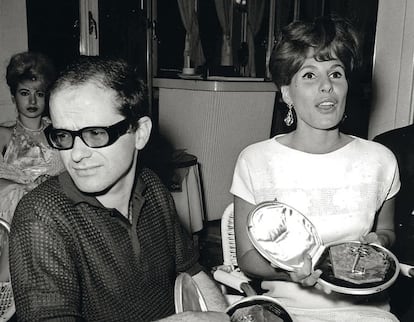
The Italian singer Ornella Vanoni, one of the great ladies of Italian song, with a sensual and melancholic voice, died this Friday at her home in Milan at the age of 91 due to sudden cardiac arrest. Italy has been enveloped in sorrow and, once again, in great nostalgia for its best years. She was one of the greatest, along with Mina, who now remains one of the last survivors of a golden era, along with Adriano Celentano and few others, when Italian music overflowed its borders and created its own myths.
Ornella Vanoni, with a very free character and life, of madness, loves and breakups, was one of those myths. He created some of the most beautiful Italian songs, of uncommon depth, masterpieces and adult works of author music of the seventies, such as The appointment (The quotewith that heartbroken but only whispered prayer, “Love, come soon, I can’t resist. / If you don’t come, I don’t exist”) or Tomorrow is another day. Passionate, skeptical, philosophical songs full of love for life, all at the same time. Soundtrack of the lives of several generations.
Vanoni has remained active and fighting until the end, always with a hedonistic and carefree point. Last year he gave a concert at the Baths of Caracalla in Rome, released an album and appeared almost every week on a popular television program, What’s the weather like?where it had a fixed section in which there was no script. He simply sat down and said whatever he wanted, between lucidity, irony and surrealism. She was a great character and few people were more interesting in an interview in recent years than her, who with her sharp and ironic tongue had no problems talking about anything, what she thought about anything and telling about her life.
Hers was a very public life, because from very early on, due to her talent, her beauty and her ease of getting into trouble, she was in the center of attention of the press. Since his beginnings at the age of 19 in the Milanese theater with the famous theater director Giorgio Strehler, his first great love. As a singer she stood out very quickly, for her elegant and sinuous voice, and for her stage presence, with a sophisticated beauty and strong personality. Her hair, a lioness’s mane, expansive curls, was one of her identifying features.
In the sixties she became very famous and formed a stormy and powerful artistic and sentimental couple with another of her most famous romances, the singer Gino Paoli, who was married. She inspired classic titles, such as Salt flavour o Endless. They were years in which the San Remo festival was almost the center of the European musical world and the tabloid press, rich in legends and gossip about Italian music, drugs and alcohol, so intense that one day, in 1963, Paoli shot himself in the heart, although he missed and ended up in the hospital. Vanoni went to see him at the hospital at dawn, to avoid the photographers, and said that they had a lot of laughs.
Four years later, his friend Luigi Tenco repeated the desperate gesture, outraged at having been eliminated from the festival, although in his case he actually committed suicide. Lucio Dalla found his body.
Vanoni went through all the decades before him, adapting to the times and the music of each era. She also starred in a dozen films as an actress. Without fear of anything, she was one of the first to introduce Brazilian rhythms and bossa nova to Italy, adapting it to her voice and language with Vinicius de Moraes and Toquinho, whom she had brought from Brazil and practically adopted for a few months. His voice was a great instrument and he also explored jazz, with Herbie Hancock among others, no less. In the eighties he flirted with disco music and sold out all the tickets on a triumphant tour with Gino Paoli.
Among her many friends and former lovers, with whom she always continued to have a good relationship, was Pier Paolo Pasolini, an unrequited love, as happened to María Callas, because the poet and filmmaker was homosexual, but she didn’t care, because she also defended being in love without sex. “Pasolini was our Cassandra, the things she intuited were real and future.” Curious, hedonistic, Milanese to the core, she said that one of the few men who had truly intimidated her was Cardinal Carlo Maria Martini, the charismatic archbishop of Milan. “I laugh at David Bowie,” he said.
In one of her last interviews she remembered that during the war her father would lie next to her during bombings to protect her with his body. “It ruined my relationship with the men, because I was convinced that they too would have let themselves be killed to protect me. But then no one has ever protected me. Maybe I didn’t want to be protected,” she commented.
He floated through life, with its ups and downs, also depression, which he faced in some periods. He loved life and said that he had been “very happy and also very unhappy.” “It’s like a wave, it comes, it comes, happiness comes, and then unhappiness comes, comes, comes,” he summarized. That is why he interpreted very well in memorable songs the malaise and complexity of a country that in the sixties, after the economic boom, discovered a certain disillusionment with love and money, an existential void that is a central theme in the great cinema and great Italian music of those years. “An intelligent and force-sensitive person has to be melancholic,” he said.
A few years ago he had to leave his house in Milan and move to a smaller apartment because, as he confessed, he had been left with 30 euros in the bank. “Family reasons, pay this, pay that other, but it doesn’t matter to me,” he explained. That’s how I went through life. This Saturday, in thousands of homes in Italy, one of his most moving songs will be heard with more meaning than ever, Tomorrow is another day(Tomorrow is another day): “It’s one of those days when melancholy takes over…”.