
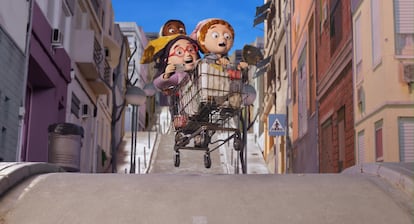
Olivia is 12 years old. He knows that his world is not going well, that his mother, an aspiring actress named Ingrid, cannot make money, and that he has few tricks left to trick his little brother, Tim, into not finding out that they are going to lose their house. That girl who hides her own fear from her family is the protagonist of Olivia and the invisible earthquake, by Irene Iborra (Alicante, 49 years old), the animated film that won two nominations for European cinema this Tuesday – in which Sirât y Lonely afternoons—in the categories of best film and best animated film, which will be awarded on January 17, 2026 in Berlin. The film arrives this Friday the 21st in Spanish theaters after premiering at the Annecy festival, the mecca of animation.
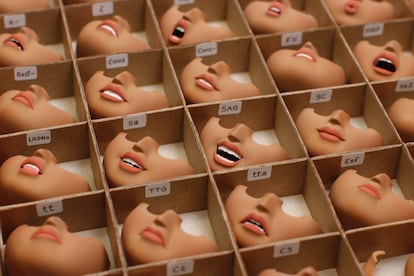
Olivia and the invisible earthquake It is the third feature film made in stop motion of the history of Spanish cinema. The technique requires infinite doses of patience and a well-coordinated technical team. “Seven years have passed since we started with the script until now,” recalls its creator, who included Maite Carranza, author of the novel, in writing the script. The movie of life from which history is born. “We spent a year filming it,” something that, he confesses, did not discourage him, but… “There are always doubts. Since we premiered it in Annecy, I have been amazed by the degree of connection of such a diverse audience with the story. Because it has been screened in countries where, perhaps, they do not suffer the problem of evictions due to abusive mortgages, although they do connect with single-parent families and their difficulties, with those mothers who struggle to raise their children’s lives, or with the amalgamation of a neighborhood shaped by immigration. We are all a little orphaned by the individualism generated by capitalism. And the fact is that people are excited to see how the community is formed and how the community can transform things.
Although it is only the third Spanish feature film in stop motion, This technique has been very present in Spanish animation since its beginnings, and on many occasions those shorts and those advertisements—it is used a lot in advertising—were directed by female directors. Furthermore, the Valencian Community has always been a power in the sector. Iborra has been dedicated to this animation for a long time and has some weapons with which to face it: “Patience is key. Patience and then I would say that the partner of patience is resistance. Because you have to resist those moments when you ask yourself: ‘But at what moment did I think this was a good idea?’
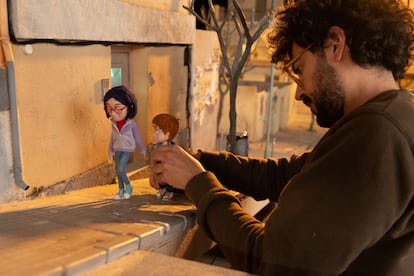
For this reason, due to such a prolonged development, the feature films of stop motion They look for timeless themes, either in popular classics, such as Pinocchio, by Guillermo del Toro, and James and the giant peach o Coraline, both by Henry Selick; well in their own worlds, like the most successful ones from the Aardman production company. “For me it was crucial that there was material that could be sustained over time. At the beginning I asked Maite: ‘When we premiere, will the drama of the evictions still be relevant?’. Therefore, the film does not only talk about that, although, unfortunately, its relevance remains,” says Iborra.
Furthermore, the animator fought not to make a niche film, but rather one that was open to all types of audiences. “For me, films only make sense if they are designed for everyone, and I knew that the novel, which deals with delicate topics for adult and child readers, was the best possible base.” He was clear about his reference: “The life of Zucchini, by the Swiss Claude Barras. It also has a child as the protagonist, it also talks about problems that affect the entire society. “He managed to reach audiences from all over the world… It’s wonderful.”
Since last year, the European Film Academy has decided that the films nominated in the sections for best documentary feature and best animated feature automatically also compete for best film of the year. This is how they achieved their double candidacy in the previous edition The sultana’s dreamby Isabel Herguera, and They shot the pianistby Fernando Trueba and Javier Mariscal. “We are super happy with our nomination,” explains the filmmaker. “We are a very European film: up to four countries on the continent have participated in our production, and we have added Chile to them.”
Among their rivals, the big favorites are the French Arco y Little Amélie. “To understand how complicated production is in stop motion, You have to notice that of the eight films that we made the first cut before the nominations, only Olivia and the Czech one were made with this technique. For me, at least, they are no longer taking away my trip to Berlin, he closes with a laugh.
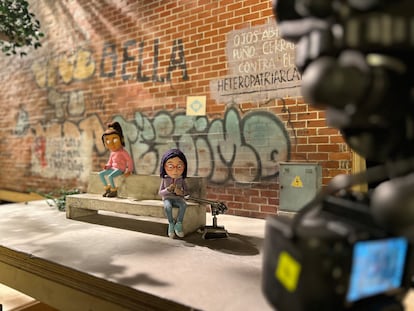
Even if it comes from foreign material, Olivia and the invisible earthquake summarizes Iborra’s artistic obsessions: “Unconsciously, I have been printing them on the screen. Obviously, I form a single-parent family with my daughter. There is an important resonance, although I have not reached the extreme of the misadventures of the protagonists… But I have experienced certain things that are in the film. And not only me, but in my environment there are many families of this type that when they see the film feel very represented. I believe, as happens in the film, that in the end, in the life, a family is built from the heart.”