
Olga Kosanović was born, raised and went to school and high school in Austria. He is 30 years old, lives and works in Vienna. He has always had his residence in Austria. She is not Austrian. As the daughter of Serbian parents, she automatically received Serbian citizenship. In 2020, after more than a year of paperwork, her naturalization application was rejected because Austrian officials calculated that in the previous 15 years, between vacations, visits to Serbian family, university studies and Erasmus, “the foreigner” had spent 58 extra days outside the country. The accuracy of the calculation and the reach of the bureaucratic machinery would have excited in Robert Musil’s Kakania, in Kafka’s trial. When she arrived at the Immigration Department, in what she thought was a boring procedure, the official told her: “First we will have to see if you are suitable to integrate.” “I was stunned,” says Kosanović in Vienna. “That was not an element that could be discussed. I worked at the Burgtheater (the Austrian National Theatre). I was already teaching film in Vienna. I couldn’t have been more Austrian at that time.”
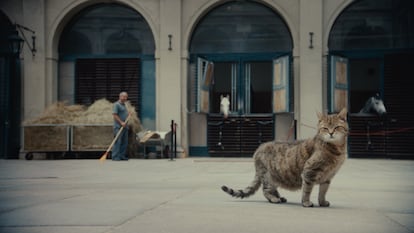
He presented his case in a television debate, which was widely commented on the internet. The reader of a Viennese newspaper wrote: “If a cat has kittens at the Spanish Riding School, they are very far from being Lipizzaners.” A Lipizzaner is a white stallion, the breed par excellence for classical dressage in Vienna in the most beautiful baroque riding arena in the world, intangible cultural heritage of humanity. The director made art of hater and the supremacist comment gave him the title of his first feature film.
Not a Lipizzaner for a long time (2025) (Very far from being Lipizzaners) has been released in theaters in Austria and Germany and already has more than 25,000 viewers, a colossal number for a documentary. It is auteur cinema, written, directed and starring Kosanović, who tells her own story, the process of naturalization to stop being a foreigner in her country. But it is also the story of a State of the European Union and its devalued democracy, which is emptied of voters. In Vienna, the fifth most populated city in the EU with two million inhabitants, 35% of the population does not have the right to vote, even though half have been living there for more than a decade. And the number continues to grow. “I have never been able to vote in Austria, where voting is allowed at the age of 16. I could do so in Serbia, but… I don’t live there,” says Kosanović.
The Social Democratic City Council of Vienna speaks openly of a “democracy deficit.” To vote you must have nationality, and the Austrian citizenship law is the strictest in Europe, along with the Bulgarian one. There are only two states in the world with more rigorous laws: the United Arab Emirates and Saudi Arabia. Among the requirements, the most debatable is the economic one. The political scientist at the University of Vienna Gerd Valchars states that, depending on the minimum income required, more than 30% of Austrian workers and more than 60% of working women (a fact that also reveals a lot about the gender gap) would not be able to obtain Austrian citizenship.
Not everyone can afford to be Austrian and have the fundamental right to vote. Because we must add the high rates of the bureaucratic process to obtain citizenship. “The cost of each case is different, it varies greatly, especially due to the number of sworn translations claimed, but mine will exceed 3,000 euros. And if it involves a family, the costs multiply,” explains Kosanović. In the documentary, the director fictionalizes with acid humor a family scene in which parents and children discuss who should become naturalized first. At another moment, he recreates a contest where the lottery of citizenship by birth is played, as important as the genetic lottery. Being born in a welfare state is not the same as being born in a perpetual state of genocidal threat. Will I have access to public education and healthcare? Will I be able to drink drinking water, fresh Alpine spring water, which in Vienna is guaranteed by a constitutional provision?
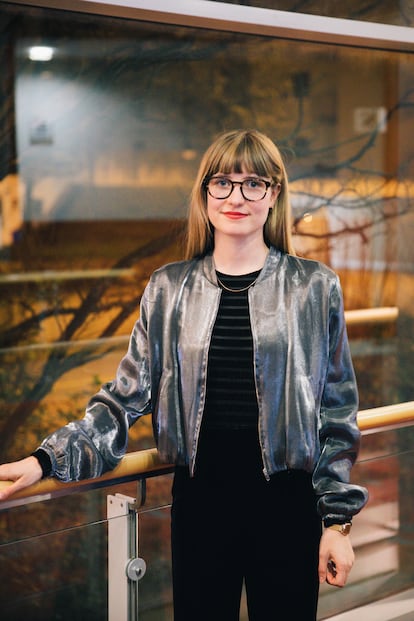
Kosanović remains a foreigner waiting to be stateless. He continued with his application and they have already confirmed that they will grant him citizenship, but first he must meet one last requirement within a period of two years: renounce Serbian nationality, a requirement with a more sentimental difficulty, because it ties him to his family, rather than administrative. When he achieves this, he will spend some time stateless waiting to receive his Austrian passport. “It will be a very tense moment because even a traffic fine, like running a red light on a bicycle, can affect the decision.” And he would remain in the limbo of the stateless.
Before presenting his first feature, he directed two medium-length films, Comrade Tito, heir (2021), a documentary family portrait where he addresses his dual Serbian and Austrian identity, and Land of mountains (2023), a drama that is disturbing like a film by the Dardenne brothers about a single father who faces the Austrian bureaucracy to obtain a residence permit. The Immigration Department demands 8,400 euros from him, which he does not have. The same amount you could get from a private policy if you amputate a phalanx. Kosanović’s cinema was already there.
But what does it mean to be Austrian? Austria is an Alpine republic, linked to postcards with mountain landscapes. “However, in Vienna, my city, there are no mountains,” says the writer Robert Menasse at one point in the film, reminding us that a nation is an imagined community. A fiction. “Having a homeland is a human right; having a nation is not. Nations did not exist before and will not exist at some point. It is not an ontological necessity.”
As the documentary progresses, without abandoning the parodic nerve, Kosanović deconstructs the myth of the Lipizzans as an Austrian identity symbol. The racist ideal of purity or supremacy is diluted until it remains soft dryly. In the smelly bark. After all, the Spanish Riding School in Vienna was the idea of a migrant born in Alcalá de Henares, Emperor Ferdinand I of Habsburg. And the Lipizzaner is a stallion originating from Lipica, in what is now Slovenia – which was part of the Habsburg monarchy -, of blood crossed with Andalusian, Neapolitan and Arab studs.