
“The danger never ends, it only changes form. We will have to fight again, and perhaps then again, before it is over.” This is what was expressed in the final pages of Odessa the colonel of the Israeli secret services who had managed to avert the danger of the lethal V2 type rockets placed at Nasser’s disposal by the secret Nazi organization. Frederick Forsyth’s famous novel (the author’s most popular after his Jackal), published in 1972, took place in 1963, and it has taken half a century for that Israeli colonel’s observation—“we will have to fight again”—to become a reality. As it says in the sequel, Odessa’s Revenge (Plaza & Janés, 2026), the protagonist of the original novel, Peter Miller, the man who uncovered the existence of the evil organization and who reappears, at 93 years old, to help his grandson in an investigation similar to the one he did: “It was obvious that Odessa would return. The truth is that it never left. Not completely.” Or as the book’s publicity says: “The Nazis were never defeated, they are just biding their time.”
I have read with great enthusiasm the continuation of Odessa, remembering how much I enjoyed the first installment in 1973, in such a different world. I have done it with the old original novel at hand, unforgettable with its blue dust jacket in which part of the profile of an SS officer with a skull cap and a menacing eye appeared superimposed on a map of South America, as a sign of everything that was hidden there. And not only there: among the things I didn’t remember from Odessa, There is the fact that its executive chief called Werwolf, the werewolf (in reference to the name of the German resistance mounted against the Allied occupation at the end of the Second World War), escaped at the end to settle on a farm on a small Mediterranean island: Formentera. In the sequel a descendant of the Werwolf plays an important role.
Odessa’s Revengepublished in English last October after Forsyth’s death in June and which the 86-year-old, already very diminished, author wrote with the help of Tony Kent, is, it must be said, inferior to the original novel and in its first pages it draws back a bit. It takes place in the present day and opens with an Islamic terrorist attack in Germany that seems to have nothing to do with the plot you expect. In fact, the word Odessa does not appear until page 63. The protagonist of the story, which starts somewhat disjointedly, is Georg Miller, the grandson of Peter Miller, also a journalist, although with podcasts and influencerwho accidentally discovers the Odessa clue, the Organization der ehemaligen SS-Angehörigen, Organization of Former Members of the SS, the clandestine and ultra-secret movement that was considered dismantled and that is no longer dedicated to transferring persecuted Nazi criminals to a safe place, but has become a much more ambitious and subtle network, like Spectra, that aspires to dominate Germany and then the world.
Resuming the organization today has the drawback that you cannot put in authentic Nazis, with the great results they give – one who leaves suffers from senile dementia – so Forsyth and Kent nourish the ranks of Odessa with new fanatic SS trained in the German secret services and special forces – the KSK, the German version of the SAS – although, yes, two of them, so as not to cut the brown umbilical cord, are great-grandsons of Reinhard Heydrich, the man with the iron heart as Hitler described him and “along with Himmler, the greatest son of a bitch the Nazi party ever produced,” as he is very graphically described in the novel. Version 2.0 of Odessa, the new bad guys, despise the AfD, the successful far-right Alternative for Germany party, as a by-product and a “bunch of Neanderthals”, but they use them for their nefarious purposes. The story has a branch in the United States where Odessa extends its tentacles in political life in order to complete its great plan and its deployment. In this parallel plot, with a populist American president, the protagonist is a young African-American woman involved in a congressman’s campaign and who discovers a plot by the sinister organization.
Despite the unpromising beginning, the novel hooks you, and soon you begin to turn pages as if there were no tomorrow (even more so if you simultaneously read a novel by László Krasznahorkai as I did), recovering the good feelings and excitement of the usual Forsyth. The story includes an unscrupulous ex-mercenary and former member of MI6 on the side of the good guys (a nod to the fact that the writer was one) and describes the action scenes very effectively. As I said, the historical Nazis are missing, and it’s a shame, so I’ve gone back to the Odessa original to look for them. Part of the success of that phenomenal best seller was the choice of the criminal protagonist, the Austrian Eduard Roschmann, a real SS officer, commander of the Riga ghetto, whose name was suggested to Forsyth by the Nazi hunter Simon Wiesenthal, in the hope that the novel would reactivate his search, as it happened: a man who saw the film based on the book identified and denounced Roschmann in Argentina in 1975, who ended up having to flee, dying miserably in Paraguay in 1977. “Mission accomplished,” Forsyth told me once I interviewed him. What a guy, he could tell you about adventures in Biafra (he had one lucky bullet that it almost hit him there and that he kept mine from 23-F like me), or when he had to jump into a canal that was used as a latrine to escape the mortars (the weapon he hated the most; he also talked about the time he met the Nazi pilot Hanna Reitsch, or what it felt like to pilot an RAF Vampire jet).
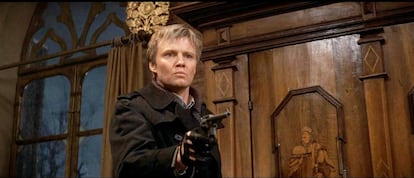
Curiously, in the novel and the film – starring Jon Voight (Miller) and Maximilian Schell (Roschmann) – the persecution of the Nazi is triggered by a murder that the real Roschmann did not actually commit, and look, he killed people: that of Miller’s father, a Wehrmacht captain decorated with the Knight’s Cross with Oak Leaves – for a medal that does not remain – and whom the fictional Roschmann cowardly liquidates to flee the Russian advance. In the film, it has always shocked me that it was decided that the actor Joachim Dietmar Mues (who, by the way, died in Hamburg in 2011 in a strange accident) played the fictional Captain Erwin Miller with a disconcerting Phalangist mustache. And from the novel and the film, all the meticulous preparation of the protagonist to infiltrate Odessa posing as a member of the SS on the run was of no use, since he is discovered immediately.
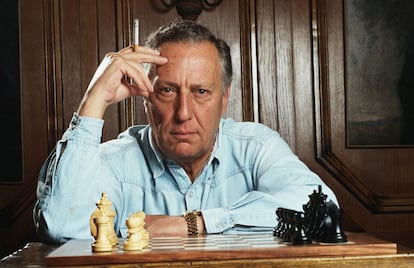
in his memories The intruder: My life in a key of intrigue (Plaza & Janés, 2016), Forsyth devotes a chapter to explaining the genesis of his Odessa and as he was guided by Lord Russell of Liverpool, advisor at the Nuremberg trials, and Wiesenthal. He remembers the second’s response when he asked him to help him invent an escaped Nazi criminal as the protagonist: “why invent one? I really have them.” The problem, furthermore, he added, was not that there were few to choose from but too many.
Forsyth, whose character Peter Miller reproduces almost step by step the research that the writer himself did for the novel, was the one who made Odessa popular – which Wiesenthal already talked about in his 1967 autobiography. The murderers among us (Noguer)—and relaunched all the interest in the hidden Nazis and the possibility that they wanted not only to escape but to return and that in fact they had already penetrated (or continued to be) in the springs of political and economic power. In that sense I have read a fascinating book, The Fourth Reich, the specter of nazism from World War II to the present, by Gavriel D. Rosenfeld (Cambridge University Press, 2019), which traces the evolution of the IV Reich concept, which to my surprise had a positive meaning at the time as an overcoming or antithesis of the Third Reich (it was proposed that Thomas Mann preside over it once Hitler was defeated), before becoming the epitome of the return of Nazism. In reality, Hitler didn’t like the Fourth Reich: the Third Reich was enough for him to do everything bad he thought, and besides, his was going to last a thousand years. After the Second World War, the idea of the IV Reich was consolidated as revival of the III and willing to finish the plans of the previous one.
Rosenfeld recalls the importance of the shadow Nazis in popular culture with films such as The stranger (1956), by Orson Welles, who himself played the hidden Nazi criminal as a teacher! in a small town in Connecticut, or Chainedwith Claude Rains in the role of head of the hidden Nazis dedicated to their Nazi things (obtaining uranium for an atomic bomb) in Brazil (ahead of The children of BrazilIra Levin’s 1976 novel and subsequent film about the escapee Mengele’s plan to clone Hitler). Marathon Man (1976), Robert Ludlum’s Nazi novels, Captain America comics (the archvillain Red Skull appeared in 1972), even in chapters of Journey to the bottom of the sea, Mission impossible y The Cipol agent Nazis came out conspiring, or surviving as in night porter (1974). In real life, the appearance in Germany of the SRP, Socialist Reich Party, with leaders such as Otto Remer, the officer who stopped Operation Valkyrie, or the Naumann Conspiracy of prominent former Nazis did not invite optimism. Nor was it believed (erroneously) that Bormann was still alive (as the famous Ladislas Farago and so many books maintained).
It is difficult to separate Forsyth’s Odessa from those times, which I have relived with a strange nostalgia when reading the sequel to his novel. Things were very clear then and the Nazis, no matter how dangerous they were, had to move mostly in the darkness or on the margins of our democracies. They were the bad guys without a doubt. Now his successors, his vindicators and those who have similar ideas are at the center of political life and roam freely, demanding greater space. Maybe that’s Odessa’s true revenge.