
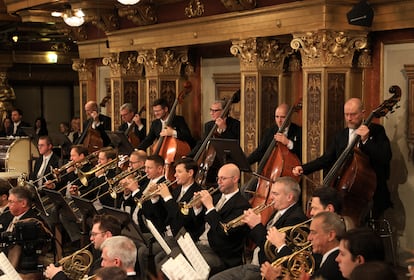
The origin of the Vienna Philharmonic’s invitation to Yannick Nézet-Séguin (Montreal, 50 years old) to conduct its prestigious New Year’s Concert has a relationship as unexpected as it is revealing with Vladimir Putin’s invasion of Ukraine. The Canadian director’s first meetings with the orchestra, starting in 2010, did not convince an ensemble that was as demanding as it was difficult to seduce. For years, the relationship progressed without enthusiasm.
Everything changed, however, on February 25, 2022. That day, Nézet-Séguin replaced in the extremes to Valeri Gergiev at Carnegie Hall in New York, after the orchestra broke relations with the Russian conductor for refusing to publicly condemn the invasion of Ukraine. It had been five years since the Canadian had led the Vienna Philharmonic, but he agreed to take charge of the three concerts of the American tour without modifying a single work on the program, and also while rehearsing Don Carlos by Verdi at the Metropolitan Opera in New York.
The effort was as intense as it was decisive. “Those concerts changed our relationship with him,” acknowledged Daniel Froschauer, president of the orchestra, during the press presentation of the New Year’s Concert, on December 29 at the Imperial Hotel in Vienna. Nézet-Séguin fell ill shortly after that musical feat and had to resign from conducting Verdi’s opera at the Met, but his bond with the orchestra has continued to strengthen since then.
It was very clear on the morning of January 1, with one of the best starts to the New Year’s Concert in recent years. Far from opening with a march, Nézet-Séguin opted for the overture to Johann Strauss Jr.’s first operetta, Indigo and the forty thievesa risky choice in which some of the distinctive features of its reading were already perceived: the care in the articulation and the subtlety in the connection of the different sections of this complex medley.
The harmony with the orchestra was further strengthened in the first novelty of this edition, the interesting waltz Legends of the Danubeby Carl Michael Ziehrer, with an exquisite introduction conceived as a musical journey through the territories bathed by the great river, where Hungarian sounds follow one another, a brief Ländler Austrian and a wheel Bosnian, presented with notable refinement.
The first spark of shared enjoyment between Nézet-Séguin—who conducted the entire program from memory—and the orchestra became visible in the next new feature of the program, Malapou-Galoppby Joseph Lanner, with its initial shouting and the inclusion of popular Indian instruments, such as the reed flute, enhanced by Michael Beyer’s brilliant television production. The third novelty, the fast polka, was less inspired. bubbly impby Eduard Strauss, which passed without leaving a comparable mark.
The first part, however, passed like a sigh, marked by freshness and charm, and culminated with two especially brilliant performances: the famous quadrille with motifs from the operetta The batby Johann Strauss Jr.—present every year at the traditional Vienna Philharmonic Ball—and the gallop Carnival in Parisby Johann Strauss Sr., closing the block with contagious energy.
After the intermission film—in which several paintings from the Albertina came to life to celebrate its 250th anniversary, with contemporary music that linked Monet with Ravel and Kandinsky with Poulenc, performed by members of the Vienna Philharmonic—, the second part opened with another overture: The beautiful Galateaby Franz von Suppè. The Canadian turned it into an opportunity to showcase the orchestra’s excellent wind soloists, including trumpet player Josef Reif and flutist Karl-Heinz Schuetz.
Next came the polka mazurka Siren songsby Josefine Weinlich, the second composition signed by a woman included in a New Year’s Concert. Much more interesting and striking was the later novelty, the rainbow waltz by the African-American Florence Price, heard in an arrangement by Wolfgang Dörner, with a swing American as unusual as it is effective in this context.
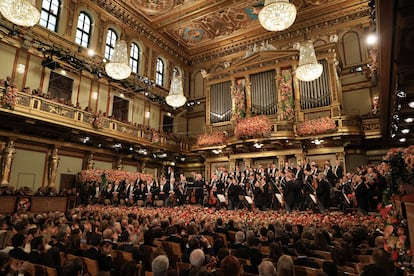
Shortly before, the first pre-recorded ballet scene had been seen, with the Diplomat’s Polka by Johann Strauss Jr., filmed at the Hofburg. It was a breath of freshness thanks to the classic narrativity of the American choreographer John Neumeier and the intellectual elegance of the Swiss designer Albert Kriemler. Yannick Nézet-Séguin naturally recovered the fun in pieces like the Copenhagen Steam Railway Gallopby Hans Christian Lumbye, although without reaching the musical excellence that Mariss Jansons imposed in 2012. Something similar happened with the very famous waltz Southern Rosesby Strauss Jr., used in the second ballet scene, this time filmed at the Museum of Applied Arts in Vienna: the Canadian directed it, eliminating numerous repetitions and without the powerful global vision that Riccardo Muti set in 2018.
It is clear that the Canadian maestro needs to delve much deeper into some fundamental scores, as evidenced by his reading of the Egyptian marchby Strauss Jr., which sounded more convincing in 2014 with Daniel Barenboim. All in all, the best of the New Year’s Concert was once again, once again, the music of Josef Strauss. A well-phrased and nuanced version of the waltz had already been heard before. Dignity of womenbut the true musical peak of the matinee was palms of peacewhere the director exhibited exquisite mastery of the transitions between his five waltz sections, despite also eliminating some repetition.
Among the tips, the marked Straussian aroma of fast polka was surprising Circusby Philipp Fahrbach Jr., which also debuted in the New Year’s Concert. before the waltz Next to the beautiful blue DanubeNézet-Séguin took advantage of the traditional greeting to send, in French and English, a message in favor of peace and kindness, also inviting us to accept and celebrate our differences through the music that unites us.
The famous waltz by Strauss Jr. was once again an ideal example of the Canadian’s freshness. The final strake with the Marcha Radetzkywhere he displayed his natural charm, leading the applause from the stalls for the first time. In the concluding section she returned to the stage and closed from the podium, but not before stopping to give a kiss to her husband, the violist Pierre Tourville, who was exceptionally incorporated into the Viennese orchestra.
The Vienna Philharmonic seems willing to expand the list of conductors invited to the New Year’s Concert, and in 2027 the Russian conductor Tugan Sókhiev, linked to the orchestra since 2009, will make his debut at this event. There is now less time for a female conductor to take the podium in this important musical liturgy.