
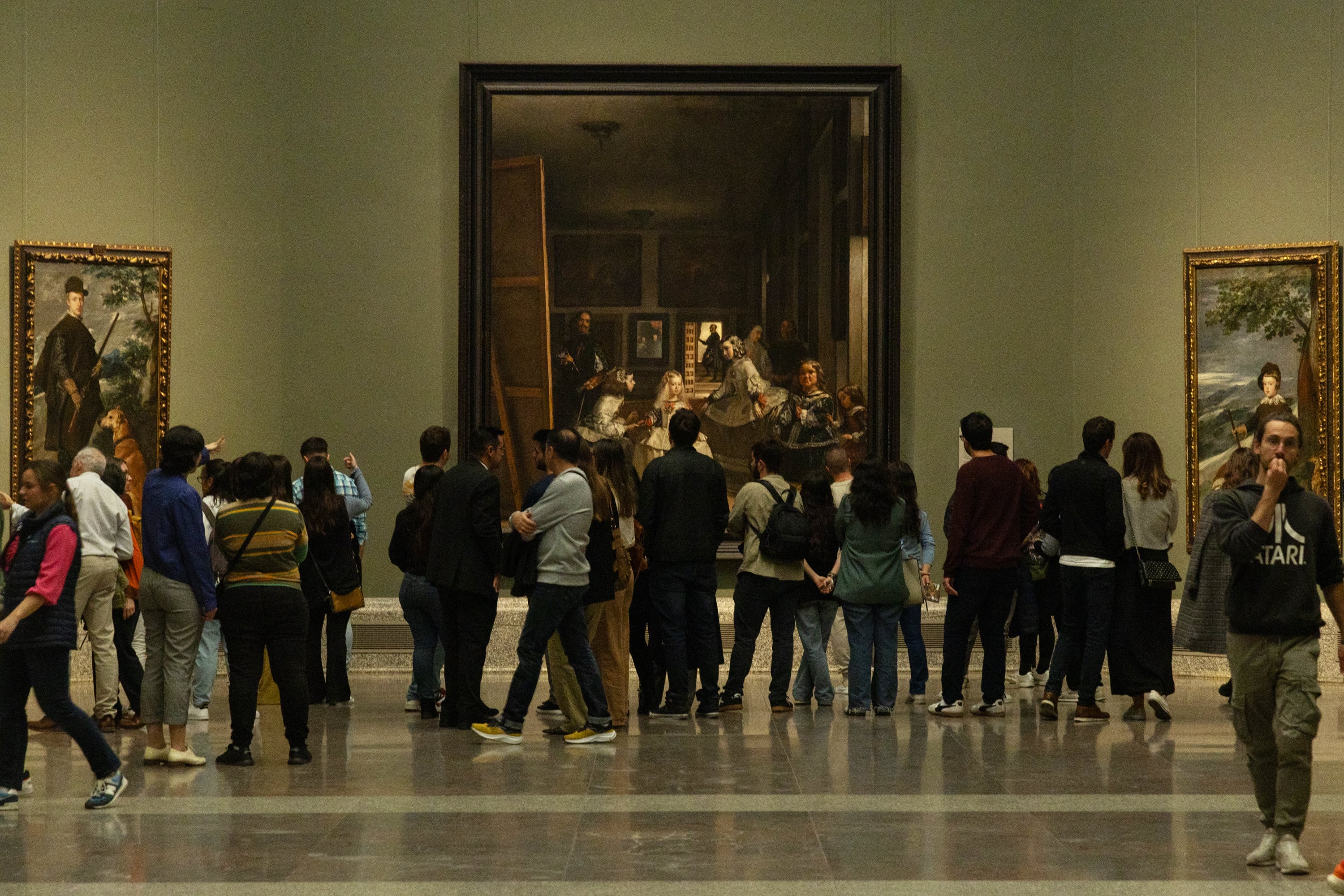
In 2025, for the third consecutive year, the Prado Museum broke its best historical record, with 3.5 million visitors. A few weeks after the figure was known, Miguel Falomir, director of the institution, assessed the data during the presentation of this year’s temporary exhibitions: “The museum does not need a single more visitor, what it probably needs is a different profile.”
In Spain, until now, no museum had considered any type of measure to reach that complicated balance between achieving the task of disseminating the heritage of a country without becoming a tourist attraction. In Falomir’s own words: “Going to the Prado cannot be like riding the subway during rush hour.” To avoid this, the manager has advanced that the museum is preparing a plan to achieve that balance and “increase the quality of the visit.”
For the moment, Falomir has limited himself to announcing that the museum is studying variables such as optimizing the space of more than 70,000 square meters, which starting in 2028 will be expanded with the inauguration of the Salón de Reinos, still under construction, which will gain 2,500 more square meters for exhibitions. The project is signed by the British architect Norman Foster and the Spanish Carlos Rubio, and is located next to the Casón del Buen Retiro, in the vicinity of the Prado.
“We will also have to resize the size of the visiting groups, rethink the accesses so that so many people do not accumulate in some…”, listed the director of the Prado.
The average visitor to the museum is foreign (75.85%), Falomir recalled. “Even so, we are the museum that most nationals visit,” he added, “but we want more to come.” To achieve this, they will propose new initiatives such as the Prado at night, one of the activities that attracts the most Spaniards. Once a month, on a Saturday night, the institution opens its doors for free and lines wrap around the building to enter. This type of zero-cost activities, such as admission starting at one hour in the afternoon, accounted for 45% of visits, followed by 44.7% who paid the normal price.
“The big problem with large museums is that the visitor is sovereign. That is, we do not know what they are going to do on each visit, what they are going to see, how many hours they are going to stay… We have to think about what to do so that the public is not only interested in iconic works, for example,” explained Falomir, who also pointed out that the policy of prohibiting photos in the rooms “has been effective.” Almost half of the audience was between 14 and 34 years old and women accounted for 53%.
In Europe, especially after the end of the covid confinement, large museums such as the Louvre implemented different measures to restrict capacity that have continued until now. The French museum only admits 30,000 people a day from 2022, and some rooms are managed with time slots and advance sales to avoid crowds, in addition to increasing the price of tickets for visitors from outside the European Union. “The Prado is between eight and nine times smaller than the Louvre, with more than nine million visitors a year. At the moment we are not collapsing, but we want to continue offering a pleasant experience,” said Falomir.
In 2026, the Prado will focus its programming on thematic exhibitions after 2025 full of major monographs such as the one dedicated to the artist Mengs. “We try to cover a wide spectrum of topics, it is the museum’s obligation,” explained the director during the presentation. This change, common in the museum, has to do with “the crystallization of the lines of work,” in the words of the director. That is, the projects reach the theaters after years of work.
Falomir has advanced that shows like In the manner of Italy, Spain and Mediterranean Gothic (1320-1420)the first major one of this course, dedicated to showing the enormous influence of Italian creation on the artistic landscape of the Middle Ages in the Spanish kingdoms, may not have the same response as that of Veronese. “We assume this because we must take into account that the majority of visitors come to see the permanent collection and that takes pressure off of us to develop the exhibition program. We are privileged,” said the director.
Other exhibitions
The Museum will claim the role that queens Isabel de Farnese, Christina of Sweden and Philip IV’s own wife have in its history with the exhibition Mariana of Austria. Another exhibition will be Rilke and Spanish arton the centenary of the author’s death. In Meadow. 21st century, There will be reflection on how the art gallery should “reinvent” itself and not “rest on its laurels” to continue maintaining the “cultural leadership it has until now,” in the words of Falomir.
At the end of the year it will be inaugurated Hans Baldung Grienabout the figure of the German Renaissance painter; and on photography the Prado presents the samples The Multiplied Meadow. Photography as shared memory y The artist’s universe before the camera. They complete the programming, Valeriano D. Bécquer. The paintings of customs, Ricardo de Madrazo. Drawings and watercolors, The painting of hungerin which the story of this painting will be told, which went from being one of the most valued in the Prado to “little more than a joke,” the director has announced.