
It would be unfair to reduce Adriana Lecouvreur by Francesco Cilea to a simple tear-jerking verismo. Whoever delves into this score, premiered in November 1902, with an exceptional cast led by Angelica Pandolfini and Enrico Caruso, discovers a composer deeply fascinated by timbral refinement. An orchestra more focused on atmosphere and psychology than on immediate effect. And voices that display an inexhaustible range of colors and nuances, far from the high stentorian.
Cilea guides her protagonist, the famous 18th-century actress from the Comédie-Française, by the hand, and writes on her musical notes an inexhaustible range of inflections to accentuate the sweetness or vehemence of her singing: melancholy, in a shrill voice, with gentle sadness…This last indication introduces the final duet with Maurizio, No, my foreheadwhich constituted the culminating musical moment last Saturday, November 22, in the return of this title 11 years later to ABAO Bilbao Opera.
Adriana clings to the love of her lover, who has just asked her to marry him, although the poison sucked from a bouquet of violets that will kill her is already flowing through her veins. However, the composer avoids falling into easy pathos and covers the music with a post-romantic refinement. He traces a deep melody in F major with a delicate embroidery on which he writes the indication lingeringinviting the singers to savor it. This is what the soprano Maria Agresta and the tenor Jorge de León did with exquisite softnessbefore crowning together the B flat, the highest note written for both by Cilea, who adds the indication stunted to underline its expressive intensity.
To conclude the duet, that melody passes to the first muted violins in the pianosurrounded by the harp. Marco Armiliato, who returned to the Euskalduna pit 15 years later, transformed it into an ethereal stroke, an openly symbolist gesture that links to the ending of the opera and the death of the protagonist, where nothing points to a dramatic and deafening climax, but to an almost unreal sweetness. The efficient and solid Genoese conductor, common on large stages such as the Metropolitan Opera, La Scala or the Salzburg Festival, was the true architect of the success of the performance.
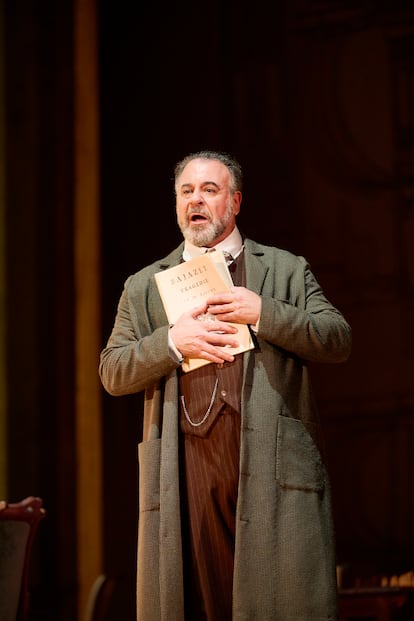
Armiliato laid the path for the voices to fully explore Cilea’s signature subtle inflections. His direction managed to overcome a somewhat monotonous first act, elevating the fourth to a truly memorable experience. He achieved this by enhancing the singing through careful attention to orchestral texture and flexibility of tempo. To do this, he relied on the brilliant Bilbao Orkestra Sinfonikoa (BOS), whose notable evolution in recent years was related by the Italian director himself, in the local press, to the spectacular urban transformation of the Biscayan capital.
Maria Agresta was, without a doubt, the great winner of the cast, playing Adriana in constant musical growth. The soprano from Salerno failed to capture the vocal subtleties in her first appearance with the cavatina I am the humble handmaidwhich lacked that delicate thread of voice that Cilea demands at the beginning of the final couplet: a breath is my voice / which will die on the new day (“a breath is my voice / that will die at dawn”). A nuance that Francesco Cesari takes as the title of his excellent essay included in the hand program. After the intermission, Agresta impressed with the recitation of the melodramatic monologue of Be able to at the end of the third act, and shone in the final act with Poor flowersinterpreted with infinite sadness and subtle inflections in pianissimo.
The rest of the cast was entirely Spanish, with three very solid protagonists. The Canarian tenor Jorge de León displayed his vocal power as Maurizio, although he did not initially achieve the subtleties of the character, when he addressed his cavatina in full voice. The sweetest effigydespite being indicated in pianissimo y in a low voice with transport. He shone in the second act with My soul is tired and offered firm treble in the martial The Russian Mencikoffbut it was in the fourth act that he fully integrated Cilea’s precise expressive inflections.
The mezzo-soprano Valencian Silvia Tro Santafé did not achieve the authority required in the haughty imprecations of Bitter pleasureat the beginning of the second act. However, her incarnation of the evil Princess de Bouillon, Adriana’s rival in Maurizio’s love and responsible for her poisoning, offered powerful highs and resounding lows. In any case, it seems to be more related to the bel canto repertoire, judging by the excellent Favorite by Donizetti that he performed on this same stage last season.
The baritone from Malaga Carlos Álvarez granted nobility to the endearing Michonnet, the councilor in secret love and protector of Adriana. His voice was somewhat monotonous in the famous aria in the first act. Here’s the monologuealthough his performance went from less to more, reaching an outstanding level in the final act. The six supporting roles were one step below. The bass Luis López embodied a Prince of Bouillon lacking in cynicism and authority, while the tenor Jorge Rodríguez-Norton lacked more precise diction and a more refined comedy as Abate di Chazeuil. The four actors from the Comédie-Française also failed to define their characters. However, the six brought freshness to the buffo sextet of the first act. And the Bilbao Opera Choir deserves mention, which solidly resolved its few interventions.
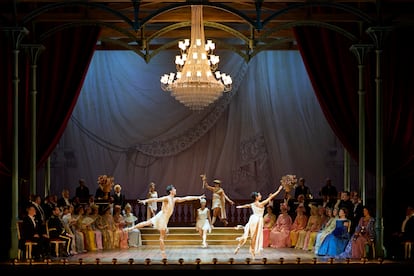
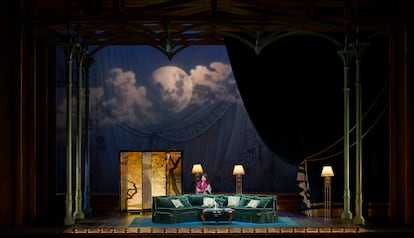
Marco Pontiggia’s stage production, premiered at the beginning of last season at the Teatro Lirico di Cagliari, is based on a brilliant metatheatrical conception. It transfers the action from the 18th century to the dawn of the 20th century to pay tribute to Sarah Bernhardt, the famous French actress who triumphed in 1907 playing Adriana Lecouvreurby Eugène Scribe and Ernest Legouvé, in his own theater and that, in 1913, he filmed a silent version of the work. However, the implementation of this proposal is quite poor. Antonella Conte conceives a traditional set, composed of a modernist framework and backdrops, although Marco Nateri’s costumes provide certain modernist nods, such as the dresses of Adriana and the members of the chorus in the third act. The lighting successfully matches the atmospheres of the plot, fully understandable despite the discreet direction of the actors. And the ballet of the third act constitutes a modest eighteenth-century pastiche without major aspirations.
Adriana Lecouvreur. Music by Francesco Cilea. Book by Arturo Colautti, based on it Adrienne Lecouvreur (1849) of Eugène Scribe and Departure: Vegetable Mary, soprano (Adriana Lecouvreur); The Princess of Bouillon, Luis López, Baritone (Bullon of Bouillon ) Josu Goat, tenor (Free), Olga Revolt, soprano mezzo-soprano (Mademoiselle Dangeville). Bilbao Opera Choir. Choir director: Esteban Urzelai. Bilbao Orkestra Sinfonikoa. Musical direction: Marco Armiliato. Stage direction: Marco Pontiggia. ABAO Bilbao Opera. Euskalduna Palace, November 22. Until December 1st.