
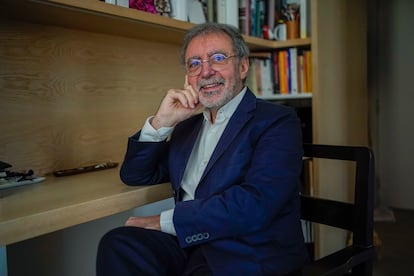
An international reference in museum management and a figure who rarely goes unnoticed, visionary for some and radical for others, Manuel Borja-Villel (Burriana, Castellón, 69 years old) has just ended his two and a half year mission as advisor to the Generalitat of Catalonia, which in 2023 commissioned him to rethink the ecosystem of its public museums. The program, named Museu Habitat, intended to open a debate about its future in the 21st century. The assignment now closes with a recently delivered report, full of conclusions, which points to structural changes: improving the working conditions of the sector, questioning the logic of infinite expansions, investigating the origin of the collections and contemplating the restitution of works.
It is the end of a turbulent period. The return to Barcelona of the former director of Reina Sofía, previously at the head of the Fundació Tàpies and Macba, aroused hope, but also many misgivings. Some Catalan museums interpreted his appointment as interference, with the MNAC on the front line. The assignment included advising the museum on its future expansion, but the institution’s refusal redefined the perimeter of the project, which ended up focusing on the exhibition Fabulous landscapesinaugurated last summer and also the subject of controversy. Back in Madrid, Borja-Villel defends his action and places the discussion in a broader framework: that of a system crossed by precariousness and cultural wars, with the advance of the extreme right as a backdrop. In this landscape, she insists on a real turn in issues such as decolonization and feminism.
Ask. What is your assessment of a project that generated criticism from day one?
Answer. The project has been ambitious and, in part, against the grain of the conservative times we live in. My evaluation is very positive. Today I would accept the assignment again. The opposite reactions have not been so many. The exhibition had a significant number of loans from Catalan museums, including the MNAC, and the network of complicities has been extensive, inside and outside Catalonia. The important thing is that a debate has been established that cannot remain on a merely discursive level.
P. What do your proposals and recommendations pursue?
R. It’s not about deciding what time the museum opens or how the paintings are hung. They are not norms or a decalogue. It is about “closing by opening”. Sometimes decolonial or feminism has become a fashion, but it is not enough to organize decolonial exhibitions if nothing changes structurally. We must go further, rethink the institution and imagine a governance that favors redistribution and sustainability. There is a clear relationship between museum and death. Museums are dedicated to exterminated peoples or to animals displayed in taxidermy. The museum functions as a device that fixes, classifies and separates, even when it aims to honor what has been exterminated. We wanted to bring it closer to life.
P. How must museums change to remain legitimate in this century?
R. The current museum is based on violence, precariousness and hierarchies. Other structures must be opened: what I call the “museum of the impossible”, which undergoes a reparation of violent histories and forces us to question the collections, based on property and accumulation. It is obscene that certain institutions accumulate hundreds of thousands of pieces, as if they were Elon Musk.
“Museums are colonial structures, based on systematic plunder. It is obscene that certain institutions accumulate hundreds of thousands of pieces, as if they were Elon Musk”
P. They reproached him that, at a time of so many attacks on culture and the public, questioning the museum was equivalent to weakening it. What does he answer?
R. Culture is critical. If you don’t touch it, there is no need for anyone to destroy it because you are already destroying it yourself. Taking care of institutions means always questioning them. And we cannot forget what we care for: colonial structures, based on systematic plunder. Denouncing that there is criticism is a conservative position, under its guise of common sense.
P. In his memory he talks about promoting solidarity and care. How do you translate that in the museum, beyond words that sometimes sound empty?
R. We live in a society that is reaching fascism. And fascism is a system that inverts meanings, like when some leaders talk about freedom and then practice the opposite. The art system is no stranger to this: it speaks of affects while maintaining hyper-individualist and competitive structures. Solidarity and care would mean, for example, that an institution truly restored what was plundered and worked to create other types of common structures and institutions around that restitution.
P. Defend museums that are not temples but habitable places. What does it mean exactly?
R. It’s not about opening bars or organizing yoga classes. That’s banality. That they are not temples means that they must stop being closed and fixed structures that claim to represent untouchable national essences. A society, a culture or a heritage are not immutable truths: they can be transformed in the name of shared knowledge.
P. In its report it calls for improving working conditions and denounces the “extractivism” of the sector.
R. Precariousness generates fear, suspicion and rivalry. It is contrary to solidarity and limits research. Changing that involves modifying laws and rules, but it can be done. We must also stop associating culture with real estate and tourism. In Barcelona that logic has been a disaster. Repeating that is a big mistake.
P. Regarding restitutions, he writes: “Everything that was stolen must be returned.” In Spain the idea persists that there was no looting.
R. And that is why we must decolonize thought. What should be returned, such as the Quimbaya treasure, should not be debatable. In the end, what has been restored is very little. If there are legal obstacles, they will have to be changed. And if not, we will have to truly assume the shame of Europe and accept that we are colonial and obsolete structures. On the other hand, whether there was looting or not, we must ask ourselves with what money certain collections were formed. That has to do with memory and repair.
P. He is very critical of museum expansions. Do you consider them unviable?
R. Many museums expand following a dynamic similar to that of this indefinite growth, which we already know is self-destructive. It is expanded so that more people come, to improve flows, to have more income, but then we know that this is never the case. In contexts where everything depends directly or indirectly on the public, expanding can be shooting oneself in the foot: more structural spending without sufficient financing. After the pandemic we thought that there would be a policy of degrowth, that other types of structures would have to be created. The reaction has been the opposite.
P. What do you expect the Generalitat to do with its conclusions? It is a very ambitious report, but perhaps a little utopian in the current context.
R. Let them not remain on wet paper. If we continue with a brick museum model, which is typical of the nineties, we find ourselves in a trap. It is expanded and then it is said that the public is unviable, that it cannot be managed well, and it is handed over to private hands so that this management becomes more effective. It is something to take into account. We run the risk of art becoming a spectacle or a form of luxury. We have seen it in cities like Paris, which were almost exclusively public, but where in a very short time the private sector has gained a lot of ground.
P. Did the criticism of your project prevent the debate you were looking for?
R. I don’t believe it. In fact, we are talking. There have been very good articles in different media. And during the three months of the exhibition I have not stopped receiving positive messages. There have also been people who have attacked the project with bitterness: some have gone so far as to write up to four articles. All this speaks of the intensity with which the project has been experienced. I value it positively. Some ideas are far-reaching and I hope they are taken up again. Does wealth have to be linked to property? Are museums sustainable? Can an institution that maintains colonial hierarchies and norms be decolonized?
“With privatization, we run the risk of art becoming a spectacle or a form of luxury”
P. Do you admit that there was clumsiness in communicating your appointment? He was presented as a “czar of Catalan museums.”
R. Surely. I did not participate in that communication, but that image of the “tsar” generated an unfavorable climate. In reality, my way of working is the opposite. At the 2023 São Paulo Biennial I proposed an absolutely horizontal structure with three other curators. And here, in Fabulous landscapesI worked with two others.
P. “Of course, the intention was not to interfere in the dynamics of the different museums, much less tell them what they should do,” he writes. Why was it then interpreted as interference?
R. As it was presented, it seemed that I came to tell each museum what to do. That would be contradictory to the project, which was opposed to that illuminist, almost enlightened idea. It also has to do with a situation of precariousness: when everyday life is already difficult, a request that comes from above to think about other things that everyday life generates a certain self-defense.
P. Do you do self-criticism?
R. There has been at all times. The report talks about how certain proposals were modified in a process of constant questioning. What would you have tried to do differently? Maybe link the project more with what myself and other colleagues and groups were doing in other places. It would have enriched the approach and perhaps would have been better understood. And, on a personal level, I would have liked the media impact not to have focused so much on me, because the proposal was absolutely collective.
P. How was your relationship with the MNAC? Museum sources indicate that they understood each other well at first, until the relationship went sour.
R. There were initial attempts to do something together, but it didn’t work out. The relationship was neither good nor bad: it simply did not exist. The original commission changed by decision of the museum’s board of trustees or its director, and it seems correct to me.
P. Was your departure from the Reina Sofía in 2023 traumatic, amid criticism for a rearrangement of the permanent collection that sparked attacks from the right and the extreme right?
R. It was harsh and violent. And, beyond the personal, it was an attack on an institution and a way of working.
P. He attributes the criticism of him in Barcelona to the famous cultural war. Wasn’t it a different situation?
R. Each situation is different, but there are common patterns: personalized attacks, polarization, criticism of any position that is not supposed to defend “ours,” be it Spanish or Catalan. There has been an unequivocal return to order.
“The consequences of a PP-Vox government could be serious. It would be radical cultural and intellectual impoverishment”
P. Do you fear a PP-Vox government?
R. The consequences on culture can be serious. If we look at what is happening in the United States, we see direct attacks, but also fear. The institutions are very quiet, unlike what happened in 2016. In Spain there could be a very rapid erasure of decolonial statements and more precarization, more identitarianism, more hierarchies and vertical structures. It would be a radical cultural and intellectual impoverishment.
P. Will we see a cultural system at the service of power?
R. Yes, one in which nothing is critical of the idea of the nation, with less research and more subcontracting, outsourcing and privatization.
P. Aren’t you tempted to run a museum again?
R. I don’t think I will. I am writing a book about these last few years, from the reorganization of the Reina Sofía to the experience in Barcelona. In September I will be at NYU as a guest professor, if nothing happens before… You can never say never, but today I don’t see myself in the daily management of an institution. I prefer to think about it.