
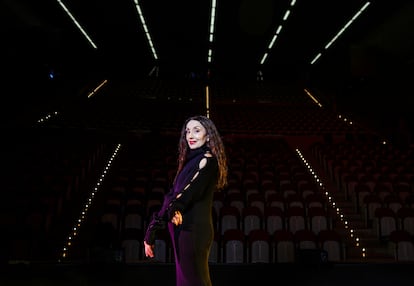
“Around me everything is music.” “That thing about whether I’m a rocker or not has always made no difference to me.” “I have always sailed on many seas.” It’s Luz Casal speaking. She is 67 years old, she is Galician (and Asturian). His new album, I’m going to allow myself, It is a musical and human challenge. It is the first she has published since the King granted her the title of Marchioness of Light and Peace, in June of last year. In Toledo, on January 2, the tour premiered. On January 17 it makes its major premiere at the Movistar Arena in Madrid, within the Inverfest festival. Ella (music by Charles Aznavour) is part of the songs on the new album, and in this case she is accompanied by Carla Bruni, Italian singer and wife of former French president Nicolas Sarkozy.
Ask. Music is his life.
Answer. Yes, everything I have done musically has to do with my life. Personal life is mixed with music. For me everything is music. I’m going to allow myself, This album tells who I am, what I can afford, what is of interest to me, naturalness, spontaneity. That which allows me to consider that I am a free person.
P. I told the hotel concierge that I had arranged to meet you and he told me: “Old rockers never die.”
R. And the rockers less so! Many songs I sing can be very misleading. We are boxed in typologies, in tastes, in trends, as if you couldn’t be from this group because you are already from the other. Musically, I have always sailed on many seas. That thing about whether I’m a rocker or not hasn’t always mattered to me. I am what I am or I work to know what I am. As a listener, my tastes are very broad. I listen to everything. I can understand and enjoy an electronic music concert and listen to the Beatles. I started listening to rock as a personal choice. Bolero, flamenco, classical music, everything came with my training and my environment. On this album there is all of this. If here I would sing alone Tears o Bravo I would die of sadness or boredom.
P. And how does he do it?
R. I have to go from one side to the other with the freshness and naturalness that I have, but feeling that I am interpreting different stories. I accepted Pedro Almodóvar’s invitation to sing the songs he offered me in Far Heels because it gave me, on an interpretive and gestural level, to do something else, to feel something different.
P. At the Toledo concert, at the end, this shout was heard: “You look like a marchioness!”
R. I didn’t hear it. About the marquisate… It’s an honor. I receive any award with great gratitude. I know immediately that if they give it to me it is because they can also give it to anyone. I received it with joy. Maybe it forces me to take responsibility, but I will continue to be a badass and continue to wear red lipstick.
P. The red of dawn He will always talk about you, about your loneliness. AND black shadow lives in you.
R. My dream is to enjoy things, even the bad things. For me any day is different from any other. The interpreter must have the ability to understand the work. A singer, a pianist, a guitarist, a violinist, must know how to express what a melody, a lyric, contains. In the case of black shadow, Words alone already show you a path, an environment, a landscape. That, together with a melody, is what transcends. That’s why it’s so important for me to have the musicians I have. Capable of rock and roll or a song like black shadow o I don’t care about anything… Being able to get into such different songs seems to me to be one of the coolest exercises at a concert. I let you go, The last one I sang in Toledo goes at the end because I think that afterward I can’t sing another one.
P. The setting helps him.
R. I may have said it before: the stage is the place where I am most free, where I feel most free.
P. Free from everything?
R. Yes, it gives me a feeling of almost physical power, like you are above everything… It happened to me in Herodes Atticus, in Athens, where I was many times. There I saw myself so short, everyone on top of me and I was so short… I felt like that crowd was going to eat me. It was a cool feeling, like anxiety. The stage gives that: through the songs you sort of let go. You see it in McCartney, in the Stones, in Raphael, in many people: is it because of the fame, is it because of the money? It’s because it catches, it catches a lot.
P. He sings other people’s songs, but they are all his own, as if they came from his soul. For example, Everything changes. It was written by the Chilean Julio Numhauser and sung, above all, by Mercedes Sosa. You sing it now, old and current.
R. I firmly believe that it is valid. There are phrases: “The climate changes with the years. “The shepherd changes his flock.” It’s a lyric with a rhyme. It happens like Violeta Parra’s song Thanks to life. They are songs that you can sing all your life and they are a reflection of the present as well, because they have an extraordinary message. I have never recorded them on, let’s say, official discs.
P. What did that mean to you, and to Galicia? black shadow What did Rosalía de Castro offer to poetry?
R. For Galicia it is like the Galician anthem, because the anthem also has very complex lyrics that I don’t fully understand. black shadow It is not the anthem, of course, but it has something profound. There are songs with other mysteries, but this one has something, and not only for Galicians, that reaches the soul of anyone, and also of any performer.
P. What is the song that lives with you the most of all the songs you have sung?
R. Because of the number of times I have sung them, maybe I don’t care about anything, Rufino y Think of me. Rufino It always enters the repertoire, someone asks for it and I sing it. It was created by Carmen Santonja. He said that that character, from the eighties, was characteristic of the Movida era. And notice that that Rufino Now it can remain valid.
P. At what point in your life did you most need a song?
R. When I lost my father. I was working on a record. And I’m going to Asturias to bury him. I return to the house in Madrid, with enormous sadness, a feeling of orphanhood that I had not felt before, and I write Among my memories…”The world stops existing, and I look back and search through my memories.” It was like the moment of feeling sorry for everything. I think that is the song that I have needed the most. It was the expression of feelings that if I had not released them, they would accompany me for a long, very sad season.
P. He has played one of the women, Amália Rodrigues, Portuguese, and Olga Guillot, Mexican.
R. May Olga Guillot be in my life through the interpretation of Bravo It’s because the lyrics are outrageous. I have never sung about hate. From love to hate there is only one step, it is about a love betrayal, which I have not had. I have a certain intolerance to betrayal, but I do what I can so that no one betrays me. A couple who love each other like hell and now hate each other. It is the most appropriate lyric to express relief: even if you die, even if a train hits you. As for Amália Rodrigues… There are the tears of Teardrop. Fado singers sing with their voices somewhat strangled. Amália sang very well, she was a very important voice with a lot of feeling.
P. And everything changes?
R. Yes, in life, brother, everything changes. Looks like we’re on tour. Like children on the swings, you think you are here and you appear on the opposite side. What apparently does not change is what changes, I have the feeling that my life changes. “Change the superficial and also change the deep… “.
P. Have you cried while singing?
R. Yes, but it is not good to cry, the beautiful voice does not come out. I find crying almost impudent.
P. I asked a poet, Manuel Rivas, to think of questions for you.
R. I admire him, I adore him.
P. Are social networks conditioning music, accelerating it, commercializing it?
R. Speeding it up, without a doubt. This acceleration also democratizes the possibility that, anywhere in the world, someone can make a song, an album, without depending on practically anything.
P. The poet wonders if you remember the singers.
R. Yes. It is one of the first images I have, being in Asturias, my mother always worried so that we would not forget Galicia.
P. Will artificial intelligence, Rivas asks, steal voices and souls?
R. Voices it is possible to steal. But the soul is impossible to steal.
P. And David Uclés, the novelist, asks him: if death were to live forever in a novel, which one would you stay in?
R. Without a doubt, in the poem by Rosalía de Castro that gave rise to the song Black shadow.
P. This would be the journalist’s last question: do you give thanks to life?
R. I chose that song when I was undergoing cancer treatment. Thanks to life. He told me: “When I return to the stage, the first thing I will do will be sing it.” And then I realized that that song was what I could say to people. Let him listen, let him walk again. Everything Violeta Parra writes there was for me to tell people that I was on stage again and that I was grateful for life, despite everything. The good thing about bad experiences is that they teach you life lessons. And yes, I want to be light and stay.