
The security guard grabs his waist, pulls up his pants and raises his eyebrows. Jane, a 43-year-old tourist, insists. Ask him again for explanations. He has invested more than 150 euros and 13 and a half hours on the plane. His family has arrived in Paris from Texas and the visit to the museum was the highlight of the trip. The icing on the cake, she says, putting her index finger and thumb together. “Well, we won’t open,” the employee tries to settle on Monday, the first day of strike at the Louvre this week. Jane can’t believe it. Nor are several hundred people queuing – and ridiculous postures in a fragile balance on the cement pedestals to take photos – in front of the pyramid that the Chinese architect Ieoh Ming Pei designed in 1993 to modernize the museum and speed up the entry of visitors. It was almost 33 years ago. Golden times. Since then, everything has gotten worse.
Mass tourism, aging facilities, numerous economic crises and erratic management – its previous director, Jean-Luc Martinez, was charged with trafficking in works of art – have slowly pushed the most important museum in the world into an abyss that describes, like the poetic subtext of one of its great canvases, the lost splendor of a nation. The great work of this catastrophe, however, will forever be the video of four hooded men taking a set of Napoleon’s jewelry worth around 88 million euros on October 19. In broad daylight. Then came floods, landslides. And the strike.
“Ma’am, it’s closed. Why? This is France,” the guard summarizes to Jane’s desperation.
On Monday the museum remained closed. Strike. Tuesday, too. Weekly rest. On Wednesday and Thursday it was half open, after employees decided to continue with partial strikes to protest working conditions, the aging of the facilities and “the waste” of a plan baptized as New Renaissance and presented with great fanfare by the President of the Republic, Emmanuel Macron. The museum put up a fight: if it closed it would risk another 400,000 euros a day. “The management’s response has been direct contempt, silence. Laurence des Cars (the president of the Louvre) is bunkered. But we will see if they dare to open anyway,” lamented the unions on Wednesday morning at the doors of the Louvre, which that day opened with closed rooms and hardly any workers in key places. The visitors, however, paid the entire ticket, after hours of queuing.
Finally, the strikes would be called off on Friday, Wednesday afternoon, with the museum staff at half throttle, but the public at full capacity, the only way to enter without a long wait was to sneak in through a side door, access for people with a professional card and for rogues, since no one asked for proper accreditation. It shouldn’t be done, but it is a journalistic experiment to delve into that hell that officials describe.
Go ahead, come in.
There are hardly any security guards – they are on strike – and those who exist devote themselves devotedly to their cell phones. Once in the center of the lobby, under the pyramid, the magnetism of the Denon wing, where the main pictorial treasures are located, including the Mona Lisadissolves the journalist in a long queue that will be followed by a collection of physical obstacles in some rooms. Today, without a doubt, it would be impossible to tour the Louvre through its galleries in nine minutes and 43 seconds, like Anna Karina, Samy Frey and Claude Brasseur in Band aside, by Jean-Luc Godard. You walk in small steps, slowly. In 420 seconds, however, jewels valued at 88 million can be stolen and disappear without a trace.
The posters, faded and poorly laminated photocopies, confusingly announce the proximity of the Mona Lisathe prize that almost all visitors seek, like one of those pokémon in augmented reality. After climbing the stone stairs and following the human flow, one inevitably enters the motley Hall of the States, where Leonardo’s work has shared space since 1966 with large paintings by Paolo Veronese and the Venetian school. There is a lot, all impressive. The most important work, The wedding at Cana (1563). But it goes unnoticed, despite being the largest painting in the Louvre (70 square meters) due to the tourist compulsiveness of “I was here” imposed by the Mona Lisa (1506).
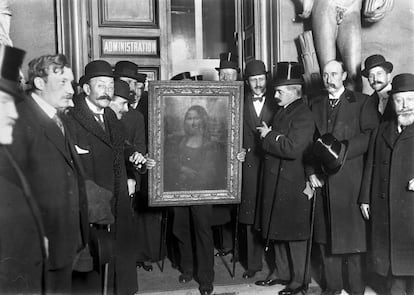
The work was stolen in 1911 by Vincenzo Peruggia, an Italian glassmaker from the Louvre. Today it is still there, protected by a huge glass. That is the good news in these uncertain times for the museum, which, in full psychosis due to the latest robbery, moved some of its most valuable jewels to the Bank of France. But the Louvre, awaiting the major renovation proposed by Macron, who plans a special room for the grand hit Renaissance style and a special entrance for those who just want to take a photo with it and leave, it has placed black fences that suffocatingly cage visitors in front of the work. Pure sadism. “No!” a security guard shouts at a Japanese man who tries to take a photo while leaning from the side to avoid being crushed by other compatriots.
The scenes, beyond the potential viral contagion and the suffocating heat, border on human abuse. One of the catenaries in the facility falls, a German stumbles. A British woman laughs. And some of the hostages Mona Lisa They manage to escape, settling into the chairs normally occupied by the guards who are not there today to claim their work. “Please be courteous to the museum staff,” reads a sign at the exit, perhaps too late.
The signage is confusing. The place maps, more difficult to decipher than the Ikea ones. Everyone ends up in the same space, milling around the most coveted works. If there is hubbub, there is a masterpiece. Although in some sections the phenomenon can be confused with the mess at the door of some bathroom with broken toilets. There are many.
One rebels suddenly, and tries to go in the opposite direction. but there it is Liberty leading the people (1830), by Eugène Delacroix – with the people, yes, but blinded by the flashes -, and the viewer can only see a crowd. Like the one who was traveling on board desperately in Medusa’s raft (1818), by Théodore Géricault, a few meters away, although difficult to see under the increasingly dim light of the room, despite the fact that today the sun comes in through the skylight.
The problem is not new. It has been hammering the management’s conscience for years. Art historian Didier Rikner, a specialist in the institution, believes that “the Louvre is today a museum adrift.” “The museum experience is terrible. There are closed rooms and a lack of signage that concentrates people in the same places and leaves empty rooms like those of the vermeers. The bathrooms are sad. And on Wednesdays and Fridays, the entire second floor is closed between nine and ten thirty,” he criticizes.
Organizing the human tide is not easy. The Louvre receives about 30,000 inhabitants every day. Generally accommodated in hourly flows. It is possible that this Wednesday afternoon will be busier than usual due to the strike. There are nerves among the visitors. “What a pain, mom” (Pain in the ass)protests an Anglo-Saxon boy. The vigilantes remain calm, however, in that spiritual strike, with a present body. And poor Leonidas too, waiting there The Battle of Thermopylae (1814), by Jacques-Louis David, right on the mountain pass where the historic clash was about to take place. A strip as narrow for the Persians as the museum corridor, somewhat cracked in the ceiling, where visitors now dodge each other, squeezed together like the public attending the enormous Napoleon’s coronationpainted by the same author a few years before. It’s amazing. And it doesn’t matter when you read this and what the museum is like.
The museum experience, that could be the leitmotiv of this drama, has mutated enormously since the last time the Louvre underwent a major renovation, when it received some 2.8 million visitors a year. No infrastructure resists. The workers of the Palais Garnier – the opera house – are in solidarity these days with those of the Louvre. “We are the same,” explains one of the union spokespersons. The museum pyramid was supposed to receive four million visitors annually. But they grew exponentially. Then, the pandemic created the mirage of a more sustainable, measured, selective tourism. I end up being the opposite. The world decided to take back what was theirs. Quickly, compulsively. Today visits are close to 10 million.
Else Müller, spokesperson for the SUD Culture union, believes that “everyone has seen that this museum is poorly managed.” “And we, who are closely linked to this place, to its works, to its history, experience it as a martyrdom. The roof has already collapsed, the jewelry has been stolen, rooms have been flooded… The only thing we want is to transmit this heritage to future generations,” he laments. That, and a legitimate raise, too.
Paris loves riots. And the Louvre, built on the banks of the Seine at the end of the 12th century, was for centuries the official residence of the kings of France, until Louis XIV, fed up with the rebellious crowds in Paris, abandoned it for Versailles. Today those feverish hordes have changed their appearance and motivations and walk the halls armed with guides and brochures. Although there is no adaptation. Of all kinds. A man in a wheelchair desperately searches for the elevator that will transport him from one floor to another, much slower than the one the thieves used on the morning of October 19.
The president of the museum, before the Senate investigation commission into the theft of the jewels, acknowledged on Wednesday that the museum is going through a “crisis” and is suffering from “disorganization” in security matters. questioned in France InterDes Cars considered that she still has enough credit to remain at the head of the Louvre, a museum she has directed since the end of 2021 (she is the first woman to do so). “I am in charge, I run this museum in the middle of a storm, that is very clear, but I am calm and determined to accompany the 2,300 Louvre agents,” she said, adding that she assumes her “daily share” of responsibility for the museum’s poor functioning.
The problem, believe the unions – and also the Court of Accounts – is that the management prioritized the purchase of art over improving the conditions of the infrastructure. Also on security issues. The report from France’s highest audit institution accuses the Louvre of having an insufficient video surveillance system in its three wings, of having applied severe cuts and delays in spending on security in recent years and of showing a poor prioritization of priorities.
At the end of the tour, before passing through the old medieval structure of the museum to appear again in the hall under the pyramid, Athanor (2006), a mural by Anselm Kiefer, manages to confuse the grey, grainy and material appearance of its imposing relief with a leak from the ceiling. So much so that, as sometimes happens with contemporary art, it is difficult to be sure where the artistic work ends and the accident begins.
On Friday the employees decided to vote in favor of calling off the strike and ending a week of pain. The problems, however, will still be there on Monday. The grandeur of the museum and its stratospheric works of art, no matter how many problems it faced, too.