
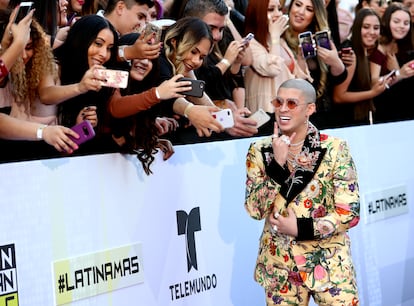
What are we talking about when we say that someone “sings well?” What is singing well? A thorny question, and even more so today, when the suspicion between generations does not seem to admit either calm or intermediate positions. There is unanimity in affirming that Maria Callas was good at opening her mouth and making sounds. Just like Frank Sinatra, Mercedes Sosa or Beyoncé, the latter to enjoy today. But can we consider that rugged and penetrating whisper of Leonard Cohen through that prism of excellence? This is when the real debate begins. The fact is that there is a noisy, abundant and, let’s also say it, current of classic tastes that considers that Bad Bunny, the biggest star of current pop (sorry, Taylor Swift), is not skilled in tuning, intonation and vocal projection. You only have to delve into the comments of the articles that this newspaper publishes about the Puerto Rican to see the heated exchange of opinions that the topic arouses. Something has changed after his now famous 13 minutes in the Super Bowl, but not the basics. We capture the sentiment of many comments in this one: “What a great show, what a slap to Donald Trump, what bravery… But he keeps singing badly.”
Patricia Ferro speaks from her decades of experience as a vocal pedagogue, as she works as a singing teacher for important figures of Spanish pop such as Pucho (Vetusta Morla), Valeria Castro, Antonio García (Arde Bogotá) or Xoel López. “If singing well is displaying virtuosity according to the parameters of a hegemonic beauty, we are limiting it to something very small. Because with that criterion we could do without singers, since perfect voices are already being produced by artificial intelligence,” argues the educator. Here we have a first conclusion: there is no such thing as singing well or singing badly; there is singing. “When people say that Bad Bunny sings badly, they are wrong. What happens is that it does not represent them,” adds Ferro.
With a commitment to identity as a Puerto Rican and Latino, and with an increasingly broad musical palette, Bad Bunny has changed a lot since his beginnings, back in 2016. In an interview with EL PAÍS in 2021, he noted: “I am not a musician. I am an artist who sees things differently and tries to create his own world.” Santi Carrillo, director of Rockdelux, appreciates a certain persecution of Puerto Ricans. “He is subjected to a scrutiny that many others are spared. It is clear that Bad Bunny is not a marvel at vocalizing, but it is his distinctive sign. His songs with another type of voice and another more normalized lexicon would not be the same nor would they have the same effect. It is another type of vocal modulation where excellence is not the number one objective, although on the last album, I should have taken more photos (2025), sings better than others. But it has happened here with Loquillo or with Jota, from Los Planetas, who were a disaster at singing at the beginning and then knew how to modulate and personalize their voice.”
Two elements function in this debate as an incentive to encourage the critics of the author of Unforgettable dance: he autotunewith tons of stigma in tow, and sexual lyrics. The two resources as a form of complaint have become outdated in the case of Bad Bunny. Perhaps at the beginning of his career, yes, but for some time now he has neither used speech corrector in an obvious way nor have his texts been monothematic. “There is a prejudice with the use of autotune, but there is no reflection or knowledge about it,” says Marina Arias, a graduate in Musicology who completed her thesis on the impact of reggaeton in Spain. “We have a autotune visible, which provides a robotic sound, and then a lighter one to correct tunings. I, for example, don’t listen to that autotune visible in the Super Bowl performance.”
That spectacle on February 8 recomposed the figure of Benito Antonio Martínez Ocasio (the Puerto Rican’s real name) until he appeased his detractors, with the exception of Donald Trump, who defined him as “terrible.” The music critic of EL PAÍS and Cadena Ser Fernando Neira surrenders to that recital: “I am more interested in the figure of Benito than that of Bad Bunny. As an artist he is appreciable, but I don’t think he is revolutionary. However, those 13 minutes of the Super Bowl in 40 years will be studied and analyzed as a historical episode of music, in the same way that we review frame by frame the 21 minutes of Queen at Live Aid in 1985. The meaning of the “Bad Bunny’s performance transcends far beyond the musical.” Santi Carrillo supports this theory: “Bob Marley was the first artist of the third world who triumphed internationally and became a kind of hero who decorated t-shirts and posters. Later, Manu Chao also developed that role. And Bad Bunny is at that level of transcendence. “Part of Puerto Rican music to embrace a social commitment.”
Time for comparisons, and here the field, in addition to being wide, is deep. Art as a sporting trend to designate who is better, who wins. It is a weapon that can be turned against the purists, because if we put figures to art, Bad Bunny has no rival, considering the number of listeners on digital platforms and the tickets sold for his concerts. Educator Patricia Ferro dismantles the game of comparisons: “There are a lot of voices that are not correct, although they touch people’s sensibilities. They are voices that communicate. This is the case of Bad Bunny. Voices that do not identify with hegemonic beauty are also those of Leonard Cohen, Bob Dylan or Robe Iniesta. Who can question these artists and say that they do not sing well. Who would question Sabina. Pasión Vega is a vocal marvel, and has as much value as Robe. Camilo Sesto or Nino Bravo exhibited extraordinary vocal ability, but so did Sabina. Was Camarón a worse singer than Camilo Sesto? Obviously, no, did one of them sing poorly compared to the other?
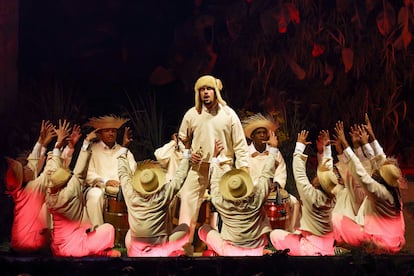
Some have seen a critical view towards the Latin musician influenced by the traditional Anglo-Saxon school, a closed and partly self-conscious vision, as the vocal teacher explains: “There is a bias when evaluating Bad Bunny. I don’t know if I would call it classism. Yes, it is a limited view, because the phenomenon is not observed in its context. The way of singing has to do with the way the artist speaks in his field, with the type of language he uses with his people and with the place where he has been. “Those who criticize him do not understand the context from which Bad Bunny comes.”
But what is Bad Bunny’s voice like? Musicologist Marina Arias dares to define it: “Serious, full of nuances, tremendously expressive. It has malleability, it can opt for a melodic or rapped tone. And it knows how to use many different registers depending on what the song asks for.” Fernando Neira does not find it reproachable in vocal terms, but he considers his style “not very unique.” “He is not a person who is identified in vocal terms with the second syllable, something that in others that personality is more accentuated,” he adds.
Bad Bunny performs in Spain this spring. Starting on May 22, his show will be seen by 600,000 people, who will fill the Barcelona Olympic Stadium twice and the Madrid Metropolitano ten times. A demanding adventure that will test your vocal cords and your star status.