
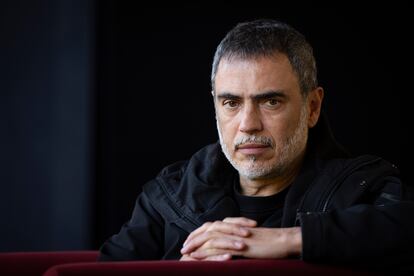
“When there is harmony in the kitchen, the dish comes out better.” The actor and theater director Julio Manrique utters the phrase in the Teatre Lliure restaurant, but he is not talking about the restaurant but about the Lliure. The metaphor expresses very well—Manrique masters words and language: someone has said that with him you should never forget that he is an actor—the thoughts of the person who is currently in charge of the emblematic Catalan collective, which this December celebrates the 50th anniversary of its founding. Manrique (Barcelona, 52 years old), who has been director of Lliure through a public competition since February 1, 2024, when he replaced Juan Carlos Martel, and has a contract until February 1, 2029 (three years left), faces the anniversary event with the consideration that the key concept must be the idea of transmission, and looking to the future.
The commemoration events will not be announced until June, which will start at the beginning of next season, but Manrique advances that it is not planned to stage an emblematic spectacle of the Lliure as has been done in other anniversaries (with The Marriage of Figaro in 2016 for 40 years). He also reveals that Lluís Pasqual, one of the founders of the Teatre Lliure and its most iconic character after the death of Fabià Puigserver, will have a role in the celebrations, despite the controversy with which his mandate ended in 2018. “The 50th anniversary has to be a celebration and not an exorcism, and we will try stubbornly,” says Manrique. “There are already enough haters and bullets and bags of shit in the world, theater has to be something else.”
The director of the Lliure has recently premiered at the theater the boatman (until March 15), by the British Jez Butterworth, who already rode Jerusalem in 2019. “He is a very powerful author, and the boatman “It is a work that takes place in August 1981 in the countryside in the county of Armahg in Northern Ireland, for a single day, during the harvest festival. We follow the experiences of a family, the Carneys, against the background of the theme of the land and the Northern Irish conflict and the hunger strike of its prisoners that year.” In the play, a corpse appears in a swamp, which triggers (and worth the word) the plot. “It is a very romantic piece, which catches you like a bad thing.” Manrique traveled through Northern Ireland to prepare the show. “There are many open wounds, that was very heavy, it is a very small place and everyone was part of the conflict, a war between neighbors.”
the boatmana great show with 19 performers that “can only be done in a public theater,” is Manrique’s second direction since he has been in charge of the Lliure (the previous one was the seagullby Chekhov, with which he opened his first season at the theater, in October 2024). What he has not done since he has been director of the Lliure is act. “I don’t miss it,” he says. “It wouldn’t be easy for me either,” he adds. His idea is to direct one production per season, something that allows him, he emphasizes, to have “a very good team” in the management of the Lliure. “I’m happy above all doing theater,” he says, “it’s what I really like; mind you, I’m happy running the house, what we do day to day, but my driving force is the rehearsal room.”
The balance of the two years he has been at Lliure, “I don’t know if it’s up to me to do it, but I’m satisfied,” he says. “It is a huge responsibility, and a very exposed place, where they look at you a lot, with a magnifying glass, they judge what opportunities you give, how you use the budgets, everything. It is impossible to satisfy everyone. You have to make a program typical of a public theater and at the same time take risks. You don’t have to do archeology, but you can’t renounce tradition and history either. You have to use the entire palette of contemporary theater and go outside, to dance, to the circus, to performance.” Manrique defines himself as “a very spectator of things that I wouldn’t know how to do,” and highlights that he wanted to make a very open program, focused on the idea of a high-quality art theater for everyone. That the public understood his proposal and attended was essential, he says. “Theatre does not exist if people do not come,” he emphasizes. “We wanted what we do to matter, and that is happening.”
Behind closed doors, he adds, it was also essential for the staff to be comfortable and feel part of a team, “to all go together, even though it may sound illusory.” He considers that the effort “has borne fruit” and “the atmosphere” of work has changed. “The labor agreement is in progress, we have made a lot of progress, and we are going to leave a good legacy for those who come after.” He insists that it was necessary to “undo knots and open windows so that the air could flow.”
His contest-winning project was later cut; things like the young company fell. “We did what we could, we threw a stone at the moon which is the way to at least hit the bluff; the idea of the company was from other times and I saw that it was very complicated for it to work in these times.”
El Lliure de Manrique, father of three children and whose partner is also an actress, translator and already director (she has debuted with To the extent of the impossible) Cristina Genebat, has promoted the social aspect through the Ànima Lliure project, with the aim of opening theater to everyone and to diverse voices and bodies. Has too much emphasis been placed in this direction? “It does not seem to me that insisting on the social program, on inclusivity, opening the theater to functional diversity and neurodiversity is fair. I have a personal relationship with the subject and I am very aware of what the world has done and still has to do to integrate these people. That said, I do not believe that art has to be socially justified, the theater has meaning in itself. The important thing is always that the shows are good, the artistic criterion comes first. Thus, we have been able to see works at the Lliure such as the Hamlet of the La Plaza Theater performed by actors with Down syndrome, which was an extraordinary show, in which the to be or not to be took an impressive flight, or The invisible life, “from the true story of the blindness of its interpreter.”
Manrique points out that we are in a good moment for theater. “It is real, the figures and the espietasthe theater occupation snitches. The theater works, there is a desire to go, that has to be seen partly as a reaction to digitalization, screenism, AI. People want to see people live, something that if you are not there you miss it.”
Is there a general tendency towards small format and closer stories to the detriment of the most universal ones, the great theatre? “Not in the Lliure. There is the version of Antigone which will be seen in May, the Casting Lear from last season, or the same the boatman. True, we try to always keep in mind where we come from, and that if a classic text is chosen it touches you and is not another Shakespeare, another Chekhov just because. It’s about bringing it to our time, adapting it to these coordinates, making it speak to you in some way about the here and now. The theater is not a museum, but a place for debate, to talk about our time, and that can be done from the classics too.” Manrique continues: “I would like all artistic forms to be present at the Lliure and we do not give up exploring the great historical and classic works. It is true that there is a current trend towards the self and autofiction, also in the performing arts. There are no fixed formulas, everything can generate interesting things and failed shows. It is true that there is an entire generation that exploits the world of the self and that has a very close relationship with networks and their imagination, all of that has a place, it is okay for it to go out of the ordinary and disruptive things arise.
It is common for directors of publicly funded theaters to ask for more resources, and that has been a tradition in the Lliure. “My policy is not to complain, it doesn’t seem very intelligent to me, it is better to convince and seduce with results. But it is true that the budget for activities had deflated a little, although in 2026 it has grown thanks to the extraordinary contributions for the anniversary. I am very grateful to the administrations, I am aware that they do not have it easy.”
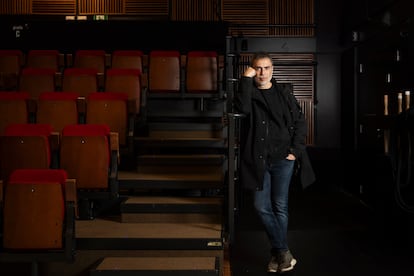
The anniversary, Manrique points out, will be celebrated in the fall of this year, from September to December, with a special program and more things such as exhibitions, publications, “and some parties.” The director assumes the responsibility of being in charge of the historical collective at such an important moment. “It was my turn, yes, to be there, well guay, there is much to celebrate. Everything has happened here, good, less good and also bad. It is evident that I was not there at the beginning: when the Lliure was founded I was three years old. But, although I have done many things in my career, such as being director of the Teatre Romea, participating in the creation of the production company La Brutal, starring in the Hamlet by Oriol Broggi in the Library (one of his best performances along with Vania by Oskaras Korsunovas) or all television, and cinema, I feel quite part of the Lliure, at heart. I made my debut as a professional actor in 1994 at the Lliure de Gracia with class enemy by Josep Maria Mestres, produced by Zitzània, the company created by Pere Planella and Guillem Jordi Graells. At Lliure I met people I was amazed by. It was a very mythical territory for me. And it was fundamental in my life because thanks to a scholarship from the Lliure to participate in an international workshop on Shakespeare organized by the European Theater Union network I got to work at the Théâtre des Bouffes du Nord in Paris with Peter Brook.” At the Lliure he has participated in thirty productions in total, he was part of Àlex Rigola’s company and premiered The curious incident of the dog at midnighttheatrical version of the novel.
Regarding the most difficult point of the anniversary celebration, the participation that Lluís Pasqual will have, Manrique is clear: “Lluís Pasqual will have a role. All the people who have been important for the Lliure must be there and Lluís deserves to be recognized and have a role in the celebration. Lluís Pasqual and others.” In fact, Pasqual, currently immersed in the preparation of a film in which he will play King Hassan II of Morocco, is scheduled to direct a show. Elaborating on the topic, for Manrique, “it is never a sign of the health of a sector that its significant people are stoned.” About him Pasqual casewho resigned from the direction of Lliure after the accusation of abuse of power by the actress Andrea Ros and a campaign against it, reflects that there has been “a change of paradigm and mentality” regarding the behaviors permitted to directors. “At the time of, let’s say, Strehler and company, being talented gave directors impunity, and allowed them to not be particularly delicate, which led to excesses. Times change and they have changed more in line with people who like to work with and from the good vibes on stage. Those of us who like people to love us and not be afraid of us. And that’s good. Fortunately, the forms most typical of another era are disappearing on their own. We have to put things in their proper place. context, but it is normal that today some things about how people worked before shock us.”
In any case, Manrique affirms that “instead of getting into soap operas” the important thing about the celebration will be “the idea of transmission, looking and recognizing where we come from with our eyes on those who will come.” It sounds very Chekhovian, it could be a thought of a character from The three sistersa work that, curiously, both of them, Pasqual and he, have done in the Lliure. “It’s the danger of always having Chekhov in your head,” Manrique laughs frankly. “But the truth is that if you don’t spend at least five minutes thinking about what’s to come, you’re wrong. Nothing is over with you, this is going to continue, like life.”