
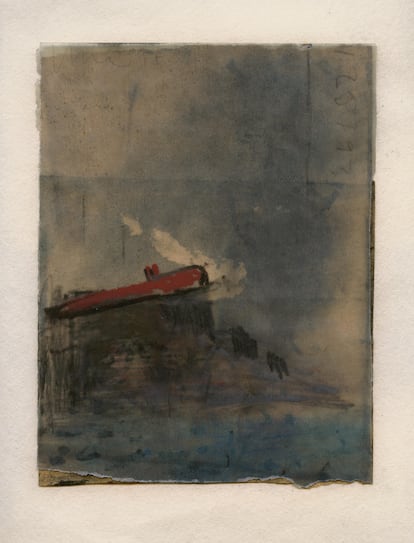
There are childhood memories that span an entire life and, in the case of Juan Uslé (Santander, 71 years old), also an entire body of work. At the age of six, the painter learned from the commotion he caused among his neighbors and, later, from photographs published in the press, that a ship had sunk off the coast of Langre (Cantabria), very close to his home. More than 25 years later, newly installed in his New York studio in 1986 thanks to a Fulbright scholarship, the painter inaugurated a new stage of his life in America—the same place from where the shipwrecked man had once set sail. hawthorn— recreating that episode from his childhood. However, in that large-format painting titled 1960the ship was no longer submerged in the waters, but was held in the safety of an islet above the sea.
Starting from that work, and ending again at that point, the retrospective Juan Uslé. That ship in the mountain (from November 26, 2025 to April 20, 2026), at the Reina Sofía Museum in Madrid, proposes a temporally chronological and spatially circular tour of the 40 years of career of the painter, one of the most international figures of Spanish contemporary art. From that New York that, from the moment he set foot there for the first time, felt like “his home”, a place in which “he had already lived before”, to the town of Saro in Cantabria, his original home and where his second studio is located, the painter has repeated again and again throughout his life the same transatlantic journey of hawthorn. From both sides he has drunk, been inspired and created: from the heart of the cultural world to the most remote corner possible from all that hubbub.
The exhibition – “small”, for the painter – occupies 11 rooms on the first floor of the Nouvel building, where from now on the temporary exhibitions will be housed, leaving the upper floors for the permanent collection. This rearrangement of the spaces and the collection itself is part of the museum project of the director of Reina Sofía, Manuel Segade, which also seeks to expand the visibility of Spanish contemporary art. Curated by Ángel Calvo Ulloa, belonging to a younger generation than Uslé, this overview of a hundred works seeks to offer a re-reading of the painter’s work from the point of view of the present. It is also a kind of exhibition of exhibitions, in which the artist’s historical exhibitions in institutions and galleries make up the architecture of the concentric promenade, in whose almond the photographic work of Uslé is located, where we glimpse, as Calvo Ulloa said in the presentation to the media, “a very particular way of understanding the medium and of understanding the world.”
Despite being a pure painter—a profession with which, said the artist, present at the press conference, he has “shaped” his life and to which he feels a powerful “commitment”—the photographic and moving image plays a decisive role in his artistic perspective. Inserted in his gaze from those snapshots of the hawthorn going down the drain, photography serves Uslé as a means to think about painting. From this sensory and intellectual restlessness arises the Dolca Line (2008-2018), a series of 170 photographs that do not represent the images he captures on his canvases, but rather his way of approaching reality. From an old photograph where the boy Uslé is holding a Dolca chocolate bar to distracted portraits, reflections in windows and landscapes of all kinds, these snapshots, placed as a frieze throughout the room, bring the viewer closer to the context that surrounds the artist and that forges his inner universe, one of the key ideas of Calvo Ulloa’s exhibition concept: linking the life and work of the painter.
From that photography center, the exhibition—the second that the Reina Sofía dedicates to the Cantabrian artist after Open Rooms in 2003, in the Velázquez Palace—radiates spaces occupied by Uslé’s pictorial series, called families, which expand throughout his career. Instead of dedicating the rooms to families, the curator has chosen to mix them in rooms spread over different periods that demonstrate one of the painter’s maxims: “Do not stay in the comfort zone of style.” “I commit myself to what I have been able to enjoy, which is painting,” added the artist, dressed in a gray hat and colorful sports shoes. “But I also commit to the word: that is why I give titles to my works, which are stories, or jokes, always something that is the result of an experience in the process of creating a painting.”
From the lived to the dreamed, from the organic to the geometric and from the emotional to the intellectual, the journey shows the mutating forms with which Uslé approaches abstraction, the language he cultivates and which once again occupied a prominent place in contemporary creation from the 1980s onwards. They are paradigmatic families like I dreamed that you revealedmaterially begun in 1997, although conceived some time ago, and painted in the silence of New York nights following the “background music” of his heartbeat. One room is dedicated to Uslé’s participation in Documenta IX in Kassel in 1992, a milestone in his career that elevated him critically and encouraged galleries around the world to court him. “That overexcited me and led me to try to hide,” he recalled with a laugh.
Uslé did not forget to mention his partner and his daughter, the artists Victoria Civera and Vicky Uslé, as well as his “pocholos” (his grandchildren) as fundamental stimuli for his fruitful career in life and art. With Civera he landed in that New York of the eighties that for the first time allowed them to call themselves painters, and with her he lived “like snipers” the Madrid Movida in which “the hordes that went to your openings They overwhelmed you.” Of that somewhat “disoriented” young man who at the same time enjoyed “the adventure” and experienced “uprooting,” someone who grew personally and professionally “as he went,” today there remains “less muscle, although more ambition,” as he stated. “What is still present is hunger,” he summarized. “I still have that inertia, which is moved by an engine called desire.”