
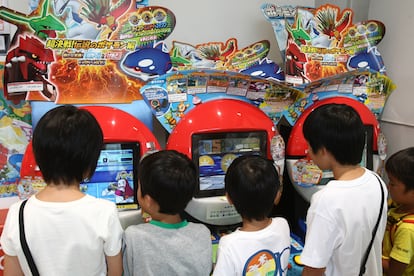
10 years ago Nintendo, the Japanese company that has accompanied the childhoods of millions of people around the world, launched its biggest hit in decades: Pokémon GO. In 2016, with its diffusion on mobile phones, the game reached its maximum number of concurrent players, more than 232 million users catching Pokémon globally — the augmented reality game would end up being downloaded more than 650 million times. That same year and in that same game, a boy from Malaga who was barely eight began his journey to “take over everyone.” Now, hand in hand with a global phenomenon that turns 30 this February 27, Leo P4t0m4n (Patoman) Marín left on February 15 to the stage in London at the Pokémon Europe International Championships 2026 (EUIC 2026). The man from Malaga, who had just turned 18 and whose favorite pocket monster is the eternally confused Psyduck (his alias comes from this yellow duck), was about to break records.
But before the young man from Malaga, there was a young man from rural Machida, in Tokyo, who, in the sixties, enjoyed spending his afternoons catching and collecting insects. It was Satoshi Tajiri, germ light of Pokémon. The game came from its intention to provide that same social experience of collecting small creatures and sharing them among friends. “Pokémon It is a social experience from minute one. You can’t pass Pokémon Really, if you don’t connect with people, you don’t exchange, you don’t fight, without that social component. What the objective was selling you, what the anime song said, was ‘get everyone’ and for that you need others,” says Israel Mallén —whose favorite Pokémon is Bulbasaur—, author of the essay PKMN Generation: A Life in the Tall Grass.
From collecting bugs in Japan to the world
After having seen two children playing the legendary Nintendo Game Boy connected via cable link (in the pre-internet era, this allowed two of these devices to interact), the missing piece appeared in Tajiri’s mind to achieve the sociability of the exchanges of his childhood. This idea was only missing one face, and that’s where Ken Sugimori came in with his watercolors to give identity to the 151 creatures that the franchise would launch. cross media most profitable in the world: since 1996 the saga has generated more than 90,000 million euros. As a comparison, throughout its almost 30 years of life, the Harry Potter universe has earned just over 25 billion euros.
These colorful animals (the word “Pokémon” comes from the compression of “pocket monsters”, or pocket monsters) would quickly expand to every medium that exists under the sun, from books and manga, to the classic anime — which in the Spanish case arrived before video games, like a herald announcing to the parents of the peninsula: prepare your wallets —, to movies, to one of the most successful card games in the world (with almost 39,000 million cards sold in these three decades), to the number of generations of video games that have sold more than 490 million units (that’s how we get there to having more than 1,025 creatures that you can catch and train), to museums everywhere, or even your own theme park.
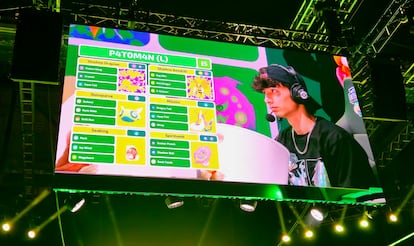
What do you do with these pocket monsters? They are caught, trained to raise their level, perhaps evolve them into more powerful forms so they can face them in battles (governed by element advantages and disadvantages: fire beats grass, electricity beats water, etc.), to infinity until one becomes a Pokémon master. In the case of Patoman, he has built his team over a long time and with great care: his Shadow Drapion and Shadow Beedrill, a Dunsparce that will be a wall, a Milotic that will appear at key moments, a Seaking and a Spiritomb. The creatures that Patoman uses are the same as those we see in any other of the more than 120 official titles, what changes is what surrounds them, the type of combat (or lack thereof). Pokémon hasn’t gone the last 30 years without innovating.
But Pokémon does not emerge as a perfect creation in 1996. Tajiri sold the idea to Nintendo in 1991, and luckily for many, Shigeru Miyamoto—creator of Mario, Donkey Kong, Legend of Zelda, among other icons of the video game— saw the potential in the project and sponsored it until its launch. Development took so long that Game Freak, Tajiri’s company, had to undertake several projects with Nintendo to finance the creation of Pokémon and many on the team even chose to continue working without pay when the funds ran out. All for the love of the idea, all until those first two cartridges of Pokémon Red and Green (Red and Blue outside of Japan) changed the world on February 27, 1996.
The issue of insufficient funds affecting the development of Pokémon titles would not be exclusive to the first releases: historically, Nintendo has allocated relatively low budgets to the creation of new titles of its main goose that lays the golden eggs. Pokémon Scarlet and Purplethe last in the saga and inspired by Spain, had just over 21 million dollars for its development (a low amount for a blockbuster). Even so, this generation of games are the second best-selling in their history, with almost 27 million copies, or just over 1.3 billion euros in profits.

This is something that, although it does not affect sales, it does affect the perception that fans have of this world, something about which Mallén expresses: “It is often thought that Pokémon is a multi-million dollar franchise, and it is, but not all that money reaches the games and the studio that makes them.” This is especially noticeable at a graphic level, although Mallén counters that “on a mechanical level, it has always been a restless saga.” And it is in the mechanical section where Pokémon explores how to change-without-changing, a cheetah modern that evolves without changing type.
The global competition
After having lost early on the first day of EUIC 2026 – a competition to which this newspaper was invited by the organization – Patoman will win 15 battles in a row in three days (a record in itself within this competition), to emerge as the leader in the losers’ final and access the grand final. The duel is against Colin Colin6ix (read as “Colinsix”) Spa, an orange-clad Dutchman, known as “The Final Boss of Europe.” Patoman faces him with his cap turned upside down like Ash Ketchum, a character from the saga. The best of five rounds are competed.
Proof of how current the saga is among the players, EUIC 2026 has had more than 7,000 competitors (doubling the 3,500 athletes at the Milan-Cortina Winter Olympic Games) and 17,000 attendees. Those legions have made it the event of esports largest in the history of the continent, explains Chris Brown —his favorite Pokémon is Charizard, although now that his two-year-old daughter crawled towards a Squirtle, he is rethinking it—, global director of esports of the Pokémon Company and in charge of organizing all the saga competitions in the world.
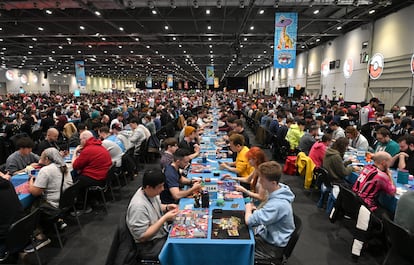
Brown says that EUIC 2026 serves as an innovation space to “test new ideas” before transferring them to the Pokémon World Championship 2026, which this year will be in San Francisco (California). He is enthusiastic about the 30th anniversary and indicates that he sees in Pokémon the potential to reach 100 years, although for now he is content with imagining “full stadiums” for the world championships in the next three decades. “In the world of Pokémon we always see these battles happening in large arenas, and we will make that a real experience for our trainers,” he adds.
The Iberian Psyduck
The five rounds begin that will define the European champion of Pokémon GO. They win two each, so the title fight is decided at the last moment. With a charged Tomb Rock, Patoman’s Spiritomb crushes Colinsix’s Drapion, triumphing in the last round: he is crowned European International Master of Pokémon GO for the second consecutive year. He is the only Spaniard to reach this level. His father, Jorge Marín, who until three years ago did not know what Pokémon was, now perfectly understands the key aspect of the saga: “It is more than a game, it is a community”, and with the same encouragement he celebrates his son’s opponent: “Colin is a magnificent rival, he is a master of this game, and the truth is, what better way than to play against him in a final.”
Hours later, and with his trophy clutched tightly in his hands, Patoman will remember that he was so involved in the high-level match against his own Gary Oak, that even when the judges declared him champion, he “wanted to keep playing.”
At the end of the day, Pokémon is something social, with a lot of feeling, about keeping your initial chosen one in battle despite having a disadvantage because you believe in that creature you have raised, you believe that that handful of pixels is not just a sprite further. It is your companion and has been for billions of people over 30 years.
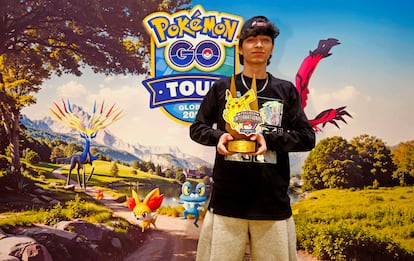
As author Israel Mallén says: “When Pokémon stays in a circle of ‘look what a cool strategy’ or ‘look what a tiny novelty’, that’s fine and necessary. But Pokémon is something else, it’s like soccer. In soccer, no one is there just for the tactics, it belongs to the people and Pokémon belongs to the people.” Patoman walks away with the trophy in his hands, a giant Pikachu hangs from the ceiling of the convention center and, below, the last handful of competitors march out.