
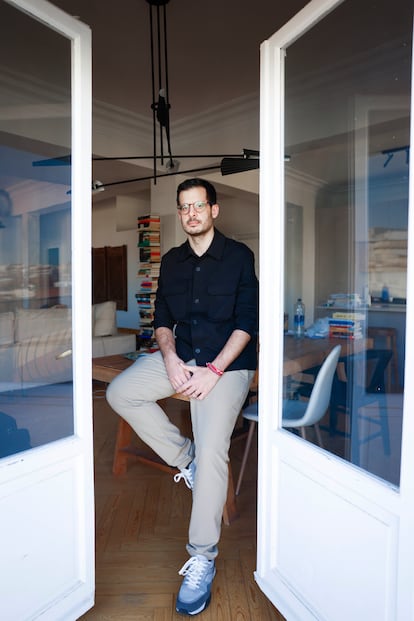
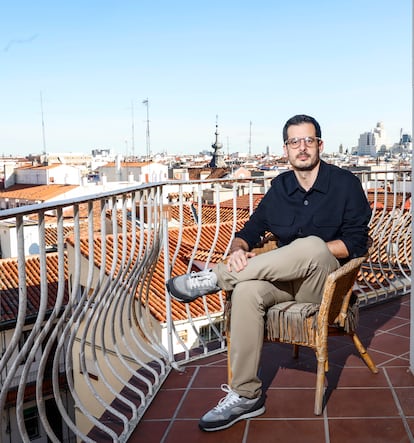
“I undressed too much. I don’t want to be that man who is so restless and worried that comes out there,” says José Luis Sastre (Alberic, Valencia, 42 years old) pointing to the page of his last interview in EL PAÍS two years ago on the occasion of his first book, The Stolen Phrases. Reflect on the number of hours you work. “Knowing how to waste time will make me age better. Miguel always tells me that to learn to do nothing you have to sit down and say: sofa, radiator, piano, window, street. I haven’t gotten to that point, but I’m working on it,” he says while ordering a glass of water and taking a seat. Miguel is Miguel Maldonado, his partner on the Sastre y Maldonado podcast. “We didn’t know each other at all. If the podcast has had something special, it is that it has been the construction of a live friendship.” It is Monday and he has just arrived from Valladolid, where he has followed the elections in Castilla y León with his radio program Hoy por Hoy, directed by Ángels Barceló. He is a columnist for EL PAÍS. Prepare a new program on TVE, The Judgment. And he is now publishing Plomo (Plaza&Janés), a novel about a police officer who takes on the escort of a councilor who is threatened with death. A story about two anonymous heroes, one of the hundreds who existed in the Basque Country under the terror of ETA whose name was never known except when it was printed on an obituary. It can be, however, the story of any terrorism faced by someone who could have avoided voluntarily putting himself in the target. Plomo does not take place in any specific era, nor does any recognizable name appear. If the attacks are recognizable, the atmosphere is (very) recognizable.
Ask. Why do you write this book?
Answer. Because there is a path worth exploring. I was shocked to learn the story of the bodyguards who protected Judge Borsellino. When the mob kills Judge Falcone, Borsellino says, “Now it’s my turn. We have to go fast.” So shortly after Falcone’s funeral he tells those around him that he is going to continue working, aware that he is already dead. And the group of bodyguards that protected him approached him and said: “We are going to be with you until the end,” knowing that not only could they be killed, but that their death was going to be anonymous. Nobody was going to know them. In fact, they kill Borsellino and kill some of his bodyguards.
P. Impress.
R. I don’t know what I would do. It is an interesting dilemma for the reader. What moves those people who, to defend others, out of a sense of duty, renounce—or put it above—another duty, which is your duty as a parent, your duty as a person, your duty to survive.
P. One chapter is crossed by a long discussion between the main bodyguard and his brother-in-law. “One does not save the world,” his brother-in-law tells him, who wants to dissuade him, who wants his sister and nephews to be happy and not live in that hell. The escort feels that he is being held responsible for what happens to him. Another success for the terrorists.
R. In that conversation it is explained that he who continues is brave, and he who gives up and takes a step back is not a coward.
P. “If I don’t do it, someone else will.” It is a phrase that is usually uttered to justify evil, but here it is used in the opposite sense. An idea of community.
R. Sometimes the premises that define us the most are those that are explained in the simplest way. This guy does what he has to do, what he thinks he has to do. I have read the articles of Albert Camus. How in the worst moments, during and after World War II, he was able to draw that lucidity from the simplest things. That’s why that phrase at the end, which is a phrase that I have always had for myself, that idea of justice that is so simple, so everyday: in every era we have to do what we have to do.
P. It is heartbreaking how the protagonist, faced with the hatred and moral misery that surrounds him, the snitches, the graffiti, the threats, the emboldening, says: “I wouldn’t want to hate, but it is inevitable.”
R. You end up hating. They can turn you into someone who hates, not just someone who is afraid. And overcoming that is very difficult. Because it’s not just that they kill your father or that you see how they kill him. The thing is that the threats, the comments, the persecutions follow. Overcoming this human drive to hate requires a condition and a courage that I don’t know if I would be capable of. That’s why I was interested in the idea of duty. Not just the people in the front row. I have personified him in the councilman and his bodyguard because literary he helped me, but also prosecutors, people who went to work in barracks, professors, teachers: people who had the courage to say and do what they believed needed to be said and done. I was interested in that and the idea of goodness: if it exists, if it is still possible. It may sound naive, but I believe that it exists, and that it has existed. That all that hatred has ended up being imposed by a genuine idea of goodness that explains why so many people sacrifice so much without gaining anything.
P. To speak out is to point out.
R. This is common in many times in history and surely also today in people who not only suffer threats but also have to endure comments from people who love them: “But why did you get involved in that?” And he has to explain why he is doing what he believes is his duty.
P. That question drives the novel.
R. You go to sleep thinking, “Am I putting my kids at risk just by doing this?” There is a moment in the novel in which María asks the councilman: “Have you thought about leaving?”, and he answers: “I have to justify why I do it so many times that I think I anticipate that question.” Why did you do it, if no one was going to remember you and you also ran the risk of endangering your life and that of those around you. That’s heroic. And for generations we have taken that heroism for granted: “It’s their job.” But are we aware of what that work entailed?
P. Were we aware of that value?
R. I’m not sure. In the chronicles it was said: “They have killed a councilor and his bodyguard,” and for many people it was almost as if they were worth less, as if it was assumed that they were going to die with them just for doing their job. I think that at some point you have to reconsider, and if this novel helps a little, it will have been worth it.
P. A terrorist or someone who justified and encouraged terrorism dies, and there are tributes and popular recognitions. But when a police officer or a councilor who spent twenty years looking under the car dies…
R. We have gone very quickly with some forgetfulness. There is a moment in the novel when a woman at a funeral says that when everything passes and a normal life is achieved—which for so many years was an aspiration—we will be “an annoying memory.” I don’t know if it is annoying memory or not, but I believe that our duty is, at the right time and also with the passage of time, to continue calling things by their name.
P. There are always a few who do not abandon their position. Those who jump on the front line in wars: they know that they are going to die, and also that there is no platoon without a front line.
R. When a country suffers from terrorism or conflicts like that, democracy is saved by people we end up forgetting. They are people who have allowed political, economic, union or social leaders to have sufficient protection to do their work. And also, on a closer level, there are those small networks that we build: friendships, links. That fraternity—a very post-war concept, when one wonders what we have been able to do as humanity—had a great impact on me when I read about it. Sometimes I’m embarrassed to say it because it seems naive, but I believe that: the more complicated the world becomes, the more I draw on that idea of community, of creating networks, of helping each other. We have identified participation only with institutional policy, and not. Political commitment has also been exercised by many people who have sacrificed themselves and who have never appeared on any list.
P. María’s son, the councilor, asks her how to stop being afraid. She answers that by spending it.
R. Confronting him again and again until he stops having that effect.
P. A very hard scene: that sixty-year-old woman who puts her hand in her bag to look for a gift and the bodyguard jumps on her, believing that he may attack her. He says he has become irascible and distrustful. The price to pay is very high.
R. Those who have not paid with their lives have paid with a change of character. There is a psychological impact. Imagine the children who grew up in that environment. In the novel there is a bodyguard who does not dare to say “I love you” to his children, but hugs them tightly, as if saying “I don’t know if…”. And these children grow up with an abstract fear, without knowing very well where the danger is. It is not fear of something specific: it is living watching your parents look under the car, being afraid when turning the key in the ignition. Growing like this marks. Can you have a normal childhood?
P. And the temptation of violence returns to that guard, who loses his temper and risks a sanction.
R. I understand that reaction. You are living hell. And the only thing this woman has done is be a councilor, trying to provide a public service. But they publicly massacre her, insult her, threaten her. And the guard says: “It makes me angry that the only thing I can do is file a report.”