
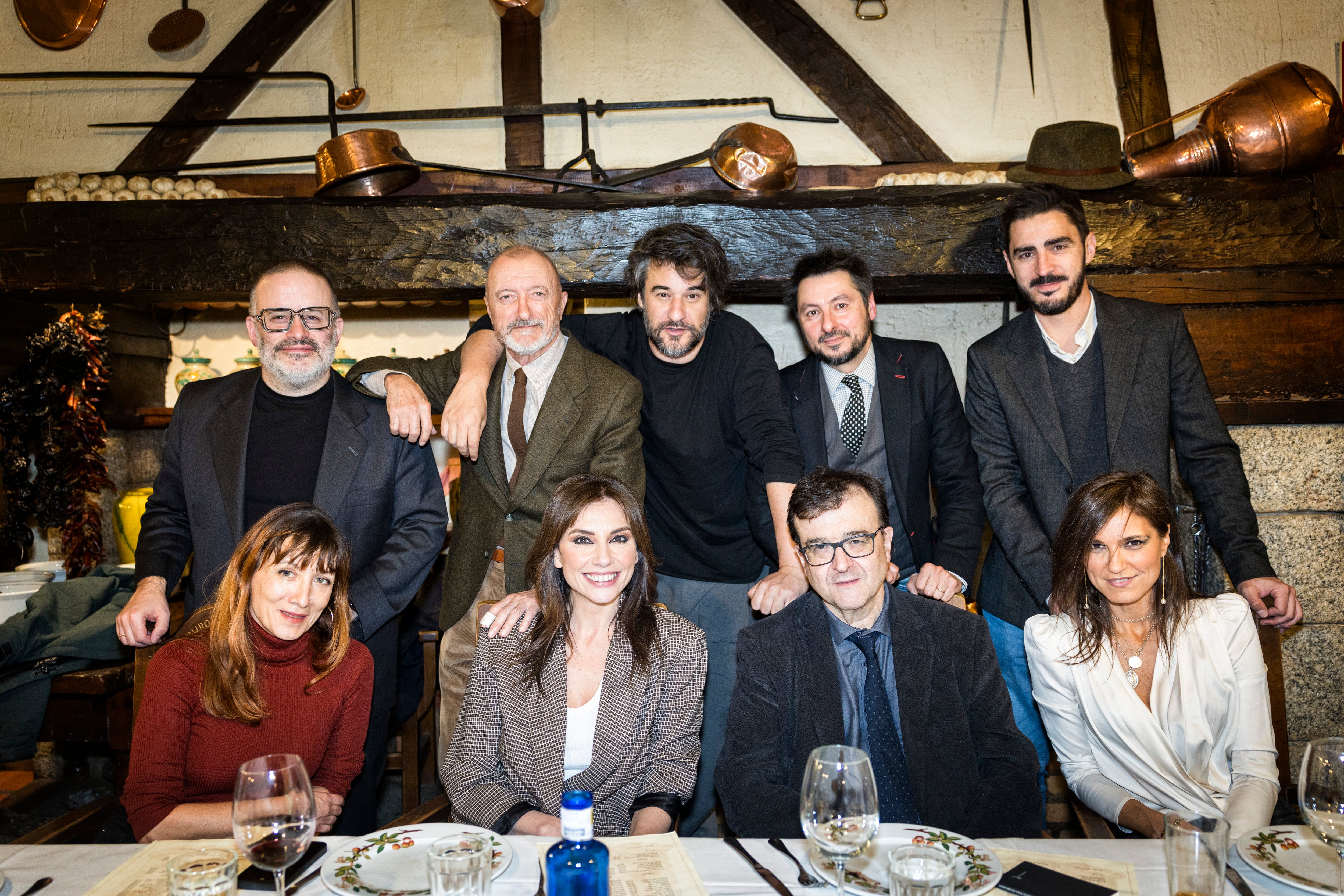
Javier Cercas (Cáceres, 1962) was awarded this Thursday with the 11th Raúl del Pozo Opinion Journalism Award, which honors journalists and writers who contribute with their work to sustaining the democratic press and free opinion.
“I am very proud that this jury made up of real journalists thought of me,” explains Cercas in statements to this newspaper. “I am also a little overwhelmed because I am not a journalist… I have been given some awards in this field, but every time it happens I have to clarify that I do not consider myself a journalist: I consider myself a novelist. Journalism seems too serious to me for me to consider myself such a thing,” he explains. For eleven years, this award (without a financial award, but which includes a dinner with the jury) has been intended to recognize and value outstanding work in Spanish political journalism over the previous year.
What is considered Cercas is a newspaper writersince he has been publishing his column in EL PAÍS every two weeks for almost 30 years. This is a figure that, as he explains, has had great importance in Spanish letters. And he gives examples: Larra, “the best Spanish prose writer of the 19th century,” Ortega y Gasset, a fundamental philosopher of the 20th century, and some of the great writers such as Azorín or Josep Pla. “All of them newspaper writers,” says Cercas.
“By this I mean that I am a novelist, but that I take writing for newspapers with the same seriousness that I take novels. I want a page of mine for a newspaper to be as well written as a page for a novel. I rewrite both one and the other: they must have the same literary consistency,” he points out. The author of The madman from the end of the world, The impostor, Soldiers of Salamis o Anatomy of a momentnovels with a strong load of what we call reality or non-fiction—a fact that also connects in some way with his work in newspapers—he has collaborated on Cadena SER and in media such as El Periódico de Catalunya o Global Chronicle. “Having a column in EL PAÍS in which one can say what they want and how they want is one of the greatest privileges that a writer can have in our language,” acknowledges the author, who in 2023 published Don’t be silent (Tusquets), a compilation of his essays and articles between 2020 and 2022.
What relationship is there between the novelist and the columnist? “It is complex, and in a certain sense these two characters are opposed,” says the author. For writing novels, the irrational part predominates, but in articles the rational part must prevail. “If not, I would have a problem,” he adds. “Both coexist in permanent tension in me. I hope it is a fruitful tension. Lately my columns are small essays, sometimes stories… That same mixture of essay, story and autobiography that is in my novels.”
It’s not the only difference. “I am a novelist, but I am also a normal and ordinary citizen, with the same rights and duties as another. The novelist has no rules, he works with total freedom, he can write all the crazy things and barbarities – and, in fact, he must do so -; but the citizen follows the same rules as any other citizen,” says Cercas, who adds the fundamental difference: “The novelist should never take sides, the columnist sooner or later has to do so.”
The jury for this edition of the award was made up of journalists and writers Antonio Lucas, Manuel Jabois, Edu Galán, María José Solano, Juanma Lamet, Marta Flich and Arturo Pérez-Reverte, as well as the late David Gistau as perpetual president, in tribute to his colleagues. In previous editions the prize was awarded to Enric González, Soledad Gallego-Díaz, Pedro García Cuartango, Carlos Alsina, Manuel Vicent, Lucía Méndez, Lydia Cacho, Ignacio Camacho and Sergio del Molino.