
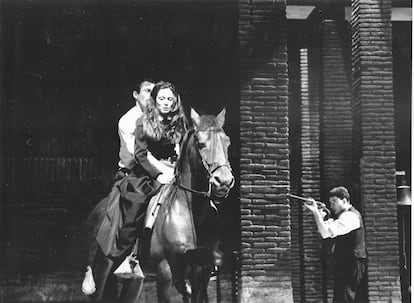
Almost 40 years ago, in 1988, Aitana Sánchez-Gijón (Rome, Italy, 57 years old) took the stage of the Spanish Theater in Madrid to play Acacia, a woman with whom her stepfather falls in love in The ill-lovedthe masterpiece of Jacinto Benavente. He was barely 19 years old, had almost no experience in acting and did not predict the long and successful career that awaited him. “I was a young actress, it was my second theatrical production. I felt a little overwhelmed by everything: the cast, the place, the text…”, she remembers. This Friday she will return to the same play and the same theater, but with the role of Raimunda, the mother of the one she played so many years before, in a new production directed by Natalia Menéndez.
“It’s deeply exciting. Like life itself, you start out being the daughter and end up being the mother. That is, so that the viewer who doesn’t know Benavente’s work can understand, like having done Adela in Bernarda Alba’s house and then do Bernarda,” she explains. The comparison is timely, because while she acted in dozens of plays, series and films, Benavente’s text waited untouchable in a drawer, without any national production trying to put it back together. Almost 40 years of accumulating dust that proves the oblivion to which the author has been subjected in our century.
“In fact, there are very few representations, because if you really go to the hard core of the matter, there is extraordinary dramatic material. There is Hecuba, there is Oedipus Rex, there is Electra, there is Blood Wedding. The show has that timelessness that makes us review the human condition and, in this case, the world of unbridled passions, the damage that uncontrolled impulses can do, family secrets, all of that is something that continues to happen to us as individuals,” says the performer. She says it in defense of an idea that has haunted Benavente for years, even before that distant montage last century, and that may be the first explanation for the phenomenon of prolonged silence. The emeritus professor tells it of Theater Theory and Practice, and one of the great theater experts in Spain, César Oliva: “Most of his works respond to a kind of social criticism of their time, today they smell a little like mothballs, they are old and I think they are no longer valid.”
Benavente was a very prolific author, he wrote more than 150 theatrical texts and championed bourgeois comedy, that genre from the beginning of the last century with ingenious but simple dialogues, and which did not attempt to delve into social demands. Rather, it realistically portrayed the customs, vices, and family conflicts of the upper-middle class of the time. The ill-loved It escapes, however, from that genre in which the playwright specialized: it is more of a rural drama. It tells the story of a love triangle where a stepfather develops a forbidden and obsessive love for his stepdaughter, triggering violence, family secrets, and tension in the community. There is forbidden desire, honor, social morality and the pressure of the environment on reputation. Something that, for the professor, makes it one of the few salvageable works of the playwright for our times —“removing the dust of the past, of course”—.
“Due to the theme, and even the dramaturgical development, more than its validity, it is a topic that can be understood today, surely outside of the author’s intentions,” explains Oliva. But it does not avoid being involved in that old manners, nor having high doses of melodrama, highly esteemed—and even necessary—by the bourgeoisie of the time, which was the one that filled the theaters. “I have always said that any other author would have gone to see how the townspeople really talk. Benavente wrote The ill-loved on the stretcher table at home. That is, it was what sounded familiar to him,” says the professor.
Natalia Menéndez has adapted the text together with Juan Carlos Rubio to erase, precisely, “the costumbrista part and the melodrama” and leave “the tragedy naked.” That, says the director, “reveals the poetics of a work that has those pulses, those gestures, those hidden desires that hurt and that challenge us today.” “I think we have to talk about this,” he concludes. It drastically reduces the duration, gives the performance a hectic pace, and opts for a realistic staging: with costumes and sets from the period, but with symbolic details, such as the construction of the walls with enormous cracks, like wounds that do not close, a sound space by Mariano Marín that “makes nature speak”, or very minimalist props.
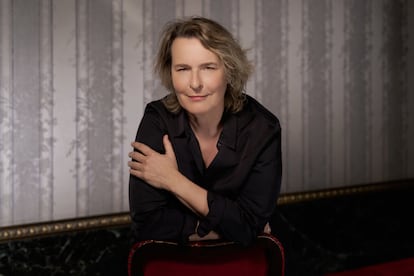
For her, the forgetting of the Nobel Prize is not due to her work, but to external factors. The most important: “Benavente’s political position at a given moment, which must not be forgotten.” The playwright, although his ideology changed, was a bourgeois who supported the dictatorship of Primo de Rivera and was well regarded by the regime after the Civil War. “What a person was conditions us a lot when we approach his creation,” says Menéndez. And shouldn’t it be like that? “Are we democrats or what are we?” he responds. “I’m going to look at the play. I’m not going to see if he had a card for one party or another. Time has passed, I think we can review things and understand that that person was very daring writing what he wrote, because there has never been a play that talks about this again.”
The success of its time faded quickly—and this is the director’s second explanation for oblivion—with the arrival of Lorca: “When he was born, many flowers remained unlit.” The man from Granada, who was born 32 years after the man from Madrid, as Menéndez says, “was very interested in him” and his work can, naturally, be reminiscent of that of Benavente. Mar Mañas, professor of Hispanic Literature and member of the Madrid Theater Institute, also explains it: “Both are innovators who fused rural drama with elements of Greek tragedy. They transcend by talking about human passions and so on.” Although Oliva, who agrees less, highlights a clear difference: “When Lorca writes Yerma, The Bernarda Alba House o Blood Weddingcostumbrismo is translated into the poetic sector. What lasts most in Lorca’s time is the poetic language, not the traditional one. There are no syncopated phrases, people who speak badly, etc.”
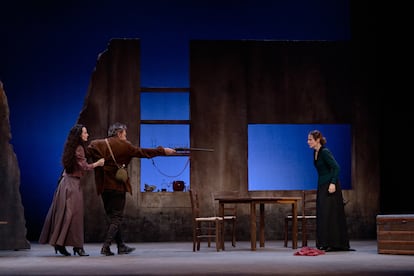
Regardless of that, for Professor Mañas, rescuing Benavente and his malquerida It is necessary because “it is a classic”, and it would even serve as a mere archaeological exercise. “The term archaeological always seems derogatory to us, but what we have to do is contextualize that archeology. To know the classics, which is important, you first have to see them.” A philosophy that, by the way, seems to dominate Spanish programming since the arrival of Eduardo Vasco as director. A policy that has its detractors, but that Mañas likes because “in a public theater you have to see the classics. You have to bring them closer to the public, among which there is also a good part of students, and do informative work.”
It is true that ignorance of the Nobel’s work abounds, even in the theatrical spheres. Lucía Juárez, a Dramatic Art graduate who plays Acacia in the new production, admits to not having read Benavente until she started working on this production. In fact, he learned about Menéndez y Rubio’s adaptation before the original text. Her approach, that of a 31-year-old young woman, offers a different point of view. “I think that the theme that the play deals with still carries a kind of silence and I think that it is not represented more times because you have to dare to get in there,” he says.
He does not want to explain his idea too much to “not do spoiler“, but, unintentionally, she does it a little: “There are well-known examples within the world of culture, which I will not mention but which are well known, of this type of relationships and this type of passion and this type of silence.” She is surely referring to those unbridled passions that her castmate talks about and that directly affect Acacia. Playing that woman, she says, stimulates her a lot: “In the times we are in, where young people suffer the abuse of the older generations Because of his convictions, I think he is a character that anyone my age would be encouraged to be.”
With everything that surrounds it, could there be people who approach the new production with a certain prejudice? “Let them do it, the worse for them,” responds the director. “I think that entering a theatrical space with suspicion is absurd. Let’s see if you know any author who has had the courage of this one.”