

_
_
Informative text with interpretation
The Catalan artist, who last night completed her second concert of the ‘Lux’ tour in Madrid, absorbs contemporary stage languages to create her own rules on stage
The images of the first concert of Rosalía’s ‘Lux’ tour in Madrid
n
“}},”video_agency”:false,”alt_image”:”The images from the first concert of Rosalía’s ‘Lux’ tour in Madrid”},”url”:”https://cloudfront-eu-central-1.images.arcpublishing.com/prisa/TT3VX4O75ZFN3H7VX5UYKSA3F4.jpg”,”alt”:”The images from the first concert of Rosalía’s ‘Lux’ tour Rosalía in Madrid”,”ogWidth”:16,”ogHeight”:9,”floating”:false});
03:06
The images of the first concert of Rosalía’s ‘Lux’ tour in Madrid

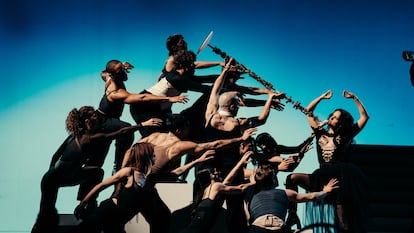
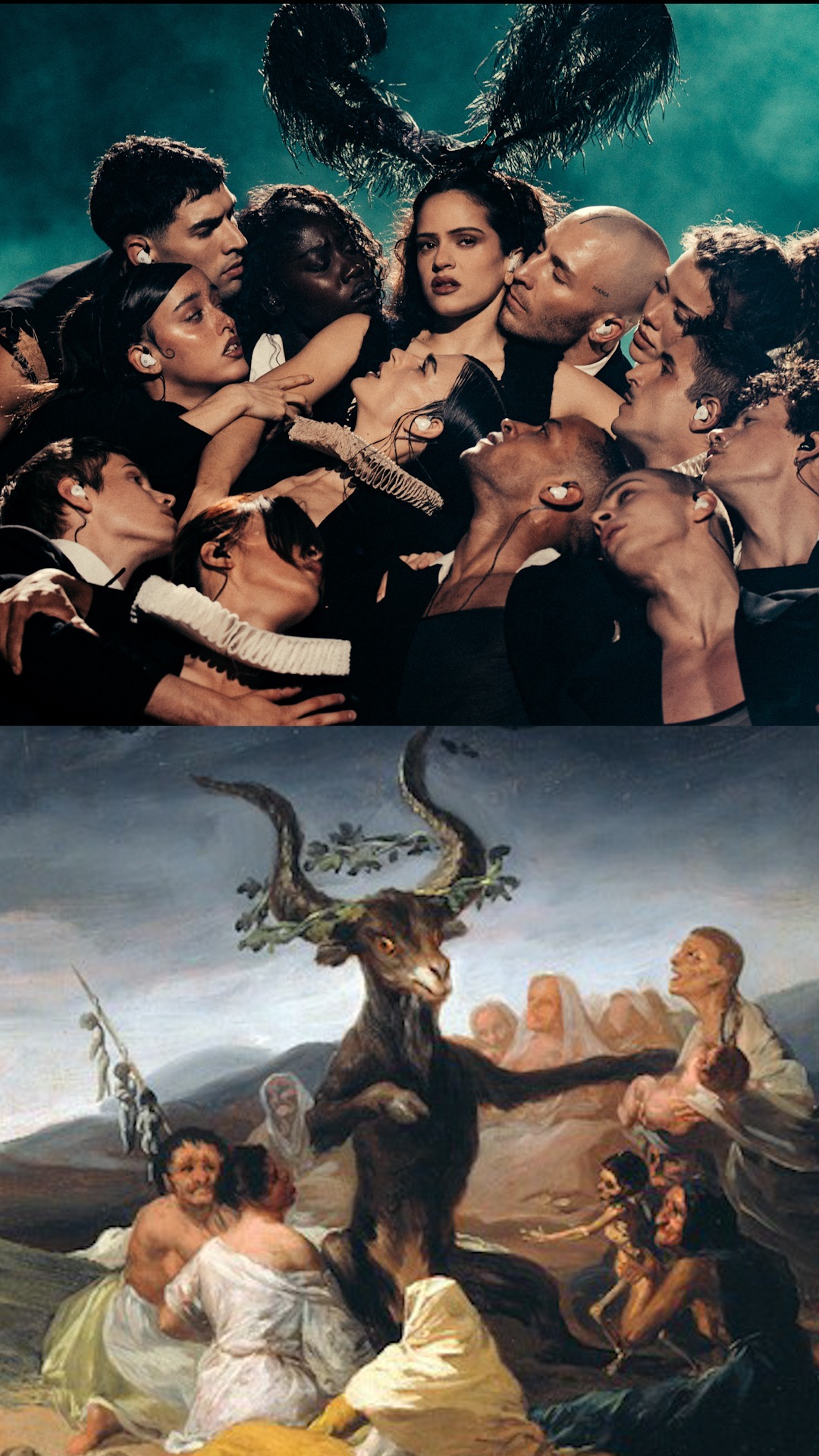
“It looks like a play! An opera!” an ecstatic woman exclaimed last night, joined by her partner and her two children in their twenties, at the exit of the second concert of the tour. Lux by Rosalía at the Movistar Arena in Madrid, in front of 17,000 people (full). Since the Catalan artist began tour of his new album, on March 16 in the French city of Lyon, these comparisons have been common both among the public and in professional chronicles. There has also been talk of ballet, contemporary dance, performance, symphonic, electronic or flamenco music, as well as Goya, Degas, the Mona Lisa and the Venus de Milo. Poured all this out like an avalanche in the media and social networks, chopped up and scrutinized as if it were a general culture test, it can seem like a cut and paste. A mix of genres, aesthetics and iconic artistic references ideal for instagramear like when you go to visit the Louvre.
But just as attending a theatrical or operatic performance is not the same as seeing it recorded, even on the big screen and with the best possible production, you cannot judge a concert with videos or clips on social networks either. In both cases, they are performing disciplines, what they call “living arts,” which have survived since ancient Greece despite the omnipresence of screens or perhaps precisely because of that. You have to experience them live to truly enjoy (or suffer) them. Many fans with tickets for upcoming concerts have roared in recent days against the avalanche of spoilers that reveal details of Rosalía’s show, but what difference does it make?: it’s as if we stopped going to see Romeo and Juliet because we already know the ending.
The artistic references of Rosalía’s ‘Lux Tour’
n “}},”video_agency”:false,”alt_image”:”The artistic references of Rosalía’s ‘Lux Tour'”},”url”:”https://vdmedia.elpais.com/elpaistop/20263/31/1774971943_still.jpg”,”alt”:”The artistic references of Rosalía’s ‘Lux Tour’ Rosalía”,”ogWidth”:9,”ogHeight”:16,”floating”:false});
02:11
The artistic references of Rosalía’s ‘Lux Tour’
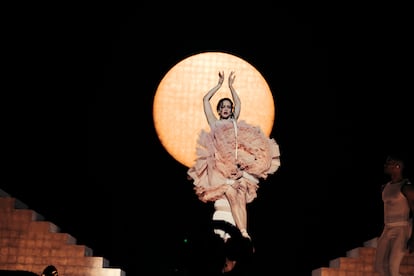
Although there are certainly many moments instagrameables, where you play and win Lux It’s live. Despite the disparity in languages, styles and aesthetics, the show maintains a unity of style and internal coherence on all fronts: narrative, visual and conceptual. There are also numerous scenic elements that support a constant, although not static, universe, with a minimalist but powerfully symbolic scenography, which synthesizes the essence of their latest album.: two flights of stairs that change position in each of the four acts in which the story is structured. show. Sometimes they invite you to rise to the sky and other times to twirl in the basements. The two large screens that frame the stage, beyond the amplification function, are fundamental in the development of the dramaturgy: they point out, frame, underline and enhance emotions in the manner of contemporary theater.
But all this would be superfluous if the most important thing in a musical show didn’t work: the interpretation. Rosalía, apart from her fabulous vocal range, is all true on stage. He can be moved to tears in his most intimate songs and then make eye contact with the audience to melt them with a smile. It is evident, as she has been criticized since the tour began, that she is not an opera diva or a ballet virtuoso when she rises on pointe, but she does not intend to be either: they are sparks that she intersperses to take us for a moment to other worlds.
This hybridization of languages and disciplines is also characteristic of current performing arts. Even before the concert began last night at the Movistar Arena Madrid, an unusual previous sound setting in pop concerts, with fragments of operas and emblematic pieces from the classical repertoire, warned of the mix. Or that little sound of strings tuning, so familiar before an opera or symphony concert, also shocking in the context. And the layout of the Heritage orchestra, located in the center of the floor, instead of in a pit or behind the artist.
On stage, meanwhile, a closed curtain representing the back of a canvas anticipated the two main visual narratives. On the one hand, the living recreation of emblematic paintings and sculptures. On the other, the impudent display of the backstage of the performing arts, another watchword of contemporary theater since the avant-garde broke the fourth wall to dismantle the artifice of bourgeois naturalist theater. In this way, Rosalía also breaks away from the corsets and conventions of concerts to create her own rules. She herself, in her first appearance on stage, will arrive stuffed in a trunk of props to emerge dressed as a ballerina with a tutu as if she were a doll locked in a music box.
From that soulless ground zero, the artist will move through multiple emotional states, supported by a first-class dance team and effective but not gimmicky choreographies, at the level of the best European contemporary dance. They are signed by the French collective (LA)HORDE, except for the one that went viral from the first concert in Lyon: the one conceived for the song The pearl por el griego Dimitris Papaioannou.
The division of the concert into four acts has given rise to comparisons with the opera, but also the grandiose design with which some sections are conceived, the emotional somersaults, the combination of intimate moments with other festive ones, as well as scenes such as the one dubbed on social networks as the “confessional interlude”, where Rosalía invites her friends to tell their worst love experiences (in Madrid, Monday was the youtuber I am Una Pringada and last night the rapper Metrika).
But no: Lux cannot be judged the way one would judge an opera. Nor as a theatrical, musical or dance show. Not even like a pop concert. These are Rosalía’s rules and they must be valued as such. Maybe we should apply a definition similar to the one that someone (we never knew who) attributed to Lola Flores: “It is not opera or ballet or theater, but don’t miss it.”
Your subscription is being used on another device
Do you want to add another user to your subscription?
If you continue reading on this device, it will not be able to be read on the other.
Why are you seeing this?
Arrow
Your subscription is being used on another device and you can only access EL PAÍS from one device at a time.
If you want to share your account, change your subscription to Premium mode, so you can add another user. Each one will log in with their own email account, which will allow you to personalize your experience in EL PAÍS.
Do you have a business subscription? Go here to sign up for more accounts.
If you do not know who is using your account, we recommend changing your password here.
If you decide to continue sharing your account, this message will appear on your device and the device of the other person who is using your account indefinitely, affecting your reading experience. You can consult the terms and conditions of the digital subscription here.
Filed Under