
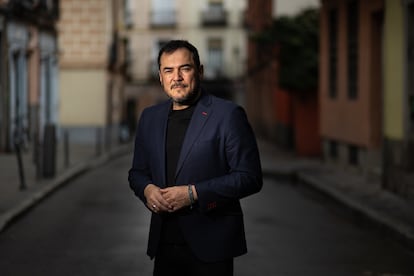
With the precision and meticulousness that characterize almost every singer-songwriter, Ismael Serrano (Madrid, 1974) dedicates part of the day before his concert in the capital this Saturday, January 17, to deciding the chatter with which he will delight the audience before each song, although, among his kind, it can last longer than the song itself. “We have a certain obsession with the word,” he admits. “We are storytellers, we like the oral tradition, which has to do with the minstrelsy. We do not get rid of the idea of a concert as a kind of dialogue. There are artists like Iván Ferreiro who hate talking at performances, but it has always been fun for me,” he says.
If you can afford to dedicate time to such a pleasant task before the appointment, close your tour Symphonicit is because he has already had everything well rehearsed with the orchestra of forty musicians that will accompany him. Yes: trumpets and violins now surround the most representative songs of his career. “It’s very exciting,” he says, “because they bring a different epic to the songs. It’s like paragliding: you let yourself be carried away by the air currents.” On this occasion it will have Víctor Manuel and Pablo Alborán as guests.
The tour has served as a presentation of his album of the same title, which updates with orchestral arrangements songs from almost thirty years ago with which the Madrid musician continues to identify. “My songs don’t lose their validity,” he maintains. “Dad, tell me again. I sang it like a son who reproaches a father, and now I sing it like a father who wonders what he will answer to his son when he reproaches him accordingly.”
It was in 1997 when Serrano published his first album, trapped in blue. In all these years, he considers that, as a musician, he has gained “in permeability.” He explains: “As a young person you are arrogant. You feel that in the industry there is permanent interference and you armor yourself, you load yourself with prejudices. Musically it is good, because you become guardian of your own essences, but you also reject things that would have been good to incorporate.”
“At 20 years old,” he adds, “everything seems urgent and definitive to you: you want to be in the center of the story and you are dying of love. As time goes by you realize that you are not dying of love and that there is no need to be in the center of the story. I also thought that there is no greater happiness than being on stage, and then you understand that you must know how to get off of it. For me, music is very important, but not the most important thing. The most important thing is life: living, falling in love, being with your loved ones. affections, learning… I have known artists whom I admire who when they left the stage were deeply unhappy.”
His children, Lila, 11, and Martín, three, occupy a central place in his life. “She really likes musicals, and she took me to a concert by Lawrence, a group of brothers from New York. She sings very well. Maybe for my next album we’re doing a collaboration,” he says.
For the average listener, Ismael Serrano is an exponent of author songs with political overtones. Perhaps because of those in his class, he was the most activist of all. Do you feel comfortable with that label, even though there are other themes in your repertoire? “I find it a pride to claim it,” he answers, “in a context in which people are very careful about taking a political position, because they know that God’s position is going to fall on them. There is fear, because they know that a toxic environment is going to be generated on the networks. But, on the other hand, that, perhaps, has overshadowed other sensitivities that are present in my music, and that I would like to claim. I am what I am, there are accusations that are almost a medal, but that label has been able to generate a certain prejudice and perhaps there is people who haven’t approached my music because of that.”
Openly leftist, he wants to think that among his followers there are right-wing people. “I’m sure that when Feijóo attributed a quote of mine to Machado, it was because it was proposed to him by someone on his team who likes my songs,” he says. He believes that social networks promote polarization. “Their algorithms only offer what we like, which is why they have distanced us from people who think differently. Before, all types of audiences enjoyed Serrat or Sabina, who were known for being left-wing. Now habits are reinforced. It also happens with musical styles: if you listen to Ismael Serrano, the algorithm is hardly going to recommend Taburete.”
After the sluggishness of singer-songwriters in the sixties and seventies, and the pop paroxysm of the eighties, at the end of the nineties a young generation of singers and composers emerged such as Pedro Guerra, Javier Álvarez, Rosana, Inma Serrano and Tontxu, among whom Ismael Serrano stood out as the most combative. “I chose to go out with Dad, tell me again as the first single,” he reveals. “It was a declaration of principles, in a context in which that tradition was being lost. I wanted to distinguish myself from singer-songwriters with love themes. “I reclaim the term ‘singer-songwriter’ now that it is stigmatized and many people avoid it, because they know that they ignore it at festivals.”
The arrival of indie rock sent most of them to the storage room, although while some of his comrades have been forced to return to play at Libertad 8 (the signature song bar par excellence in Madrid), where they started, Serrano acts as the last of the Mohicans. “I have worked a lot. I have put my guitar on my shoulder, I have toured Spain, Latin America… I have been constant and very much in control of my career.” He maintains an excellent relationship with Pedro Guerra (“he is the one I have the most contact with”) and Javier Álvarez (“I love him a lot, but I don’t see him as much”).
Despite everything, political lyrics are a minority in his repertoire, where songs about the passage of time do abound. “The problem of every person who writes songs is loss and renunciation. You don’t want to lose what you have experienced and you write songs to retain it, whether it is a love or your childhood. But I have learned that if time has taken things from me, it has given me others. When you are 20 years old you want to have certainties, that is why you are dogmatic; with age, you realize that the beautiful thing is to ask yourself questions. You have to adapt to uncertainty.”
In any case, it seems that the ups and downs of the world are conducive to a new batch of combative singer-songwriters. “The outlook is bleak. The United States seems mired in a dystopia, I am concerned about cruelty as a trend, the fact that good people are ridiculed on social networks and there are characters like Milei who refer to good people in pejorative terms. It is true that political reality is very volatile, which is why the kids want to kick the board: they are tired of not being taken into account and that, sometimes, leads them to simplify and say that pensions must be removed and taxes. Pessimism demotivates us.” She praises the role of women in current author’s music: “They even reformulate the topics of romantic love. That is also a way of making committed songs,” she says.
He does not hesitate to assure that he could compose a song about Ábalos, Koldo and corruption on the left. “Yes, why not? It should be done. We must accept the disappointment that power corrupts and point out that this also affects left-wing parties.”
He has an EP of covers ready titled Unsuspected recordingswith topics like I’m a clownfrom Extremoduro; Inevitableby Shakira; I hope it rains coffeeby Juan Luis Guerra; The cat in the rainby Rocío Dúrcal; and words of loveby Joan Manuel Serrat. And after a tour with only his guitar, he will start recording new songs that he hopes will be available to the public in November.