The Hungarian director Béla Tarr, a well-known author among film buffs and creator of films such as Sátántangó, The Werckmeister Harmonies o The Turin Horsehas died in Budapest at the age of 70 after a long illness, as reported by director Bence Fliegauf to the local news agency MTI, on behalf of the artist’s family.
Tarr made 11 feature films over the course of his four-decade career, since his debut in 1979 with Family fireplace until his last film, Missing People, in 2019. He was currently considering moving into video installations and continuing to develop his creative impulse there.
Without Béla Tarr it is impossible to understand the most radical auteur cinema of the last half century. Many creators have drawn from him, from the Portuguese Pedro Costa to the Thai Apichatpong Weerasethakul, Palme d’Or in Cannes, Gus Van Sant (who filmed, following his teachings, Gerry) or László Nemes, the last Hungarian to compete at the French festival with the groundbreaking Saul’s son: Nemes was Tarr’s assistant in The man from London. For years he taught a prestigious film course at the Sarajevo School, where, among others, the Spanish Pilar Palomero was a student.
Tarr’s probably best-known work, Satan’s Tango (El tango de Satanás), portrays over seven and a half hours, in black and white, the collapse of communism in Eastern Europe through the fresco of a desolate town in the Hungarian countryside. The film adapted the 1994 novel of the same name by the last Nobel Prize winner in Literature, László Krasznahorkai, a regular collaborator on Tarr’s projects. That creative symbiosis arose from an impulse (as he always did in his career, the filmmaker was moved by sensations) from Tarr: the director showed up at the novelist’s house with the proposal of adapting his satanic tango. It happened, the Nobel Prize winner in Literature recently recalled, on a dark day in Budapest, at the end of the eighties in communist Hungary. They didn’t know each other yet. Krasznahorkai rejected the offer. What’s more, he even told him that he would not write again and closed the door. Béla Tarr walked around the building, looked at a lighted window, and rapped his knuckles on the glass. Krasznahorkai was washing his face in the bathroom. He opened it and looked at Tarr’s face in the rain. “Watch my films and you will understand why I want to adapt your literature,” the filmmaker told him. And so they began to create. Before it came The condemnation (1988), and then, finally, they created Satan Tango (1994), which was based on that initial proposal to adapt satanic tango (1985).
The next collaboration between filmmaker and writer was Werckmeister harmonies (2000), based on the novel Melancholy of resistance (1989). In The man from London (2007), based on a novel by Georges Simenon, Krasznahorkai wrote the script with Tarr, providing his characteristic philosophical tone. Both complemented each other in rhythm and structure. The plot follows Maloin, a railway worker who recovers a briefcase with a significant amount of money at the scene of a murder to which he is the only witness.
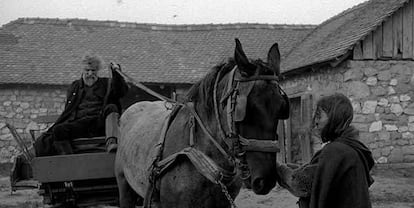
The Turin Horsefrom 2011 and considered even then as his film testament, offers another example of Tarr’s cinema: it only proposed three characters, including the animal of the title, and showed the daily life of an invalid peasant with one arm and his daughter, with so few concessions to the public as to dedicate a 10-minute sequence to how they both peeled potatoes in silence. Precisely for this reason, however, he earned the status of a cult filmmaker, in addition to winning the Silver Bear at the Berlin festival.