
Pixar knows what it’s doing very well. He has known this for 40 years, since he opened his doors as an independent animation studio; and also 20, since he became part of Disney (the fruitful marriage will celebrate its 20th anniversary this May). Hence, they have been getting the hang of what their ever-widening audience expects. That’s why there is no longer a minor or secondary project for them. It is the case of Hoppershis first film of the year – in theaters on February 28 – but which, in perspective, is the second in importance. The fourth sequel to that overwhelming success that has been going on for two decades Toy Story It will arrive in mid-June, but before that, Pixar is clear that it has more to offer the viewer.
Hence he has embarked on a film like this, in which nothing is particularly new, but everything is different, something that checks all the trademark boxes. The Emeryville factory (a small city near San Francisco, in northern California) has worked for more than six years on the story, giving it that patina of care and quality so characteristic. As in other recent great Disney hits (read Zootropolis 2the highest-grossing animated film in history), the animals are the protagonists, mixed with humor, with technology seasoned with a pinch of fantastical futurism perfect for creating a solid script, with the most logical environmentalism, that which simply seeks to ensure that what is closest is not destroyed, with the characteristic nostalgia of Pixar and with new family models. And, also, with a somewhat punky and dark touch.
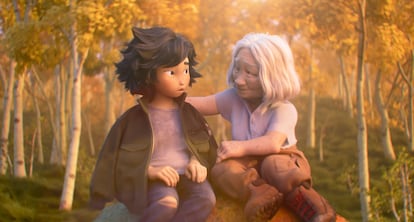
Here, the protagonist is a young woman, Mabel, accompanied by her beloved grandmother, Tanaka, who teaches her to care for and respect her environment, and a handful of animals that become friends and adventure companions. Companions until the end, because Mabel—rebellious, protestant, disheveled, chaotic; a random girl, wow—literally gets to put herself in the shoes of a beaver to save her city from the construction of a highway. Daniel Chong is the creator and director of the project. He’s used to bugs and laughs: he was first at Pixar (animated Cars 2 o Inside out), but then he left for five years to create and direct the animated series We Bare Bears (scandalous bears) and its subsequent film. When he returned, he continued with Lightyear, Inside out 2, Elio or, now, finally directing for the factory. Along with him, veteran producer Nicole Paradis Grindle, part of Pixar practically since its inception.
The professional couple explains that, originally, their beavers were not going to be the stars: they were penguins. But they advised them to change their mind: there were already enough penguins in the animation. When they discovered the capabilities and benefits of beavers, capable of building dams and helping to preserve the freshness and greenery of areas in drought, and therefore controlling and preventing fires, they were convinced. They went to natural spaces and reserves, including the great park among the parks of the United States, Yellowstone, where they got up early to inspect the territory at four in the morning, to investigate about the animals and how they behave in their natural environment. “They told us to simply listen. To listen to nature and be in it, in communion,” explained Chong. This helped them learn about the behavior of beaver communities—in fact, they have worked with a university expert on these animals—and gave more certainty to the film, with truer references.
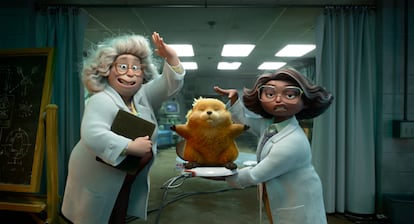
But beyond the beavers, Chong always had in mind “a secret organization that did something special, like in those movies from the nineties, Sneakers y Hackers”hence the technological moment but of touches vintage of the team that young Mabel works with to become a beaver. In fact, there are many film references in Hoppersfrom the Ghibli factory to Invasion of the Body Snatchers o Wallace & Gromit.
One of those Pixar touches is that, for example, the beavers change depending on who sees them: if the scene occurs among the rodents themselves, they are closer to an animated drawing, round, with big eyes; if humans are involved, they are more realistic. Chong explained that he has worked freehand in the first phases of the design, but later with 3D. “We wanted them to fit in with nature, to be believable, real yet stylized.”
Born in South Dakota and with ancestors from Singapore, it was not easy for the director to find the tone in Mabel, the protagonist, of Asian ancestors. The producer explained that they had to give it a kinder and more empathetic touch, “because at first people didn’t like that young girl that he yelled at everyone.” “It was a challenge,” he confessed. “But then you see her as a child, with her grandmother, and you understand it better.” In fact, the director acknowledges that he sought for his characters, especially the protagonist, to become iconic and nostalgic like so many others from the animation company. “But one of the things I remember most about growing up watching Toy Story, Bichos, Monstruos S. A. o Finding Nemo It was fun. You laughed a lot, and you adored those characters. “I have searched for that fun thoroughly,” he explains. “And this studio is very good at helping you find the emotion.”
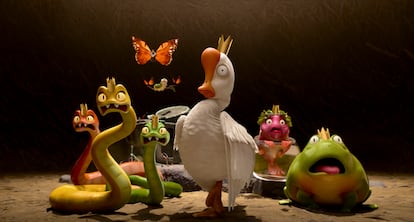
Another of the most complex parts is in the background of the film, a fight between forces of good and evil. Pixar and animation are not only for a children’s audience, but the film has dark, threatening moments, snakes, elements very capable of scaring those main consumers who are children. Producer Paradis Grindle responds. “In my experience with that audience, and in my life experience, parents tend to worry more about what scares children than what children want. And being somewhat afraid is part of the narrative. It’s part of the Grimm Brothers’ stories. And children, like adults, like to put themselves on the edge of the precipice,” he reflects. “I don’t think we have gone too far, we have thought about it a lot, we had notes from previous screenings with the public. And we went back where we had gone too far. But it is more interesting how a story for children makes you feel that bit of fear, and then go back. My children, of course, are perfectly fine,” he laughed. The director affirms that, as a child of the eighties, he grew up with films that were somewhat scary but designed for family audiences, such as Los Gremlinsand that he believes that with Hoppers they have reached “a good point.”
In the original, that humor is reinforced by voices like Jon Hamm, Dave Franco and Meryl Streep, who has an appearance as the boss of the monarch butterflies in what is perhaps the funniest moment of the film. It is true that there are a few months left until it arrives Toy Story 5but if this 2026, which is its anniversary, Pixar was looking for nostalgia and humor, they have found them.