
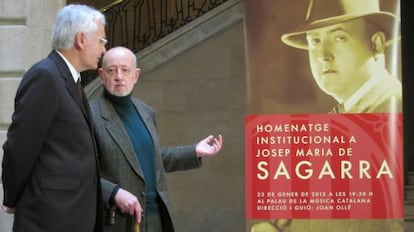
A group of nature and bird lovers met on Tuesday (and all the people we could drag along, which was surprisingly many) to present at the Ona bookstore in Barcelona the beautiful illustrated edition that the Carbrame publishing house has made of the classic (1922). The friendly birdsby the playwright and poet Josep Maria de Sagarra, in a double Catalan and Spanish edition (My friends the birds). The book is published at a very feathered moment: I have been watching falcons hovering in the city sky for days, the ornithologist José Luis Copete has given me the brainy paper that have been published in Science a group of colleagues, himself among them, on the genetic causes of color variation in wheatears, that matter; Furthermore, I have a stye in my eye, which in Catalan is called owl, owl, believed to be provoked by the penetrating gaze of one of these nocturnal birds; and I am reading the wonderful bilingual anthology of the poetry of Mary Olivier, such a lover of nature, who has published Lumen (2025) under the title Devotions and which includes poems such as Swan (“and have you finally understood why there is beauty?”), White Heron soars over Blackwater (“his yellow eyes / and wide wings carrying / the light of the world”) or snow geese (“oh love what is precious and will not last!”). Among Olivier’s verses, translated by Andreu Jaume, some specific ones seemed to allude to the absence of someone fundamental in the reissue project of My friends the birdsJoan de Sagarra, the son of the playwright and holder of his rights, died this May at the age of 87 and who has not been able to see the published book: “When death comes / like the hungry bear in autumn.”
We squeezed together on the stage of the cozy event room of the bookstore the editor José Ramón de Camps, his son and collaborator Hugo, the ornithologist and today the new secretary of Ecological Transition of the Generalitat of Catalonia, Jordi Sargatal, who also signs the introduction of the book, and yours truly, the least naturalist of all, but no one will deny that with many birds on our heads. Each one came – figuratively because otherwise it would have been a gibberish – with their favorite bird under their arm, which in the case of Sargatal is the stork, of which he has seen all the species that exist, 20, the latest, the Malayan tantalum, which is already a success, in 2011 in Cambodia; the Camps father and son the capercaillie, which they have studied and defended, and I the humble and discreet tree-creeper (brush)which nests in my garden and to which Josep Maria de Sagarra dedicates a nice passage in his book as “one of the best friends of trees.” The Carbrame edition (illustrated by Gonzalo Gil) includes the drawing of the little bird twice (it is the only one to enjoy that honor), which makes me especially happy.
Hugo explained how he discovered Sagarra’s book and convinced his father to publish it with the idea that the volume contains, in addition to notable knowledge, many considerations about birds that we can make our own and the confirmation that the author anticipated not only modern environmental awareness but also current liter nature o Nature Writing. If Sagarra was even on the island of Buda (where “the flamingo, stretched neck and rose breast, / lengthens the hoarse cry beyond the firmament”), we could find him today at the Delta Birding Festival. Come on, it was very opportune to recover The friendly birds. I, as a friend of Joan de Sagarra and José Ramón Camps and a prologue to the book (anyone would say no to Joan), related some interior details of the project, including an unforgettable aperitif between the three of us at the Sandor (and Joan’s granddaughter, Agomar, who was also at the presentation and is preparing a tribute to her grandfather), in which Sagarra explained to us the keys to her father’s passionate interest in birds. “Without the ornithological presence neither my life nor my verses would be what they are,” the playwright wrote, which he evokes in his Memoirs “the great moments of pure happiness and pure emotion” that the birds provided him.
He fell in love with birds by living with the ones his mother, Maria dels Dolors Filomena de Castellarnau, had at home, who bought them at a Barcelona bird shop where they even supplied exotic specimens. The Sagarra residence in Santa Coloma de Gramanet, the Balldovina Tower, was something like the Durrells’ Corfu and it is tempting to compare My friends the birds con My family and other animals: a sort of “my family and other birds”. The Sagarras even had a toucan. During the presentation, I began to explain how another family of the Catalan bourgeoisie, the Clapers, also had one of these birds with extravagant and large beaks, and to recount its death in a traffic accident (the bird was forgotten in the overturned car and died of consumption and fright). I have to say that it was not the highlight of the evening.

Fortunately, Jordi Sargatal took the witness, who claimed Sagarra Sr. as a precursor of “environmental seduction”, a concept in which he himself is an artist, as he made clear when explaining the way in which he obtained the complicity of the stork. Twine to interest schoolchildren in visits to the Aiguamolls de l’Empordà, a natural area in whose preservation Sargatal was decisive (a book about his life and his half century of nature protection has just appeared, Jordi Sargatal, the man who followed the birdsby Antonio Cerrillo, Icaria, 2025).
The impregnation of baby storks made us bring up Konrad Lorentz, gaining the complicity of the mature sector of the public and even more so when I mentioned Niko Tinbergen, with whom Lorenz shared the Nobel Prize in 1973 but who I find much more sympathetic: it is the difference between spending the war as a hostage of the Third Reich in a concentration camp (Niko) or becoming a member of the Nazi party and subscribing to its racial policy (Konrad); perhaps that’s where Lorenz got his empathy with geese, from the passage of the goose.
José Ramón insisted on the modernity of Sagarra’s (1894-1961) sensitivity towards birds when we ourselves, he, Sargatal and I, who are all from 1957, although I am the youngest, have lived through a time when wild birds were shot for fun with the BB gun or slingshot, and that was when they were not captured with traps to be eaten fried. That led us to talk about the barbaric French custom of eating other little birds, the gardeners, after drowning them in Armagnac (which, well thought out, should not be the worst of deaths) and the diners covering their heads with a Belphegor-style napkin to better appreciate the aroma of the dish. A star dish of French gastronomy that was Mitterrand’s last wish before dying and that has been prohibited since 1999 despite the complaints of many great chefs.
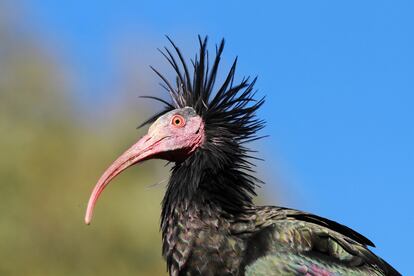
Between one thing and another—the nesting of the hoopoe in corpses, the inexplicable absence of the oriole (in the book not in the act)—the presentation was very entertaining and they practically had to throw us out while Sargatal, the only person I know capable of continuing to smile even when a tractor is mounted on him, was telling the exciting story of the recovery of the hermit ibis. I pointed out that it is a bird that pulls back (it is unofficially considered the ugliest animal in Spain), but Jordi disagreed, pointing out the beauty of the pink skin on its bald head (of the bird). That’s where we were when the audience for the next book presentation began to enter, which was nothing less than Barcelona: a quick dive (Tibidabo, 2025), by the historian and former Minister of Culture Ferran Mascarell, whose surname, it is known, is the name in Catalan of a majestic bird — which is one of the ten to which one of my favorite books by Carbrame is dedicated, The call of seabirds—: the gannet. And we left on the wings of birds.