
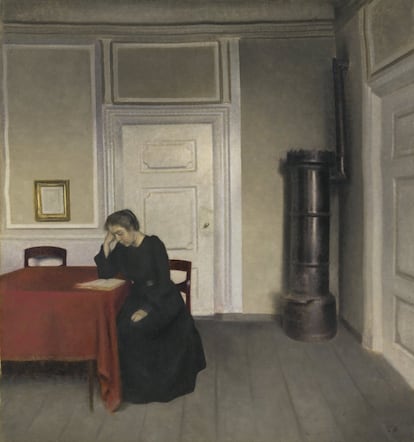
Aristotle defined the paradox of loneliness: “If you live alone, you are either a God or you are a beast.” Vilhelm Hammershoi (1864-1916) may have painted this paradox. Is austerity in a home fortitude of character or coldness? Is it calm or loneliness? Is it choice? Poverty? Strength? Carelessness or…maybe fear?
Hammershoi was a well-travelled man who seemed to have never left his home, a small 18th-century building at 30 Strandgade in Copenhagen. That street is in Christianshavn, a picturesque neighborhood, with canals, boats, markets and bustle, which, however, did not seem to interest the painter.
The silence of the rooms portrayed by Hammershoi is also found in the reasons behind a work so outside the time of any time. He was not a tortured artist. Not even someone obsessive. He triumphed in life and fell from grace just after dying at the age of 52, when the avant-garde of the early 20th century swept away any previous style.
Although his work is continually related to silence, silence as a physical space, the curator of this exhibition, Clara Marcellán, has related it to music. Hammershoi, the listening eye is the title of the painter’s second exhibition in Spain, the first was at the CCCB in Barcelona almost 20 years ago. The silence with which this painter is associated appears in his interiors, and characterizes his daily life despite the music that always surrounded him, his friends and his family. His wife, Ida Ilsted, played the piano and he himself studied cello. However, what we know about his life comes to us quietly, avoiding crises, changes, doubts and conflicts.
To Carl Christian Clausen, who interviewed him in 1907 for the Danish cultural supplement Every&Dayhe confessed that in order to portray a portrait it was necessary to know the person being portrayed very well. That’s why he made a good living by portraying absences, pictorial silences. These practically empty, grayish rooms, as if painted in black and white, end up defining, curiously, traits of the character of the person portrayed. The rooms have attention, more respect and patience than fear. A serene silence, but not warm, expectant but not tense. A silence, Marcelllán points out, “full of possibilities.”
When in that 1907 interview he complained about the fashion for interiors—“Today everyone wants interiors”—he was talking about his daily life, locked up at home painting them. To do so, Hammershoi became a set designer. Its austere interiors actually clean what their homes were. They alter the place of a sofa, they blur a Biedermeier sideboard, they wait for the sun to be reflected on the wooden floor that, far from achieving the silence of other canvases, seems to creak with the arrival of the light beams.
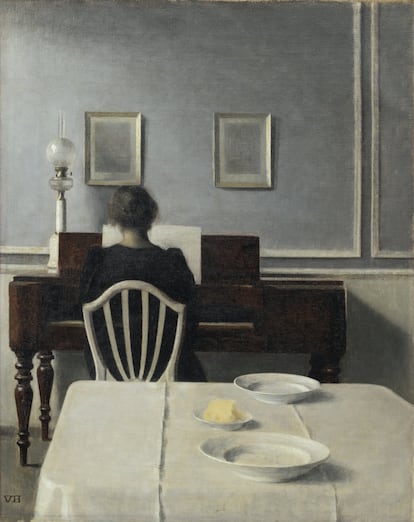
The incomplete quality of his paintings, that is, their modernity, is another choice by Hammershoi who, by emptying the rooms, fills his empty settings with mystery. Choosing subtraction over addition is an artistic decision. Also architectural. This is how he described it in that aforementioned interview: “What leads me to choose a motif is, to a large extent, the lines it contains, what I would call the architectural attitude of the image.”
One could say that Hammershoi’s architectural attitude is subtraction. Less is more by Mies van der Rohe. But, in the midst of so much calm, it is not only his desire to simplify the world that speaks here. There are many windows in Hammershoi interiors. However, there are no views. The glass could be fake: nothing can be seen through it. Rather than opening the spaces to the outside, it encloses them, only the sun passes through the space, those rays that it so patiently waits for. That his wife, Ida, seems to be sitting waiting. Playing the piano. Thinking, observing, letting time pass, posing.
Introspection as an emotion. The look as expected. In front of Hammershoi’s silent paintings, one witnesses an intimacy that does not belong to one, but that is not violent. You encounter loneliness, or calm, introspection and fatigue. These are frozen times.
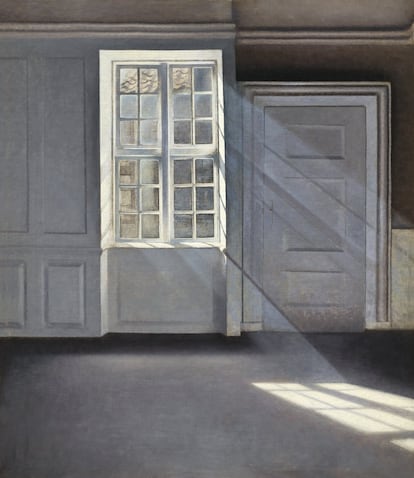
Hammershoi painted his first interior in the house of his friend Karl Madsen. And he decided that there was beauty in emptiness. It is not an interpretation. He told it, again, to CCClausen. Perhaps if he had not dedicated himself to painting stripped spaces he would not have been able to notice the Sun rays. Dust motes dancing in the sun’s rays. Strandgade 30, which finished in 1900. The painting is now in the Thyssen in Madrid. The beams of light seem to break the silence, the specks of dust dance and, finally, the space speaks. He tells us what Hammershoi’s rooms portray.
It is tempting to think that the painter barely left the house on Strandgade Street in which he lived for 10 years at number 30 and until the end of his life at number 25. On the first floor of number 30 he painted more than 60 interiors. In the second, I experiment with full-scale nudes. However, what is wonderful about the Thyssen exhibition is seeing what I saw when I went out on an excursion. Wonderful because it was almost the same thing I saw inside, filtering, subtracting, leaving the historic buildings unfinished, choosing pine forests in almost abstract landscapes.
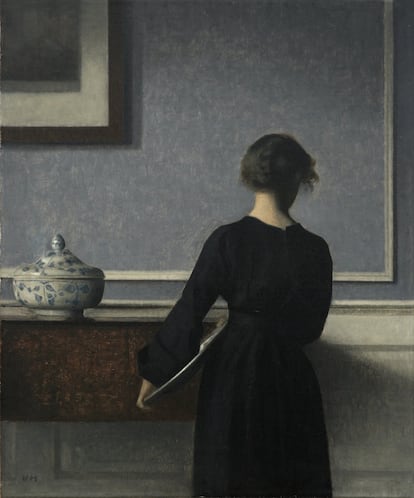
Like his living rooms—Hammershoi’s intimacy is more like a dining room than a bedroom or hotel room—this painter’s exteriors also appear uninhabited. The figure, taken from the Dutch golden age to inspire a story without recreating it, disappears in the fields and forests.
Some of these pine forests, such as Fortunen or Gentofte, are near Copenhagen. But he also paints the Rosnaes peninsula and the island of Falster, where Ida, his portrayed wife, was from. The exteriors are so bare that it is difficult to read a season in the vegetation. That is to say, in the countryside Hammershoi also chooses, filters, acts as a set designer, like many of the great landscape painters, who invented natures, idealizing them, improving them or romanticizing them. Just as it happens inside, where Hammershoi lets us in but does not welcome us, in the countryside he pushes us out, but does not guide us either. Open the door to modernity. Also to what, as viewers, we want and are able to see.