
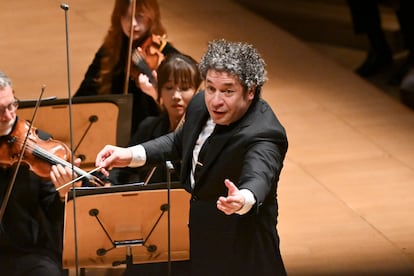
Many things separate Herb Alpert and Gustavo Dudamel. Their birthplaces—Los Angeles, in California, and Barquisimeto, in Venezuela, 6,000 kilometers away—; their ages—one is over 90; the other just turned 45—; their languages… But there is even more that unites them, as demonstrated by their long conversations, which end in laughter. The first and main thing is their passion for music, since they were little, and for transmitting everything it can give to new generations. To discover in children the passion for sounds, for culture, for all the emotions that it can provoke. Both want to open the eyes and ears of the kids of the world; not to make them virtuous, but to give them tools to be critical of their environment. That unites them more than all their differences. And that means that they have now joined forces in a very effective way to do so.
Because Herb Alpert, trumpeter, producer and one of the most famous, prolific and awarded musicians in the world, has decided to create the Herb Alpert Honor, an honorary award worth one million dollars. And the first recipient of the award is Gustavo Dudamel and his charitable vehicle, with which he channels his work, the Dudamel Foundation. Alpert has been awarding the Herb Alpert Awards for 31 years, giving five annual awards worth $75,000 to five different artists, but here he wanted to go one step further. “And I thought that this gentleman here was the first perfect candidate,” he says in an exclusive conversation with EL PAÍS.
That gentleman, who puts his hand on his chest and bows his head, with humility and pride at receiving the award, is Gustavo Dudamel, the director of the Los Angeles Philharmonic, immersed in his 17th and final season at the helm of the orchestra, before heading to New York. “I feel very honored that this comes from someone who embraces this great idea of music as a tool for social transformation,” says the musical director. The talk takes place in his office, in the heart of the Walt Disney Concert Hall, a building full of steel curves and already a symbol of the city that was designed by his late friend Frank Gehry. Precisely a Steinway grand piano in intense green, a unique piece that belonged to Gehry, presides over the room. Dudamel and Alpert sit on it, touch it, chat and laugh. Their connection, musical, intellectual and personal, is latent. Furthermore, as Dudamel explains, he spent his childhood listening to Alpert, since his father, Óscar Dudamel, is a trombonist.
Hence, Alpert recognizes that he has been following the work of Gustavo and his foundation “for years.” “The way you inspire children, the music you were making at that time in Venezuela, with that group of very young musicians,” Alpert tells his colleague. “There was a feeling, because I think music and the arts are about feelings. It’s not about the notes, it’s not just about the mechanics or playing the right thing, but how you do it. And being able to inspire kids to do things, to put themselves out there, to be themselves. They don’t have to be virtuoso. But if they can make music that inspires them, it will inspire others.”
At 90 years old, Alpert is still active, giving concerts all over the country and, as he explains, he sees that the music he played six decades ago “is experiencing a renaissance.” “It inspires audiences full of Republican, Democratic, Libertarian, gay audiences, everything you want, the whole mix, and they are together feeling it. And I think we need more of that in this world,” he acknowledges. “Art is a feeling. You stand in front of a painting by Jackson Pollock and, if you try to analyze it, you will never understand it; if you feel it, you will understand it in a different way,” he observes, something that happens the same with music, which “goes to a deeper place in the body.”
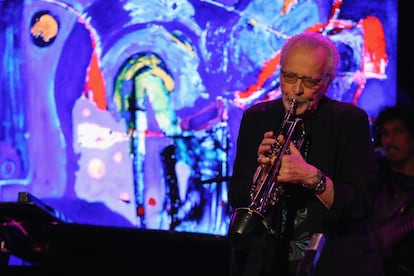
The trumpeter highlights his colleague’s humility, but also his ability to transmit his enthusiasm for the arts to others. “You are a special person and I am honored that you accept this award, and that you are the first to do so,” he says. Dudamel blushes and begins to return compliments. “You are the inspiration, a guide in terms of generosity and art, when it comes to transmitting to people, uniting them and making them enjoy and transform with music. With the music we make we live in a world of beauty, and it is important to understand its real dimensions,” acknowledges Dudamel.
The Dudamel Foundation—co-directed by him and the Spanish actress María Valverde, his wife of almost a decade—will use that money to continue maintaining its complex and expensive musical learning and immersion programs for children. But for the Venezuelan director, in addition to the financial contribution, this award means much more; He is obviously grateful for the “let’s say, material, but above all, spiritual” contribution. This honor returns him to his origins and the sense of art and music. “We have to contextualize what this means, because coming from him it makes everything more special, more unique and meaningful. It is a reference, an inspiration. In music, of course, but also in art as a tool for social transformation. This goes beyond mere entertainment,” he reflects. “It makes you be surrounded by beauty, with the technical elements, harmonies, aesthetics… When you have the opportunity to be surrounded by that, you transform. And this is the power of music. I had the privilege of growing up in that environment that my teacher, José Antonio Abreu (died in March 2018), created. I am the result of a dream. I think that, like Herb, Maestro Abreu understood the true power of music. That beautiful space for young people to not only be musicians, but to create a life through music.”
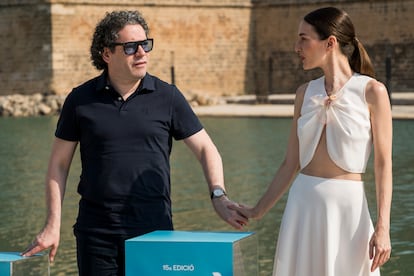
Hence, for him it is essential to have that “opportunity to multiply” opportunities for those who do not have it so easy. He wants to unite young musicians from all over the world and get them to create, think, unite them in their differences. As a director, he is used to there being “disagreements, differences in sounds, points of view or techniques, but in the end a harmony is created, and that is the best example.” “Without a doubt we live in a world in which you have to think in such a way, because if you think the other way, it’s bad, but the other side says the same thing… So we never see how important it is to think differently and how nice it is that you don’t agree. It’s something I do every day in the orchestra, it’s a collaboration,” he says.
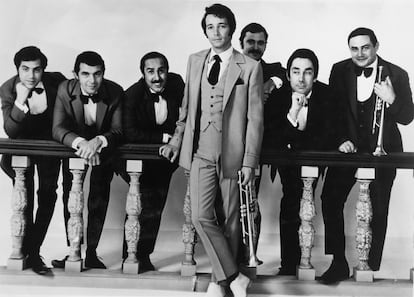
This mix of culture and ideas is also what has given Alpert his best professional results. In the sixties, he fronted the band Herb Alpert & The Tijuana Brass. It all arose from a visit to the Mexican city, bordering California, when he attended a bullfight. There, a brass band played in the stands. Beyond mariachi music, which he did not seek to make and was the best known of the Mexican tunes of the moment, as he remembers, he joined them to make powerful mixes that continue to sound and tour the world, six decades later. And no, he comments with humor, he has never stood in front of a bull.
So, will music help us, will it save us as a society? “Of course it’s to make us better,” Alpert says, without hesitation. “Music has so much power that only good things can come from it. I hope I can go back to what I said at the beginning: I would love to be able to be useful and help children to think. Not what to think, but to think, to make decisions for themselves, to not be surrounded by the opinions of others, to not follow the crowd. To think well. We could use more of that.”
Dudamel supports him, explaining the difficulty of stopping to think. “Let’s put things in perspective, humanity evolves and it’s great,” he observes. “There is a lot of technology, which is an achievement, but at the same time there is contemplation, spirituality, and balancing everything will be much better. We would have a more empathetic world.” This is what he asks: “Let’s take all these tools to the right place and enrich our nature, and the only way to do it is by creating culture. We have to go deeper and create culture, education, and come up with a way to educate people, not just cut back and make education more technical and more gridded and tell young people what they have to do. It’s about opening that up. Yes, I think we can change the world, but it goes through the base, which is education, what we give to them, to young people.”