
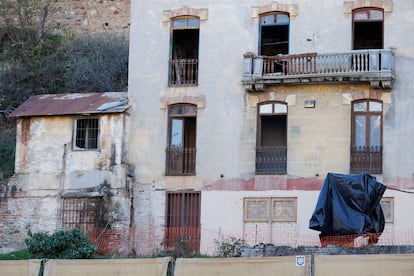
He Hotel Rheuma, on the northern slope of the Sabika hill and 90 meters from the walls of the Alhambra, it is undoubtedly a strange body in its surroundings. There, in the forest of San Pedro de la Sabika, the hunting preserve of Sultan Muley Hazen in the 15th century, and crowned by the Nasrid enclosure, this 125-square-meter, three-story building emerged in 1910 with its historicist and French-style air, a peculiar zinc roof and its central finish in the form of a handle where the sign appeared. Born with the name Bosques de la Alhambra hotel, the humidity and cold of that forest made the business unviable and it closed in just two years. The people of Granada, of course, soon baptized it as “Hotel Reúma” or suitcase house, due to the appearance of the building with its handle on the roof. It had different uses throughout the 20th century, and the Alhambra acquired it 25 years ago. Foreign body, exotic building or glop, has an undoubted symbolic value for the city.
This autumn, the Board of Trustees of the Alhambra has launched its rehabilitation, with the opposition of the Royal Academy of Fine Arts of San Fernando, which has issued a report requesting its demolition. The debate on what to do in these cases is therefore renewed. Just this Wednesday, a two-day congress organized by the Board of Trustees began to discuss the master plan that will govern the management of the monument in the next 10 years, which will have to include the future of the Reúma hotel.
Architect Blanca del Espino Hidalgo, urban planner and heritage specialist at the University of Seville, explains that now “the contemporary vision of cultural heritage includes the superposition of all contributions, cultures and periods. In addition, the valuation of the good that the people in contact with it have is relevant.” For Del Espino, Granada society has internalized the presence on that northern slope of the Alhambra of the Hotel Rheuma as something inherent to the environment. He adds to this that “the only criterion for its conservation is not that the architecture is of the highest quality, because then we would not have many examples of vernacular architecture or there would not be many elements of intangible heritage.” And he adds: “The assessment is made from the contemporaneity, from how people feel identified with our heritage.” Furthermore, he adds, one of the great dilemmas of heritage intervention is always: “What layer are we left with, how far do we dismantle, what is the pristine state of an asset? Because the superposition, transformation and adaptation of a place to what each culture represents come together.”
The paradox of Hotel Rheuma The thing is that it was acquired for what the Academy asks: to tear it down. It was the year 2000 and it cost 130 million pesetas (780,000 euros). Mateo Revilla, who headed the Alhambra Board of Trustees, announced months later an investment of 150 million pesetas (900,000 euros) to demolish the old hotel and open a promenade on the banks of the nearby Darro River. Almost 1.7 million euros for a demolition that was justified because it was a relic with no more value than the sentimental value to which the people of Granada had simply become accustomed over time.
In 2004, María del Mar Villafranca assumed the direction of the Alhambra. And he launched the drafting of the master plan that was approved in 2007. After extensive reflection, he says, they made “a decision, perhaps conservative, but meaningful: to recover the building because the Hotel Rheuma It was already part of the identity of that edge of the Alhambra.” Identity prior to that 1910 because the hotel was not a new construction, but erected on the old carmen de Holy Engracia, before carmen de with Romebuilt more than a century before. According to Villafranca, the idea was “to give it the status of the Alhambra’s embassy in the city, responding to the eternal controversy that the Alhambra was outside of it.” The former director also believes relevant the intangible value of the appreciation of the people of Granada, which in a certain way they adopted and they even gave him nicknames.
That idea—and obligation derived from that master plan that is still in force—has been accepted by the successive directors of the facility until reaching the current one, Rodrigo Ruiz-Jiménez, who defends a project that, on the other hand, is already underway. Ruiz-Jiménez recalls that a Heritage Impact Report carried out by the University of Seville endorses the intervention as “feasible and correct.” ”Like it more or less, and although it may not be the best example, it is the only building with that architectural style in the city.” In a year and a half and after an investment of 1.9 million euros, the Hotel Rheuma It will have an exhibition function and serve visitors, who will be shown “the evolution of the city, the Albaicín and the Alhambra”, so that it will be, he concludes, “a gift from the Board of Trustees to the city”.
A poisoned gift, according to the report radically contrary to its rehabilitation from the Royal Academy of Fine Arts, signed by Antonio Almagro Gorbea, retired researcher from the School of Arab Studies of the CSIC. This writing refers to Hotel Rheuma as “a construction of poor quality with elements foreign to the architectural tradition of the city and the surroundings, out of place”, and that “attacks the isolation of the palatial city”; “a romantic ruin”; “In any other place, no one would have cared about it and it would have been demolished without any scruple” because “the persistence of damage over time cannot be used as a reason for its continuity.” The conclusion is: “Demolition must be carried out.”
Noelia Silva Santa Cruz and Susana Calvo Capilla, doctors from the Department of Art History of the Complutense University of Madrid, align themselves in a written response to this newspaper with the position of the Academy: “Although the Hotel Rheuma “may be a historically sedimented element and may have acquired a certain identity character, configuring a cultural or sentimental landscape for the population, its construction represented an attack against the essence of the Nasrid monument, so the explanation that the building-interpretation center would serve as a link between the palaces and the city does not make sense and is a transgression of the very essence of the monument,” they emphasize.
The archaeologist Ángel Rodríguez Aguilera, who has carried out numerous works in the surroundings, remembers that the idea of leaving the hill free of buildings so that the Alhambra can shine in all its splendor comes from long ago, but has not happened for centuries. In fact, it was only seen like this while there were Nasrid kings. So, the defensive nature of the forest prevailed and nothing was built. Since the 16th or 17th century, he explains, there have always been constructions related to the Romayla irrigation canal, which runs along the hill. Its water, in addition to irrigation, was used “to move various hydraulic devices, such as paper mills, silk lathes or fulling mills,” because there were small paper, silk or fabric factories there. With the passage of time, all of them were demolished to free the forest of constructions, with the exception of the Reúma hotel, which, for now and it seems for many years, remains where it is.