
Few concepts are more dramatic in themselves than waiting for someone to die. Those days when there is nothing more to do in the face of a terminal illness, in which science has also thrown in the towel except for palliative care, in which all that remains are the early tears, the effort to avoid the suffering of the sick person, and the last doses of affection.
If we add the Christmas time to the tragedy of the situation, in addition to the cinematographic element, we would already have the perfect combination for these holidays: sofa, free handkerchiefs and complete trust in the family with an element of construction and not destruction. The cocktail that actress Kate Winslet has chosen to step forward and debut as a director: Goodbye, June, Netflix co-production that exclusively shows the platform, does not fool anyone. It is what it is, and what these movies almost always were. And he does it with tact and professionalism, although without brilliance.
Children and grandchildren gathered around the person who is experiencing their last glances, knowing smiles and grimaces of pain. The spirit of Christmas, multiplied by physical and psychological suffering, divided by the reconstruction of affections in a pair of sisters who have not spoken for a long time. It sounds formulaic and indeed it is. This is how the script by Joe Anders, 22 years old, is designed. A name that may not mean anything to you – it is actually a pseudonym – but it is that of the son of Winslet and filmmaker Sam Mendes.
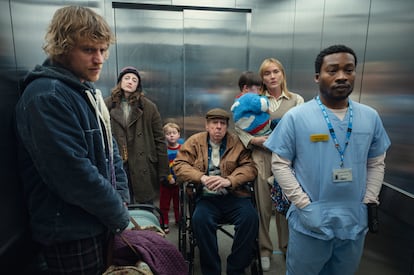
The very young writer brings a striking and brave novelty to his script: those last days—a good part of the month of December—are not going to take place in the warm environment of the home but in the much colder environment of the hospital. There are not many films of this style that do not bet on the environment of the known, of attachment next to a good fire. However, two details somewhat devalue the triple somersault involved in composing a Christmas drama in the room and hallways of a hospital. The first, the trap that in the British institution where the characters operate (which looks more private than public), there seems to be no movement, no more sick people, not many doctors, and barely one nurse, who is obviously a charm: in short, it is a movie hospital.
Second, in the face of the old battle of the two sisters who cannot stand each other, reconciliation is imposed, but this occurs more out of inertia than because the reasons were really (un)resolvable or because there is an emotional catharsis. In both senses, Anders is relatively delicate, far from drawing blood, and articulates his last act around sweetness.
Meanwhile, with the camera, the editing, the tone, the rhythm and the artistic additions (mainly the faint piano music), Winslet never forces the tearjerker, keeps her distance in the crudest moments, and trusts her film to the best that the product has: a group of extraordinary performers, with Helen Mirren as the dying matriarch; Timothy Spall as the husband who finds out nothing simply because he is scared to death; herself as the most successful and sensible of the sisters; Toni Collette as the spiritual flamboyant, and Andrea Riseborough as a textbook sociopath. It is here, in the charisma of all of them, when the film becomes stronger, armed with family affection. The same one that seems to have guided a famous mother to take another step in her career, to support the correct but still stammering writing of her young son.
Goodbye, June
Address: Kate Winslet.
Interpreters: Kate Winslet, Helen Mirren, Andrea Riseborough, Timothy Spall.
Gender: drama. United Kingdom, 2025.
Platform: Netflix.
Duration: 114 minutes.
Premiere: December 24.