
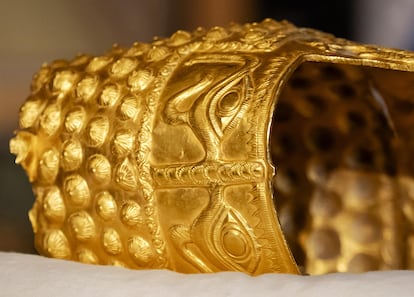
The Prosecutor’s Offices of the Netherlands and Romania announced this Thursday the recovery of the gold helmet of Cotofenesti, as well as two of the three bracelets that belonged to the treasury of the ancient kingdom of Dacia, which were stolen in January 2025. They were then exhibited in the Dutch Drents museum, in Assen, in the east of the country, and three people have been detained as suspects in the assault. Police are still searching for the third bracelet in the set. The situation caused great indignation in Romania because the pieces are considered irreplaceable national heritage and had been loaned for an exhibition that had to have adequate security measures.
“The works come from the suspects and arrived to us yesterday,” said Corien Fahner, from the Dutch Prosecutor’s Office. Her Romanian colleague, Daniela Buruiana, has highlighted “the effort carried out by the joint investigation team from both countries that has been created (with the participation of Eurojust, the European judicial cooperation agency), to be able to recover them.” The presentation of the pieces, which need to be restored, has been done with a certain theatricality. They were put in a display case covered with a black cloth, which has been raised with a countdown: “Three, two, one.” The gesture, closed with applause, has underlined the success of a delicate operation, given the unrest generated in Romania by the robbery. According to Fahner, there were no other people involved with the three detainees, whose trial should begin shortly. These are Douglas W. (36), Bernhard Z. (35) and Jan B. (21).
According to Arthur Brand, known as “the art detective,” and who has participated in the first part of the investigations, “great pressure has been put on the robbery suspects, because the trial against them is scheduled for this April, and a few months in prison, if they collaborated, is not the same as a sentence of about six years.” In the end, the thieves returned the loot through third parties. Robert van Langh, director of the Drents museum, explained that the treasures “can be restored without problems to return them to their original state.” The bracelets are perfect, “and Romania will decide where that work is carried out,” he added.
The assault occurred at dawn, and there was an explosion in the Drents museum, founded in 1854 and dedicated to works of Antiquity. The shock wave broke the glass of several windows and hit several surrounding buildings. There were no security guards in the building at the time. The set was part of an exhibition titled Dacia, the empire of gold and silverwhich presented treasures from Romania and “from the 20th century BC to the 3rd century AD.” The history of the Dacians was explained, who inhabited present-day Romania at a crossroads of cultures, since they were between the Eurasian steppe to the east, the Mediterranean world to the south, and central Europe to the west,” according to the exhibition documentation.