
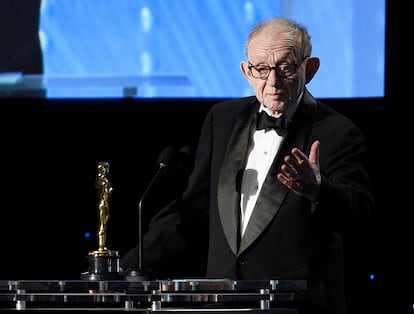
Frederick Wiseman, one of the greats of documentary cinema and a fundamental creator in understanding the success of that genre and the way it is filmed today, died this Monday in Cambridge (Massachusetts) at the age of 96. For his work of social analysis and his portrait of the failures in American institutions, he received the 2016 Honorary Oscar.
The announcement of his death was made by his company Zipporah Films, which, in the statement in which he made his news public, noted: “For almost six decades, Frederick Wiseman created an incomparable body of work, a broad cinematographic record of contemporary social institutions and everyday human experience, mainly in the United States and France.”
In person, Wiseman defined his cinema as “cinema that is fair to the people, even if it sounds somewhat pompous.” And he assured: “I have never believed in the truth. I do not intervene in the subjects of my films. Nor have I filmed moved by a preconceived ideology. Anyone who speaks about the truth is an ideologue.” Wiseman arrived at the cinema just when the synchronization of image and sound began to be possible, and the documentary abandoned the boring format of images accompanied by a narrator in off that explained to the public what they were seeing.
For this reason, he usually filmed with a team of three people: the cameraman, an assistant and himself with the pole and microphone. And he spent, on average, about 12 weeks of filming, so that people would get used to his presence and thus alter what was portrayed as little as possible. His artistic ethics were based on observation, on the invisibility of the documentary maker. In editing, he patiently constructed each film, and for this reason he dedicated a year to this work. Even when this work was finished, he checked the discards, in case he had missed something. He thus sought a dramatic structure for the material, not a narrative arc, but “rhythm and structure, obligatory in any film.”
In the first decades of his career there was one constant: his fixation on public institutions and their functioning. His work did not usually turn out well, not because of Wiseman, but because of the dark corners of the system. “I have never done anything outright critical of my country’s lifestyle. The proof of America’s democratic greatness is that I have made films that could have ended me in jail and, instead, they have turned me into someone who, although he does not earn much money making films, has a good time talking about films.” Hospitals, institutes, cabaret clubs, police departments, the Paris Opera Ballet, the British National Gallery, the New York neighborhood of Jackson Heights, the New York Public Library, the meat industry of the American Midwest, Boston City Hall, New York’s Central Park and a gym passed through his camera. “Many of the documentaries I see seem condescending to the viewer. I assume that whoever watches my films is just as smart or stupid as me.” Almost all of these documentaries were paid for by the same institutions portrayed; Another thing was the independence of Wiseman’s gaze.
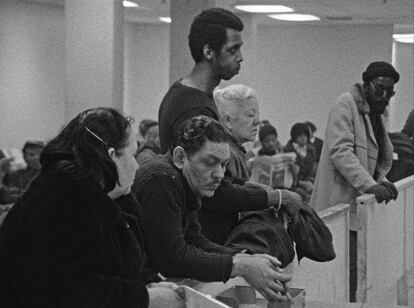
Law professor turned filmmaker out of sheer boredom, Wiseman practically made one documentary a year from the first, the controversial Titicut Follies (1967), which showed the brutalities of the Bridgewater State Hospital for the Criminally Insane. Massachusetts authorities sued it and a judge halted its public display for 22 years. However, no one could stop other films like law and order (1969), High School (1969), Hospital (1970), juvenile court (1973), Welfare (1975) o Public housing (1997).
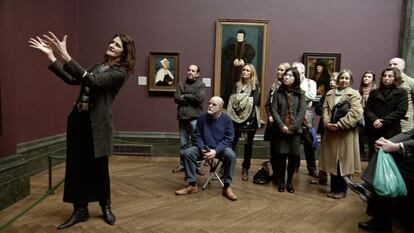
Each of his films is intrinsically Wiseman’s. An example: in National Gallery (2014) you can see a Greenpeace protest against the sponsor of an event at the museum. “Life from outside enters the museum, like its visitors. I never forget that,” he said at its premiere. And in the first sequence, a guide shows a still life by a Dutch master and points out that the kind of lobster depicted no longer exists. Curious metaphor about the ephemeral art that is cinema, which captures unrepeatable moments. “Well, I hadn’t thought about it, but it almost seems like a nod to my career, right? With my work I leave a record of a time and a place.”
Apart from that was his ideology. At the presentation at the Venice festival of In Jackson Heights, He told EL PAÍS: “Don’t get me started on Donald Trump. He’s just a clown. This is a country of immigrants. I don’t dare to generalize, but I observe that, at the end of the 19th century, all the wealth was still in the hands of those of English descent. A century later, power and fortune have spread to a much more diverse group.” Despite everything, he did not dare to pronounce the word progress. “Let’s just say some people do better.”
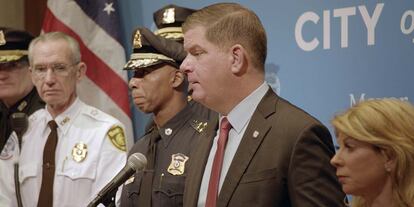
Some of his films explored themes of health and mortality, including Deaf (1986), Blind (1987), Multi-Handicapped (1986) y Near Death (1989). In recent decades, the The Garden (2005), The dance (2009), At Berkeley (2013), National Gallery (2014), In Jackson Heights (2015), From the books (2017), City Hall (2020) y The great menu, his latest documentary, the 50th, which premiered at the Venice festival in 2023, and which portrays the Troisgros restaurant, with three Michelin stars for half a century.
In the 21st century he combined his life between Cambridge (Massachusetts) and Paris, and spent confinement in southwestern France. And it achieved enormous popularity. It didn’t matter how long his films were (on average, three hours), because in none of them was there a boring sequence. Despite his age, he regularly traveled to festivals, in order to obtain financing for new projects, becoming an idol for new generations of documentary filmmakers in the antipodes of the Michael Moore style. Owner of a spectacular face, which seemed to contain all the valleys of the American Midwest, he stayed in shape, lifting weights every day: “Cinema is a sport, you have to be in shape.”
In his Honorary Oscar acceptance speech, he explained: “What keeps me going is fun and adventure. Working constantly also keeps me off the streets, or at least on the streets I like.”