
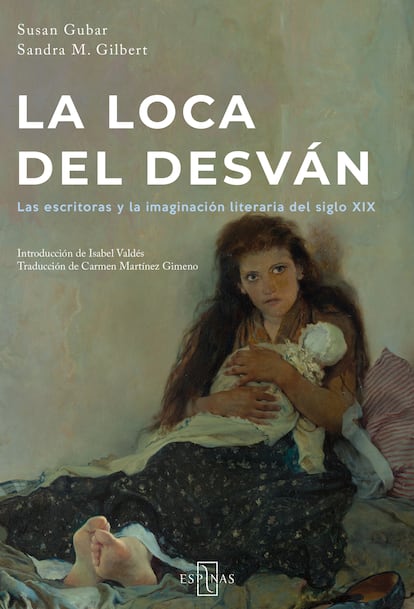
When Charlotte Brontë published Jane Eyre In 1847, British women writers were not free to write. When Sandra Gilbert and Susan Gubar wrote The madwoman from the atticinspired by the character of Bertha Mason from Brontë’s novel, the world was experiencing the second feminist wave. It was 1979. Today, almost 50 years later, the Espinas publishing house has republished the essay, considered the first feminist literary criticism: a concatenation of women recovering the work of their predecessors.
Alicia de la Fuente, the philologist who directs Espinas, explains why she decided to take on this task: “It is a book that forms the backbone of all feminist literary criticism. It is a text that is still completely valid and we wanted anyone to be able to access it.” The essay, which began as a university work, was the winner of the United States National Award for Literary Criticism and a finalist for the Pulitzer Prize.
Over 750 pages, it covers the works of Jane Austen, Mary Shelley, the Brontë sisters, George Eliot—pseudonym of Mary Ann Evans—and Emily Dickinson, and analyzes them, reads between the lines and reinterprets their creations from a gender perspective. A work that was out of print, Espinas recovered and, after the success of sales, has its second edition being prepared in print.
Bertha Mason, the wife of Edward Rochester in Jane Eyrelives locked in the attic of her mansion by decision of her husband, who believes that she has gone mad. Mason represents the woman marginalized by patriarchy, called hysterical or crazy when she decides not to comply with what is expected of her: to be docile, helpful, passive and self-sacrificing. The philologists Gilbert and Gubar saw in this character, a constant archetype in the works of Victorian writers, a way to express the discomfort and frustration that the authors experienced. A way to free yourself and say what was not allowed: show your experiences in a literary space dominated by men and a patriarchal canon.
In the introduction to the essay, EL PAÍS journalist Isabel Valdés explains how in the analysis made by the authors there are issues that women go through to this day: “Beauty, appearance(s), hunger, love, capacity and inability, destiny, freedom, desire, sexuality and sex, family, the romanticization of weakness and illness, their association, again, with beauty.”
Reread the literature
For María Adelina Sánchez, professor at the University of Granada and coordinator of the Erasmus Mundus master’s degree in Women and Gender Studies, The madwoman from the attic It was a discovery. So much so that he includes it in the syllabi of all the subjects he teaches: “It has changed how we approach literature.”
This book allows you to study, says Sánchez, for example, Frankenstein “not as the story of the creature and its creator, but as what it represented in an autobiographical way for Mary Shelley. How she represented herself in that creature, how she saw herself in that world of men.” It also allowed the incorporation of women’s work in literary studies, a representation absent in traditional criticism that decided what should be studied and how to do it.
In Sánchez’s classes, after reading the text, her students give feedback that is “fantastic, because they are seeing the works with new eyes,” which from feminism, she says, is putting on violet glasses. With them, students get closer to the life experiences of writers who had been relegated “to the position of crazy women” when, instead of having children and fulfilling their role as wives, they preferred to write.
The same thing happens in his classes to Francisco José Cortés, professor at the Faculty of Philology at the Complutense University of Madrid. The work, he explains, impacts students in two ways. The first is the way in which the character of the crazy Bertha Mason is an “ideological construction that has the role of showing the feminine duality of the good woman and the bad woman”, those ideological constructs that represent the patriarchy of the 19th century.
Even in children’s stories this duality existed. In the essay the authors analyze snow whitethe story that every girl has heard before going to sleep, which talks about that young woman who must escape from her evil stepmother who envies her for being the most beautiful in the kingdom. After hiding in the forest, she meets seven dwarfs whom she cares for and pleases, until she falls into disgrace—again because of a woman—and is only saved from eternal sleep with the kiss of the prince’s true love, to end her days fulfilling her role as a wife. In this story, the figures of angel and demon in which the women of the time were pigeonholed and that the philologists raise in the essay are more than clear: the stepmother, a woman without children, with power, who says what she thinks and who loses her value when she stops being the most beautiful in the kingdom; and Snow White, submissive, beautiful, helpful to her father, the seven dwarfs and the prince who rescues her.
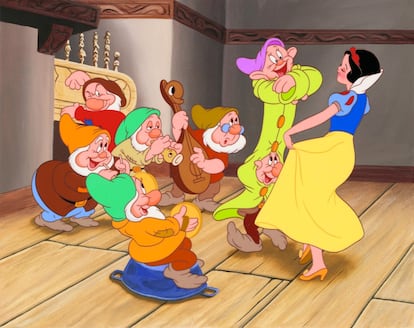
“We are not able to see the great violence that exists in fairy tales for children, against those demonized women who are victims and we do not question the male figures who are the ones who really exercise evil,” laments Cortés.
On the other hand, says the teacher, after reading The madwoman in the attic Your students are interested in the difference between male and female writers. While men have an “authorship anxiety,” a concept raised by Gilbert and Guber that explains the desire for their work to be original and not influenced by other writers to ensure literary genius; Women have an “influence anxiety,” the need to know that they are not alone and that there are more women rebelling through writing and challenging the literary canon. The teacher considers it a “pioneer” text that pays tribute to those “literary grandmothers” thanks to whom women of the 20th and 21st centuries can write openly.
Those that were missing
When Isabel Valdés introduces the book, she wonders about the absence of those writers “less Anglo-Saxon, less white, less within the canon” in Gilbert and Gubar’s analysis, and lists some such as the Peruvian Mercedes Cabello and Clorinda Matto de Turner, the Colombian Josefa Acevedo or the Brazilian Maria Firmina dos Reis. Valdés herself points out that “today’s filter can only serve to make a critical observation of the past that reminds us and makes us aware of the gaps that give rise to increasingly broader genealogies.”
In her classes, Professor Sánchez teaches the essay from the context in which it was written, an “essential” work with its limitations, but which “continues to serve as long as situated readings are done.” When her students study it, she makes sure they have the tools to understand what a work like this means now and where they need to continue working.
In Espinas they share the diagnosis of how much other authors were missing and propose understanding the essay as a bridge between feminisms; between how it was understood in the 19th century, in the seventies and today. “I think it is a text that is still valid because of the authors it focuses on, but I do think it also helps to question why other authors are not talked about,” says De la Fuente. The editor would like other texts to be published that dialogue with this one and complement the gaps. Because today there are still crazy people from the atticeverywhere, who rebel and from their attic write about the experience of being a woman.