
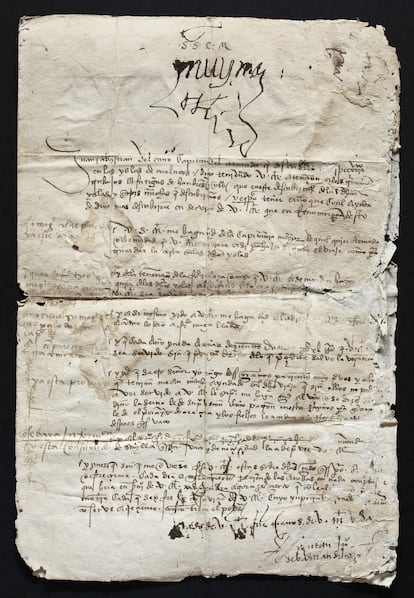
On September 7, 1522, Juan Sebastián Elcano, still on board the ship Victoriasent a letter to Emperor Charles I of Spain and V of Germany to inform him of the feat he had just carried out: he had circumnavigated the world for the first time. The king’s courier, Luis de Castellanos, traveled on horseback in just three days along the dusty roads from the Casa de Contratación in Seville and the Court, which at that time was located in Valladolid. And on September 10, the letter was received by the king’s powerful and influential secretary, Francisco de los Cobos from Ube, who became the notary of the first circumnavigation of the world and one of the first people, even before the monarch himself, to assume that the earth was round and to learn the scoop on the success of the greatest maritime feat of all time.
“Francisco de los Cobos was probably one of the first people to become aware of the roundness of the planet and that it was possible to circumnavigate it by sea with a good boat and, of course, with a brave crew,” says Vicente Ruiz García who, together with Ana Crespo Solana, is the author of The first trip around the world and Francisco de los Cobos, Secretary of a universal and overseas empire (Chair of History and Naval Heritage collection of the University of Murcia).
Since February 1518, Francisco de los Cobos (Úbeda, Jaén, 1477-1547) had taken control of the Secretariat of the Council of the Indies, replacing Lope Conchillos, who had recently fallen from grace accused of prevarication. From then on, the powerful secretary would begin to manage overseas affairs, intervening in the preparations for what was known as the spice expedition undertaken by Ferdinand Magellan, among other transoceanic enterprises.
From a very young age Francisco de los Cobos began to work in the service of the Crown of Castile, serving as assistant in the office of his uncle Diego de Vela, accountant and secretary to Queen Isabel I of Castile, as well as assistant to the secretary Hernando de Zafra, being appointed chamber clerk. Subsequently, Cobos began a dizzying political rise, being named Chief Accountant of Granada and Regidor in Úbeda and Granada. After the death of King Ferdinand of Aragon, he went to Flanders, where he was appointed secretary of King Charles in 1516, thanks to the support of William of Croy. Four years later, in 1520, he accompanied the monarch on his trip to Flanders and Germany, being appointed member of the Royal Council in 1522.
At the end of the winter of 1518, Francisco de los Cobos, Charles I and the entire court were in Valladolid, where the king received in audience a certain Ferdinand Magellan, a Portuguese sailor who offered Charles of Habsburg a very tempting offer: to reach the Moluccan Islands from the west, where spices, sought-after medicinal ingredients and essential plant elements to preserve food at the dawn of the Modern Age were found. Among the sailors who left Spain was Juan Sebastián Elcano, a man experienced at sea, but banned from justice for having sold a ship in time of war to foreign merchants as payment for a debt.
On December 21, 1521, 47 sailors and 13 Indian slaves began the return trip. Elcano and his men managed to round the Cape of Good Hope in the midst of terrible storms and ascend the African coast. “The casualties were daily due to hunger and scurvy since there was no possibility of asking for help from the Portuguese factories. Only when the last supplies were consumed and the ship Victoria was about to sink due to the waterways that ran through its hull, Elcano agreed to stop in Cape Verde,” explains researcher Vicente Ruiz.
Cobos informed the emperor of the news of Elcano’s feat. Both were keenly interested in what happened on the trip: the mutiny in San Julián, the death of Magellan and the profitability of the expedition. It was then that Elcano presented Francisco de los Cobos with said memorial requesting grants, among which were the Chief Captaincy of any Navy, the ownership of a fortress or the habit of Santiago, in addition to other concessions for those that Elcano indicated as relatives who had helped him on the trip. The requests were rejected as incongruous and disproportionate for the time with Cobos’ signature on the margins of each of them.
Essential piece of overseas politics
The study also reveals that Cobos drafted and endorsed the Capitulations of Valladolid, signed the instructions of Aranda de Duero and managed all the key documentation of the Spice Navy. Likewise, he was the one who responded in writing to Elcano after his arrival in Sanlúcar and who evaluated and limited his requests for grants or favors. “The book allows us to reposition Cobos – traditionally overshadowed by figures like Gattinara – as an essential piece of the overseas policy of Charles I and as a central administrative figure in the greatest maritime achievement of the 16th century,” emphasizes Ruiz, who is also director of the UNED in Jaén.
The 16 chapters of this publication cover everything from the Magellan-Elcano expedition to the political, artistic and cultural legacy of Francisco de los Cobos. The first chapters explore the historical, scientific and political impact of the first global circumnavigation, analyzing its consequences in the configuration of a new global identity and the role of Spain in the governance of the New World. His artistic patronage, his architectural legacy in Úbeda and his relationship with figures such as Empress Isabel of Portugal are also examined. At the same time, studies on the material culture, iconography and global projection of the Hispanic monarchy are included, as well as literary and numismatic analyzes that enrich the understanding of the period.
“Francisco de los Cobos, the man who first knew that the Earth had been circumnavigated, was the forgotten cog that made possible the greatest maritime feat in history,” comments Vicente Ruiz forcefully. The seed of this investigation was the national congress held in Úbeda in 2022 to commemorate the 450 years since the death of Francisco de los Cobos. Other researchers such as Carlos Martínez Shaw, Pablo Emilio Pérez Mallaina, José Miguel Delgado Barrado, Sergio Ramiro and José Miguel Gámez have participated in the work, which seeks to fill a historiographic gap about this character.