
Florian Zeller (Paris, 46 years old) has been succeeding in what he does for almost 30 years, but he still feels like a beginner. He began writing novels in the 2000s and soon won the Interallié Prize, one of the six major literary awards in France. He then made the leap to theater writing comedies for the Comédie-Française and, a little later, he radically changed his register to address different forms of family trauma with The father, The mother y the sonone of the most performed trilogies in contemporary theater, which cemented his status as one of the most celebrated playwrights of his generation. “Every step I have taken in my career has made me new at something again. I like not knowing everything and exposing myself to the unknown,” he says.
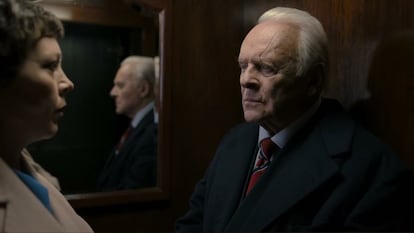
That same impulse led him to send the film adaptation of The father to Anthony Hopkins, an actor whom he did not know and whom he would end up directing in a film debut that earned him the Oscar for best adapted screenplay and gave the performer his second statuette as best actor. With that boost to the notoriety of his work, his texts, not only the three most popular, but the nearly 15 that he has written for the stage, have not stopped traveling the world—almost 50 countries now. In Madrid it is now represented The trutha comedy directed by Juan Carlos Fisher and starring Joaquín Reyes at the Infanta Isabel theater. In addition, the De Conatus publishing house publishes the famous trilogy translated into Spanish.
Paradoxically, Zeller is one of those who wants to have everything under control. He plans the preparations for the interview in advance, prefers not to have any photos taken, and gently reprimands anyone who breaks the silence in the bar of the Ritz hotel in Madrid, which is still closed, hosting the talk. “I have problems with letting things happen without controlling them,” he admits. He speaks slowly, meditates on his answers and leans over the table when the obvious passion he feels for telling stories overwhelms him. Its representative indicates that if the journalist suffers from a cold, he should wear a mask. It is not the case. Zeller has arrived at the appointment in the middle of a break in the filming of his new film, Bunker, starring Javier Bardem and Penélope Cruz, and written by him for the first time thinking directly about cinema. Furthermore, with an important part in Spanish, a language that he does not speak.
“It has been an intense, honest and beautiful experience. I really love them, I admire them (Bardem and Cruz) a lot. They have been fearless, we explored intimate territories, emotional territories, and they have been very brave in doing it as a couple, because it is not that easy. Yes, it has been one of the most joyful, intense and emotionally gratifying experiences of my life. They are both extraordinary actors, without a doubt, but they are also beautiful people,” says the author. It is his third work as a film director, after also adapting the son —much less successful than his debut—. The text of Bunker He wrote it specifically thinking about the Spanish couple. The same thing happened with the adaptation of The fatherwhere he changed the character’s name from André to Anthony to keep the American actor in his mind even though that seemed like an “unrealizable dream.”
The interpreters are one of the pillars of his writing, and he puts his faces on the characters as soon as he starts typing. “I start writing with a very specific actor in mind. I really enjoy transforming the desire to have a great actor into an artistic experience,” he explains. Perhaps because of that commitment, its powerful characters, who move from sanity to madness, offer an interpretive feast for those who take advantage of them. They have been magnets for some of the greatest – without falling into exaggeration – actors of their time. In the skin of the elderly who little by little is lost in dementia in The father, In addition to Hopkins, Frank Langella, Kenneth Cranham, Héctor Alterio and Josep Maria Pou have joined. In that of the wife, mother and housewife who goes into depression when her children leave home in The motherIsabelle Huppert, Gina McKee or Aitana Sánchez-Gijón. And in that of parents who deal with a cruel depression in their adolescent son, in the sonYvan Attal, Amanda Abbington or John Light.
They are texts that address social issues, but always from an intimate experience. Because for Zeller, “good theater is about the human experience.” “I don’t like political theater. Art is a place to ask questions. There are different voices and it is not the playwright’s role to say who is right and who is wrong,” he explains. Nor does he feel responsible for the social impact of his work, even though it touches on sensitive topics: “The only thing I feel responsible for is exploring to what extent we can be empathetic with others. For me, the most ambitious thing is trying to make people feel connected to themselves. And it all comes down to empathy.”
In his work there are two very clear references: Harold Pinter and David Lynch. The two are easily found in his works. The oneirism of one and the relevance in the silence of the other (“silence”, “pause”, “long pause”, is read regularly in the book he is now publishing). “Pinter was the one who taught me that what matters is not only what is said, but also what is not said, what is behind the words. A character can say no and it means yes,” he explains.
Zeller’s stories delve into the depths of the human mind. The form constructs the character (or deconstructs it, really). It is common for the viewer, like the protagonist of the story, to never know if what is happening is real or not. “I am the first to be surprised by what happens. With The fatherFor example, I wrote without knowing what it would be like. I tried to put myself in a mental situation where I really didn’t know what was going to happen in the next minute. And so, suddenly, a door opened and a character I didn’t expect entered. To understand what is happening, I need to keep writing,” explains the creator.
“I experience writing as a direct connection with the public. When I write a work I feel like I am in a theater, in front of a show that takes place just for me.” That is why he builds what he calls “a system of complex architecture,” which invites the audience to be part of the show. “I am interested in putting them in an active position. It is an invitation for them to find their own path, search for meaning, emotions, and I want them to actively participate in the storytelling process,” he reasons. Although this technical virtuosity is not free of suspicions. There are those who criticize that its form can be repetitive. He is clear: “What it’s about is not lying to yourself and constantly thinking about the audience. For me, that’s my starting point. It’s not about writing what people like, but about writing what they might like.”
That explains why he is predictably very zealous with his text. Despite having traveled the world, he always tries to keep it “untouchable” and away from other people’s experiments, including those of actors, no matter how extraordinary they may be. “I try to be as precise as possible and invite the actors to be precise with their language. What I want them to contribute is not text, it is their intuition, their voice and their presence. Sometimes, if you are lucky enough to work with great actors, you can witness the beauty and grace that emerge through a body,” he adds. Although, later, the unpredictability of theater (which he never tires of repeating that he loves) causes him quite a bit of frustration: “One day you’re funny and another day it doesn’t work. One day the audience receives it well, another day it doesn’t. One day the actors do it great, and another they don’t.”
That doesn’t happen in the cinema. There he found a space of greater creative control, or at least “illusion of control.” “In The father As a film, one of the biggest reliefs I had was having edited my ideal version. It was exactly what I felt in my heart. Cinema is that, it is not alive and for those who, like me, have problems with the idea of letting things flow, the illusion is very tempting,” he says. He also finds a refuge behind the screen: “Theater is the only art form in which you attend the reception of your own work. With cinema you can lie to yourself. But when a play doesn’t work, it’s a physical experience. You can realize when you’re in the room that something is wrong.” Although that also seems to him “the beautiful thing about theater: its truth.” From the criticism of cinema, like the ones he received after his second film, he prefers to isolate himself. “It helps me try to learn not to exist through another person’s gaze, another person’s judgment. Exposing ourselves publicly to reviews and critics forces you to be clear about why you do the things you do.”
He will return to it, he says, after finishing his new film. And he will continue to be accompanied by a trilogy with which, more than 15 years after his arrival on stage, he continues to feel “very connected.” He is not worried that this will mark his career, nor does he think that it will limit the creativity of his upcoming work. Are these already iconic characters missing something to do? To begin with, the film adaptation that is missing dand The Mother —“I haven’t done it because it was too early, it’s too similar to The fatherbut I hope to do it one day,” he acknowledges—and one last whim from his creator: “In these three works it is not that they are the same characters, but they could be, and I would love to one day see the same actors performing the three works in the same week. But only for my personal pleasure.” The hook has been cast, surely there will be no shortage of people who will pick it up.