

The actor Fernando Esteso, known especially for his work in popular Spanish cinema in the eighties, died this morning at the La Fe university hospital in Valencia at the age of 80, due to a series of respiratory problems that he had been suffering for a few weeks, as confirmed by his representative to Europa Press.
Esteso has been a very popular figure for decades in Spain, even with musical numbers like Ramona’s which he covered in 2011 with King África. But he did not achieve the same claim as Andrés Pajares from a more serious and authorial cinema. Only in recent years, Agustí Villaronga, who liked him, offered him a small role in uncertain glory (2017) which was followed by another with more dramatic development in Loli Tormenta (2023), the filmmaker’s posthumous film. “I am an actor, and I know how to do more things than comedy,” he told EL PAÍS during the promotion of Uncertain glory. “I had a bad time because no one called me and instead I go out into the street and feel the love of the people.”
Widowed, he moved to Valencia to live near his two children (“They watch me, and I’m happy about that”), although he always defended his aragonity: in a program on EL PAÍS through Facebook in 2017, in addition to At Ramona’s he intoned a jota: “I don’t forget where I come from.” Because his family belonged to the artistic world of variety shows and they were also joteros.
Indeed, the comedian was born in Zaragoza in 1945 and began his career in the circus and theater with his father. In 1964 he moved to Madrid, focused on the theater, and already achieved a certain comedic renown in television appearances around 1972, before jumping to the big screen with Andrés Pajares, his artistic partner in post-Transition cinema. Together, directed and scripted by Mariano Ozores, they blew up the box office with nine films in four years, from 1979 to 1983. “Those films were a testimony of the moment,” explained to ICON Fernando Esteso in an interview in 2018. “We had four weeks to shoot. We went so fast that sometimes we moved our mouths without saying anything and then we would put in a joke in the dubbing studio. We rehearsed first to laugh at our ease, because the negatives cost a fortune,” he described then.
Truthful actor, first-class comedian, excellent singer, brilliant imitator and above all, a dear friend… Fernando Esteso has left us today.
All my love for your family.
You were an idol and a childhood myth and meeting you did not disappoint me, it made you greater. See you always Fernando 😔 pic.twitter.com/YOfR5dDnmz— Santiago Segura (@SSantiagosegura) February 1, 2026
More than a million spectators saw the duo’s first film in the cinema, The bingueros (1979). The 15 million pesetas (90,000 euros) that were invested in it became 200 million (1,200,000 euros) in profits, and managed to establish a film and humor model that would be repeated in successive collaborations of the comic couple. While they were rolling The binguerosMariano Ozores wrote the following comedy, The energetic (also released in 1979).
His films came after the death of the dictator Francisco Franco and at the beginning of the Transition. It was the Spain of the uncovering, in which cinema went from showing nothing due to Franco’s censorship to showing naked women, whether it was appropriate or not. “Our films coincided with the uncovering, but we had to try to get people to pay more attention to laughter than to nudity,” Esteso said years later. “Sometimes those two ignorant innocents would start arguing about something that had nothing to do with it, even if there was a naked woman in front of them. It was never humiliating. Now you can’t make humor out of anything. Everything can be offensive,” he complained. He insisted that he never considered those films as sexist cinema.
The third collaboration of Pajares and Esteso was in I made Roque III, in 1980. They followed Christopher Columbus, discoverer by trade (1982) —Camilo José Cela complained that this film was surpassing the film adaptation of The hive at the box office—, and another string of titles, among which are The links y The pimps (both in 1981), Everyone on the ground y Father there are only two (1982), Shake before use y La Lola takes us to the garden (1983). They all attracted probably the same million viewers over and over again.

But they got tired. “We left it because we were making the same film with different scripts,” Esteso acknowledged in the aforementioned interview at ICON.. From then on, the actor had a brief career on television linked to Telecinco, in programs such as The wheel of fortune y summering, which culminated in the courts and in a conviction that forced the chain to pay him more than one million euros in damages.
In theater he performed in 1987 The strange couple by Neil Simon, with, as could not be expected, Andrés Pajares. He also appeared in the fourth and fifth installments of Torrent and some series like Gym Tony y The one that is coming.
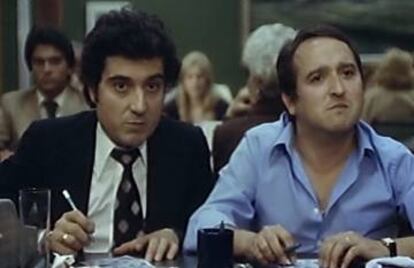
Of those moments of glory he asserted: “Now many people in the industry pretend that that film and that comedy did not exist. And instead, it fed them for years, because the public loved it.” In person, Esteso was a very polite man, slow-paced, and very aware of his role and his fame.
In recent times, he had occasionally participated in projects such as Just before Christ, in 2020, or Pajares & CIA, in 2022. He also presented the Goya for best documentary short at the 2023 ceremony, where he dedicated a few words to the deceased Agustí Villaronga and Carlos Saura. “I hope that both Carlos and Agustí, who will already be writing the script for their next film, have a memory for me,” he said during his speech. “Sooner rather than later we will meet again.”