
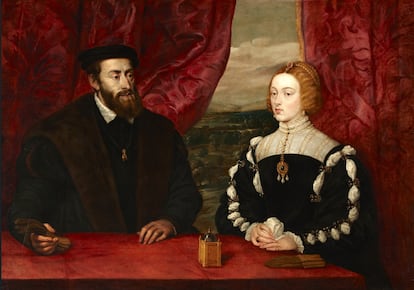
Since its creation in 2023, the Royal Collections Gallery has strived to display never-before-exposed pieces of the enormous artistic collection – more than 160,000 works and objects – that National Heritage, on whom it depends, safeguards. There is everything: paintings, sculptures, carriages, musical instruments, furniture, weapons, tapestries and toys. But also stranger pieces that occupied a central place in the history of the monarchy: cutting-edge scientific objects of the time, stuffed animals or works with unique themes – such as a rare and unknown canvas of a deer antler attributed to Velázquez. They are, explains Víctor Cageao, director of the gallery, “exotic wonders” that this year will star in one of the two large-format temporary exhibitions that will articulate the exhibition year that the gallery presented this Thursday.
“They are things that are as spectacular as they are strange, unusual and that reveal the capacity of cultural objects to continue surprising the public,” Cageao said in the presentation. Before this sample of wonderful which will open in December, the gallery will present in June Weaving courtly life, with more than 200 fabrics, embroideries, trimmings and court laces, which is one of the most relevant collections of historical textiles in the world. “Pieces,” said the director, “that not only tell us the richness and extraordinary wonder of this section, but also how through these fabrics the proper space and atmosphere of the monarchy was shaped.”
With these two big bets – of which no further details have been provided – the director of the Gallery, who took office last year, aims to “strengthen the programming so that everyone always finds new things and exhibits things never seen before.” The still very young museum faces 2026 with the challenge of improving its national projection and its presence in the cultural life of Madrid. The enormous building, somewhat hidden behind the Almudena Cathedral, received 741,589 visitors in 2025, 14.4% more than the previous year. Data that for Cageao are not “fundamental”, but that satisfy him. “We do not aspire to anything more than to offer an extraordinary program. It is a museum that has to be a reference in Madrid, it can help explain how other institutions were configured. But we are happy because the response, in our opinion, has been very good. In just two years, thanks to the work of the entire National Heritage team, we have managed to consolidate a stable and dynamic program, with an excellent reception from the public and professionals in the sector,” he noted.
One of the axes of the museum project that he inherited, and that he maintains, is the rotation of the works. Last year alone they removed 140 pieces from their permanent collection and added 148 new ones. “Rotation is basic in a gallery like this,” said the director, “this cannot be understood as a museum that is nourished at the expense of the Royal Sites, so there is a back and forth.” In addition, the changes allow for “constant restoration work.” The 715 works exhibited today will have three guests from outside institutions this year. The most relevant, a portrait of Philip IV, by Velázquez, which will arrive next October from the National Gallery in London, where it has not left in more than 20 years. You can also see a work by Gaspar Becerra, from the Museum of Fine Arts of Valencia and a Rubens from the Casa de Alba Foundation.
Clocks, topography and contemporary photography
As a complement to the two large exhibitions, the Gallery will also present, as they did last year, some other smaller exhibitions. There will be two monographs, the first dedicated to one of the great masters of topographic representation of his time, the Italian artist Fernando Brambila (1763-1834). He was commissioned by Fernando VII, in 1822, to represent all the Royal Sites, some of which have already disappeared, such as the Royal Spa of Solán de Cabras or the Royal Site of La Moncloa. “Thanks to him we know what La Granja, Aranjuez, or the Prado Museum were like at the time,” says the director. And another, titled Miniatures from the Royal Collectionswith the little-known collection of small formats —“A special technique that was developed from the 5th or 6th century,” recalls Cageao—.
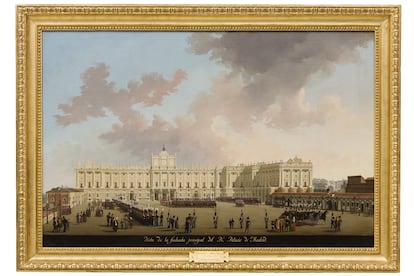
In March the 19th century clock collection will be exhibited acquired by Ferdinand VII and his daughter Isabel II, with little-known pieces, and in autumn the one dedicated to the Art of Savingwith cases, chests, boxes and chests made of different materials. And the last thing on the annual menu: the third edition of Alterationscoinciding with the Gallery’s anniversary, a new collaboration with PHotoESPAÑA that this year will have a work by Isabel Muñoz about the El Escorial monastery. “He is right now beginning his reflection on El Escorial, and he has asked us for a lot of information,” said Cageao.