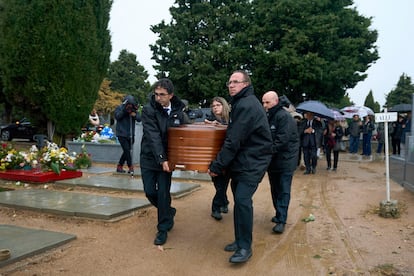
Let us not be clouded by truculence or vicissitudes. Regardless of what the chronicles of events end up ruling, with Encarna Polo Oliva we have just left an icon of Spanish popular culture of the second half of the 20th century, a woman of overwhelming charm and such an eventful life that in any other geography she would have already deserved her good. biopic with a more sociological than merely folkloric background. As an example, this brushstroke from a conversation with this journalist 11 summers ago, when Polo presented The score of my lifethe autobiography that he took pains to write for the AISGE Foundation. “As a child I sang in front of a whore’s house so that the women would throw money at me from the windows, and with those coins I paid the entrance fee for my first sessions at the summer cinemas. I have always taken money… except now.”
In the first rows of that torrid summer day, she was applauded by Paco Clavel, José Manuel Parada and the much-missed Pilar Bardem, an involuntary reflection of a plural and proud Spain that knew how to recognize the legacy of the Seville artist beyond clichés, prejudices and other stereotyped mentalities. “For me it will always be that eternal smile of the copla yeyé,” summarizes the Albacete coplera popularizer Lidia García, responsible for the podcast, in response to questions from this newspaper. Oh, campaneras! Of course we will always associate Mrs. Encarna with the well-known Paco, Paco, Pacowhich well into the 21st century experienced an unusual second viral youth after a youtuber will synchronize it with the video of Single ladiesby Beyoncé (let’s face it: the effect, 16 years later, still seems shocking to us). But García emphasizes that his talent and disposition deserve more generic applause. “The new rhythm that he gave to the copla was combined with a unique and particular sympathy, with that overwhelming joy when presenting the songs. Not only did he make the copla make us dance, but his charisma also helped him a lot in his television role.”
The diagnosis is similar if we turn to the journalist and film critic Juan Luis Álvarez, who treated Encarnita with some frequency since the second half of the 1980s. “She was very excited that I told her that she had been the most advanced, even though she had conservative ideas, but it was the pure truth,” he recalls. “To those of us who were children when the mythical Passport to Dublin from TVE (1970) we were fascinated by its colorful whirlwind, which had nothing to do with what we saw later on the street. In reality, that program was a modernity race between her and Karina…”.
“At a time when The Beatles had swept the world and the music here wanted to stop looking at Spain and look at what was foreign, she represented the midpoint between Spanish folklore, the tonadillera and pop. She called herself the queen of pop flamenco, and she was,” adds Alejandro Melero, vice-rector of the Carlos III University and researcher, who goes on to say: “She was destined to be the heir of Maruja Díaz and to do what Rocío would do in the next generation. Jury, but he opted for other more pop rhythms.”
Álvarez also adds an interesting addition in terms of musical style. In some of his greatest pop milestones onlycorves-srldourfrom The Piconeros a Pepa Banderaher then husband, the brilliant Buenos Aires composer and arranger Adolfo Waitzman, already introduced the first electric guitars, a stylistic license that would later become iconic and revolutionary with Gipsy rock (1974), the LP that forged the myth of Las Grecas. After the marital separation, Polo did not give up his efforts to recover the musical scepter of his best years, although circumstances were never favorable to him again.
We are so abducted by the developmentalist rhetoric around the happy Paco, Paco that we run the risk of forgetting some other very meritorious pages, in particular the Spanish adaptation (1968) of The Ballad of Bonnie & Clyde or, almost better still, the tune (composed by Watzman) of This man in blacka TVE series directed by Antonio Mercero that at the end of 1975 paralyzed half the country in front of the television, with José Luis López Vázquez in a leading role that the cartoonist Antonio Mingote had conceived. Encarnita’s voice (“Who are you? Who sent you here?” / “And all in black, you make me laugh”) was the unmistakable signal, as our elders will remember, to abandon household chores and sprawl out on the couch.
The actor Pepe Viyuela, when he was very young, was from that half of Spain that saw Polo in front of the television: “I remember seeing his songs on television: they immediately reached you, they were very catchy. Paco, Paco It is in the collective memory. I don’t know if she was aware that she was bringing those flamenco rhythms closer to pop and I think she is a pioneer of what is being done now in Latin music. She filled everything with joy. My parents, when he appeared, told me to shut up and listen. Because, in addition, he liked him very well.”
Music far overshadowed Doña Encarna’s role as an actress, who above all deserves mention for the Italian series Scaramouche and for a film by Ignacio Iquino titled 07 with the 2 in front (Agent: Jaime Bonet)a parody between candid and silly that was filmed in 1966 sharing the spotlight with Cassen. It is true that later we would have to talk about the tables thanks to the assembly The Cuernicabra fairperformed at the National Theater of Santo Domingo, for endorsing the summary that journalist Álvarez formulated for us. “At one point, she was a very groundbreaking lady in this country.”
Groundbreaking and, as we say now, transversal. A nice fact. The prologue of his memoirs, the aforementioned The score of my lifewas the academic and journalist Luis María Anson, director for many years of the Abc. On the day of the presentation, Anson stood up from the audience and noted: “I have always loved being among actresses, because they are geniuses on the stage. I have always admired Encarnita, just as I am amazed by Pilar Bardem’s energy and coherence, even though her ideas do not coincide with mine. We owe them a big applause of gratitude.”