
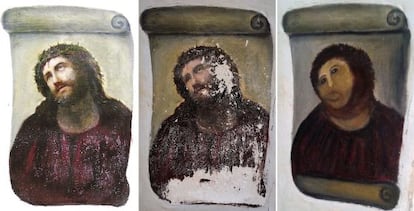
Sometimes—though almost never—disasters in the art world end in miracles. In 2012, a small church in Borja became the setting for one of them. Many remember the painting of Behold the Man that decorates one of its walls not because of the original brushstrokes from the 19th century, but because of the “disastrous” restoration carried out by a woman—who was in her early 80s at the time—who acted spontaneously and “without asking anyone’s permission,” although “with good intentions.” The result of the intervention of Cecilia Giménez, who died this Monday at the age of 94, was not only catastrophic, blurry and unrecognizable, it also became an object of ridicule. However, the disaster transformed the work, attributed to Elías García Martínez and of little artistic value, into a global phenomenon. Suddenly, the Behold the Man and Borja were in everyone’s eyes.
Since Cecilia Giménez tried to restore the fresco—about 50 centimeters high by 40 wide—the history of the Zaragoza town took an unexpected turn. What seemed like a disaster—or even a crime against heritage—became the great historical event in Borja, a town of just over 5,000 inhabitants in the province of Zaragoza. Giménez’s work was featured in documentaries, wine labels, t-shirts and even an opera. Media from around the world, such as The New York Times, The World, The Telegraph and the BBC, reported on that miraculous disaster.
The scope was such that from that moment on it was expressedBehold a man It has been used to refer to other subsequent failed restorations. And not all of them by good-willed neighbors, but also by professionals.
In Spain, before Cecilia Giménez en Borja, other amateur painters ventured to retouch the walls of religious temples. This was the case of a neighbor from Sariñena who, more than a century ago, dared to record her drawings along with the valuable paintings of Fray Manuel Bayeu. It happened in the Charterhouse of Nuestra Señora de las Fuentes, in Los Monegros. Although it cannot be considered a typical restoration – since his interventions did not affect the original frescoes – his childish-looking strokes caused a notable stupor when they came to light.
Last summer, outrage was also noted in Seville after an intervention on the image of the Virgin of La Macarena. The restoration, ordered by the Brotherhood and at the hands of an expert, caused immediate discomfort among the devotees and spread to a large part of the Sevillians, who did not recognize the final result. In just one week the face of the virgin, who had turned La Macarena into an icon of the city, was different.
In 2011, the restoration of the walled complex of Almería sparked a strong controversy due to the contrast between the original stone from the 11th century and the steel sheets used in the intervention. The result generated immediate rejection and opened debate about the limits of heritage restoration. The Ministry of Culture, responsible for the work, then defended that it was a provisional solution and the only one capable of preventing the collapse of the wall. However, various groups – including the UNESCO Center of Andalusia – protested the result and recalled that the law issued by the Ministry itself prohibited the use of materials that did not exist at the time of the original construction.
Between 1992 and 1994, the Roman theater of Sagunto (Valencia), built in the 1st century, underwent a restoration so ambitious that it bordered on total reconstruction. The architects responsible practically built a new theater, ignoring the fact that it was an archaeological ruin. The controversy broke out as soon as the works were completed and the complaint did not take long to arrive. The stage was completely new, the stands were unrecognizable and the use of modern materials made the set look more like a replica than a historical vestige.
Another case was that of the priest of the San Cosme Chapel in A Coruña, who one day decided to confront the moth and the leaks that threatened the wooden roof covering of this Galician Romanesque temple. He resorted to a solution that was as practical as it was controversial: burning oil and kerosene. The problem is that the chestnut boards on the roof were considered a heritage asset and the treatment left them completely blackened. The priest apologized, claiming that, with the limited budget he had, he had not been able to find a more suitable method. However, neither the neighbors nor the Xunta were particularly convinced by his explanations.
The restoration of the Roman mausoleum of Abla generated a comparison that is difficult to ignore: the ancient funerary monument came to be confused with a public urinal, according to the entry of a cultural blog, dedicated to analyzing the management of the region’s historical heritage. The reasons given were, once again, the inadequate use of materials and the construction of a new box that hides the original structure from the 2nd century, completely altering the reading of the monument.
In 2015, the San Cristóbal de Cea dolmen in Ourense ended up integrated into a picnic area after being transformed by workers into a table and two concrete benches. This funerary monument, more than 6,000 years old, was registered in the Catalog of Cultural Assets of the Xunta de Galicia. The intervention was discovered by an environmental group, which reported the facts to the Environment and Urban Planning Prosecutor’s Office. As they noted, “these events have caused irreparable damage to the tumular mass of what was a prehistoric cemetery of the first inhabitants of Cea, which was an example of the first monumental architecture of a funerary nature in history.”
In the end, these cases show that not all restorations go as planned. Sometimes centuries of history are erased, other times controversies are generated and, on very rare occasions, like that Borja disaster, an error can become a global phenomenon.