

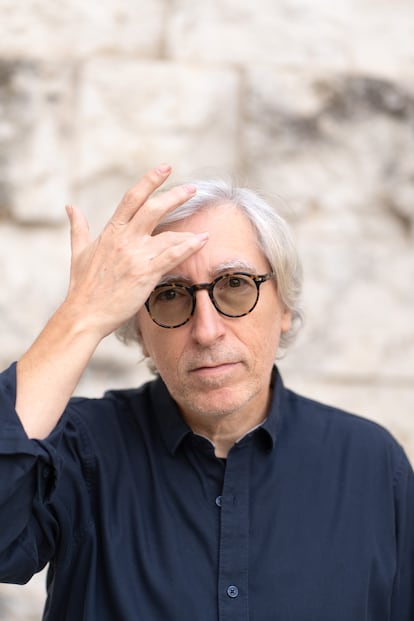
The filmmaker and novelist David Trueba (Madrid, 56 years old) closes the Seminci festival in Valladolid this Friday with the premiere of his new film, It’s always winter, which will hit theaters on November 7 and is an adaptation of his novel Blitz. It is the first time that the director has taken one of his books to the cinema, an experience that he considers “traumatic”, as he confesses. The film stars Miguel Verdaguer, who plays a landscape architect whose life takes a turn during a trip to Belgium in which he breaks up with his partner (Amaia Salamanca) and begins a relationship with someone older than him (Isabelle Renault).
Ask. Welcome to Valladolid, where many say it is always winter.
Answer. (Laughs). It is one of those cities with harsh weather that increases the feeling of loneliness. The climate is the character, tourism does not come because we are handsome but because of the climate. The Spanish character, this experience on the street, socialization, large families, bars, long conversations… is the result of the climate, not of being blessed by friendliness.
P. They say in the film that in Belgium everything is very Belgian. In Spain is everything very Spanish?
R. I made fun of those who got involved with Spanish cinema because when Coppola, Woody Allen or Jarmusch came to make a film, it was difficult for them. Spain is a living country and it is difficult to portray living people. I like complexity, people with highs, lows, hot emotions, melancholy, sadness, irony, joy, humor.
P. The protagonist protests because “you can’t be with a singer, they only last for a while.” And with a filmmaker or writer?
R. They are people with dissociation. Even if they are in a normal life situation, they have the creative element working. That makes the person more difficult. Live two realities. A singer is acclaimed on stage and then it is difficult for him to get off and make dinner for his children, which helps maintain common sense.
P. Is there anything sadder than a hotel double bed made up of two singles?
R. Being out of your city. At fairs or festivals you spend days where you don’t know anyone, in sad, cold hotel rooms. They are moments of reflection on what you do, what you are. I had it in mind in the film. When you’re out and about alone, you don’t go to a great restaurant. I like what the protagonist, the architect, says about his work: in a vulgar place the most extraordinary thing can happen. That the breakup is in a kebab bar and not in the Eiffel Tower, in a seedy and ugly place, makes us think about why we get attached to ugly things. We provide them with sentimental value.
P. Is it better to live with eyes that do not see or with a heart that feels?
R. It’s the big question. Fernando Fernán Gómez told me: “If they guaranteed you that being stupid you would not suffer, you would prefer to be stupid.” Having feelings and living with your eyes open causes pain. Is the alternative better, putting yourself in a refrigerator? The protagonist, after a breakup, remains emotionally blocked, the film is about how he is unblocked. Cinema offers company, but also insight into the life experiences of others that end up shaping your education. People have a hard time putting themselves in someone else’s shoes. Fascism, machismo, anti-immigration, homophobia… have to do with this inability.
P. Amaia Salamanca, co-star, suffers in Blitz the crisis of 36. Have you suffered the crisis of 56? What is left for you to do?
R. I just completed them, I didn’t have time! Combining the professions of novelist and film director always allows me to return to each facet with the enthusiasm of the first time. Maintaining enthusiasm for our jobs is almost a work obligation.
Society is very cruel to women by not accepting that they continue to live after 60.”
P. The film also features a 63-year-old woman who says she has already closed the chapter on love. Does love have ages?
R. Society is very cruel to women by not accepting that they continue living after 60. On the list of most attractive men there are two or three 60-year-olds, Brad Pitt, George Clooney, but no women. It is an unfair cultural reading. Beauty is not only linked to the splendor of youth. When you become mature you close the door to elements that have to do with passion, madness, letting yourself go, but it is a bit limiting. A sexual scene between a 63-year-old woman and a young man causes confusion among viewers because they are not used to it, it is deliberate. One motivation of cinema and literature is to show what we do not see and create pleasurable discomfort.
P. Cinema and the arts have expressed love and heartbreak in all languages. What must be considered to move the era of WhatsApp?
R. The mobile phone has contributed to speeding up relationships. When we were in high school, meeting someone you liked took months of observation. Now it is solved in 35 seconds. They live 35 years longer than our grandparents, but young people are distraught because their lives are slipping away. Time is not used correctly.
It is easier to adapt a book from others than one of your own, you have to face the author who wrote it
P. It has taken 10 years to carry Blitz to the cinema. Because? Do you consider it with others?
R. Not with my novels, only Blitz. Seven years ago I was about to film it, but there were financial problems. I have had many offers for others and I have resisted. They are longer, without the elements of Blitz to transport them. They are more interior, where time passes in the head. I don’t think I’ll do it again because it’s been a bit of a traumatic experience adjusting myself. It is easier to adapt a book from others than one of your own, you have to face the author who wrote it, who was different. When I wrote it I was very close to the male protagonist, but now more to the female one.
P. Which product is more rounded compared to the initial idea, the book or the movie?
R. The novel emerged by writing Land of Fields. This powerful, immediate, brief story emerged, and I had to write it. It’s the first time I stopped a novel to write another. With the film I didn’t have that urgency and it allowed me a global reflection. The problem with adaptations is not to transfer a book identically, but to take the essence and create it again. In literature you talk intimately with someone who is going to take breaks. In cinema you call for an hour and a half of linear consumption in front of a screen with more people.
P. “Marta doesn’t like to lose, not even with her past.” Have you learned to know how to lose? With what?
R. As a child, with older brothers who beat me at everything. Now I look at the festivals from a distance, at Seminci I have had the luxury of not competing, of just coming to close it, but frustrations and dissatisfactions are generated, because films and books compete. We don’t do this to compete but to express ourselves. Life is to be in it, not to win or lose, without a sporting scale. my book Know how to loseabout people who are betraying themselves, conveys that the greatest defeat is not turning defeats into lessons.
P. Who would twenty-somethings vote for today from your novel? four friends?
R. There would be division. Young people then were very depoliticized. Starting with the 2008 crisis, they became politicized in terms of employment and housing. That makes them more extremist. I learned a lot about tolerance by talking to my father’s generation, a farmer from a town in Castile, a friend of those who had fought on the opposing side. Now there are people unable to sit down with those who think otherwise. Politicians are unnerving and irritating, betraying their mission that the people can live together thinking differently.