
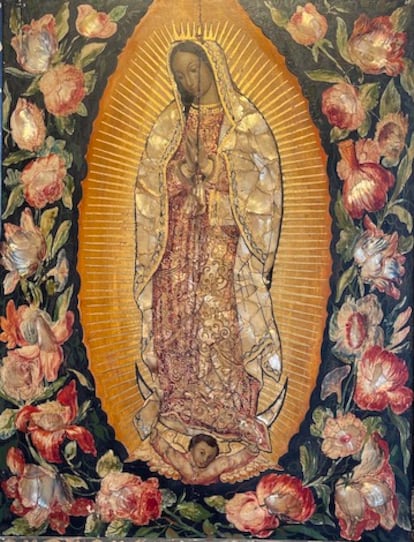
The Ministry of Culture has acquired a series of nine encochadosoil paintings on board with mother-of-pearl inlays, for an amount of 2.2 million euros, the most expensive set of cultural goods purchased this year. This was reported by the ministry through a statement in which they assured that the paintings will become attached to the Museum of America, custodian of the most important collection of this genre.
These works, from the late 17th century and produced in the viceroyalty of New Spain, deal with the Virgin Mary. This baroque art technique of mother-of-pearl fragments on wood, painted with oil paints, was developed for barely a century and there are only around 300 known examples in the world. This makes the acquired series stand out for its cultural interest and material wealth.
The collection is made up of eight encochados with scenes from the life of the Virgin: The Nativity of the Virgin, The Presentation of the Virgin Girl in the Temple, The Education of the Virgin, The Annunciation, The visitation of the Virgin to Saint Elizabeth, The Baptism of the Virgin and Saint Joseph, The Dormition and Burial of the Virgin y The Assumption and Coronation of the Virgin. It is also part The Virgin of Guadalupea similar work that “probably was also part of the same group,” says Cultura in the published note.
The tables include “singular” details such as a frequent presence of the Holy Spirit in the form of a dove in several scenes. Different episodes of the same painting are also recreated, as occurs in The Dormition and Burial of the Virgin y The Assumption and Coronation of the Virgin“which is also not very common in this type of work,” says the statement.
Likewise, “the decorative richness of the domestic and ceremonial trousseau” stands out in the iconography, the clothing of the characters “for its sumptuousness and the refinement of its execution” and the use of gold in the clouds of the exterior scenes, “a reflection of the oriental influence of the works.” In the case of The Virgin of Guadalupe The carnations and roses of Castile are valued, which “evoke the tradition of the Guadalupe apparitions to Juan Diego on the Cerro del Tepeyac in 1531.”
The purchase is known a month after the Ministry of Culture reported that the two expert committees—part of the decolonization project of the museums of Anthropology and America—concluded their work with two resulting projects with guidelines to renew the narratives of these institutions. This initiative seeks to include an anti-racist, gender perspective, with social justice and capable of eliminating all biases behind museographic discourses. In the words of Minister Ernest Urtasun: “The objective is for national museums to be children of the present and builders of the future. They are going to explain cultures as something living and contemporary, which challenges us. And we are also going to recognize the agency of the native peoples.”