
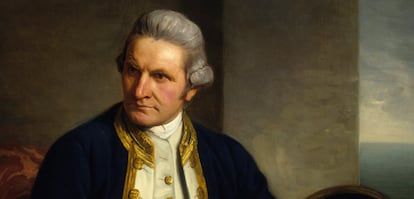
I have been immersed for a few intense days in the final adventure of Captain James Cook, the great British navigator and explorer (1728-1779). I have visited the exhibition at CaixaForum Barcelona Voices of the Pacific where he is mentioned several times—generally for the worse: one work by a Polynesian artist satirizes him and another puts his first ship, the HMS Endeavourhead down—, and above all I have read an extraordinary book about his third and final fateful trip, The wide wide seafrom Hampton Sides (Captain Swing, 2025), full of new research. As an appetizer—and worth the word—Sides maintains that Cook was cooked but not eaten by the Hawaiians after they killed him on the beach of Kealakekua Bay.
Cook, of whom Michel Le Bris in his Amoreal Dictionary of Explorers (Plon, 2010) points out how it inaugurated a long fascination that, despite the Bougainvilles and La Pérouse (or Magellan and Álvaro de Saavedra), made the South Seas a space in the Anglo-Saxon imagination (Stevenson, Jack London, The Irish Tavern), is sensationally revived in the pages of Sides, who breaks down his legend and masterfully traces the steps of the third voyage, many of whose places he has visited. The American author explains that Cook, already enormously famous after the two previous expeditions, in which he had circumnavigated the world and reached further south than anyone else (with the mistaken conclusion that Antarctica did not exist, no one is perfect), agreed to take command of the HMS Resolution and H.M.S. Discovery with the mission this time to find the Northwest Passage, that arctic grail that obsessed the British. Along the way, the expedition, which would access the northern tip of the American continent from the Pacific, through Alaska, and visit frozen places and not only the captivating South Seas (and Tenerife), had to return home a young Polynesian man who had been taken by Cook on the previous trip.
In the course of the third voyage, the most dramatic and longest, his swan song, Cook went to Hawaii, and it was there where the natives killed the captain in an unfortunate incident. I mistakenly believed that after killing it they had eaten it, at least in part, since the Hawaiians returned a charred piece of the leg, weighing about three kilos, which they will tell me if it is not to be suspicious. In a second delivery, more pieces of the legs (without feet), part of the skull, fragments of scalp and hands, which had been salted, arrived. Sides recalls that unlike other Polynesians, especially the Maori (who ate ten of Cook’s sailors on his second voyage), Native Hawaiians were not traditionally cannibals. “My opinion is that I don’t think it was eaten, but it was certainly cooked,” he explained to me Thursday in an interesting (I was going to say succulent) telephone conversation from his home in New Mexico. Cook—one thinks what a great couple he made with Lord Sandwich—was roasted, although not for culinary reasons but as part of a ceremony to remove the meat attached to the bones, which was where the locals believed the spiritual strength of the deceased resided. In fact, Sides points out, what the Hawaiians did is treat Cook as a relevant deceased of their own culture and convert his remains (the part not returned) into relics: those of a man considered high-ranking and very powerful.
Sides recalls that to this day the elders of Hawaii, despite the many morbid and grotesque stories that have circulated, have always vehemently insisted that no one ate any part of Cook’s body and that the captain’s remains were given treatment as dignified and respectful as that accorded to the great chiefs. Of course, the bones circulated a lot around the island.
Sides has not been able to give me information about the supposed arrow made from a piece of Cook’s tibia that Tony Horwitz mentions in his splendid blue latitudes (RBA, 2004) and that he tracked it to an Australian museum (taking the opportunity to reflect on the possibility of cloning the captain). Sides, by the way, met Horwitz and told me the sad news that the Pulitzer-winning writer died in 2019 of a heart attack.
Regarding what happened on the beach in Hawaii that fateful day of Cook’s death, Sides says that the captain lost his composure and “did not act with the diplomacy he used to.” The Hawaiians, who had a different concept of private property than the Europeans, had stolen a boat from the expedition and Cook seemed to go crazy: he went looking for King Kalaniopu’u and took him hostage to force him to return what was stolen. “He was unreasonable and did not read the situation well, there was a violent escalation and the warriors protecting the monarch attacked the captain and his men while they tried to return to the ships.” Cook, who fired his pistol killing a warrior, was hit on the head by another with a mace (there are some very eloquent ones in the CaixaForum exhibition) and, when he fell, a third stabbed him in the neck with a Pahoaa traditional dagger that often featured shark teeth or a swordfish beak, and continued to stab him viciously. Then they smashed his skull with a stone. It is curious that Cook ended up in a similar way to Magellan.
Sides believes that the experienced Cook had developed overconfidence and believed that he could handle any situation well. “He committed a sin of hybris as the Greeks would say.” It is possible that Cook also suffered from some illness or mental disorder, he adds. It seems that he was no longer the same as on his other voyages and there are testimonies that he had become more strict and even cruel, making the whip, an unusual punishment for him, used with a frequency worthy of Captain Bligh of Rebellion on board (by the way, Bligh, who years later would command HMS Bountywas part of Cook’s third expedition, as was another future star, George Vancouver). “We will never know what happened to Cook, there has been speculation that the physical damage of so much travel was taking its toll on him, he seemed exhausted.” Hampton Sides cannot escape the joke that Cook, who had been to extreme northern and southern latitudes, crossing both the Antarctic and Arctic Circles, was obviously bipolar.
He points out that Cook is currently quite frowned upon in Hawaii and other places in the South Seas, where he is attacked as a symbol of colonialism and a character whose arrival marked the “fatal impact”, the beginning of the destruction of traditional cultures: a “Christopher Columbus of the Pacific”. Sides’ judgment is different: “You can vilify him, but he is without a doubt one of the great captains and navigators of all time. He is actually blamed for what came after. Cook, a self-made man, austere, fair, sincere, was above all an explorer, his interest was knowing the world and drawing maps, in which he was a true genius. His objective was primarily scientific. I admire him for his abilities. He was very interested in other cultures and showed a unusual respect for them, to the point that it can be said that his view is that of a proto-anthropologist. He did not show prejudices, he did not moralize and he never tried to convert the natives. He even attended a human sacrifice. It is true that the victim had already been killed when Cook arrived at the lively ceremony, but he saw how a chief ate the left eye of the sacrificed man.
It is curious that there is no memorable film about Cook. “Yes, it’s strange, because his adventures are very cinematic.” Sides liked it a lot Master and Commanderthe adaptation of the novels by Patrick O’Brian whose protagonists, Aubrey and Maturin, reproduce in some way the relationship between Cook and the naturalist of his first trip, Joseph Banks, of whom Sides, by the way, does not have a very good opinion.
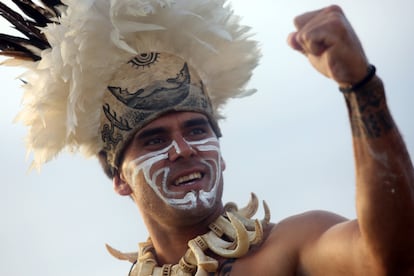
In The wide wide sea There is enough sex, which makes you think about The island of the three mermaidsby Irving Wallace. “In many places in the Pacific such as Tahiti, European sailors could openly have sexual relations with the unapologetic local women,” the author notes. To them it seemed like paradise; even more so because of the body control that the locals had, whose ability to move their hips by giving them a rotary movement was praised. On the other hand, Polynesian women found kisses disgusting. “There has been a lot of debate about what drove them to these unions. Partly curiosity, breaking taboos, and a genuine desire for different men who were mostly very young. Perhaps there was a natural impulse to escape the endogamy of the islands, and gifts would also play a role. There seem to have been sincere romantic relationships. The dark side was the massive spread of venereal diseases by Europeans.”
Would we have liked Cook? Probably not too much. Hampton Sides emphasizes that he was “a sailing machine” (although curiously he did not know how to swim), circumspect and unromantic. He valued precision and had no social skills. He had started in the Royal Navy from the bottom, as a private sailor, and as a captain he took care of his men. He could eat anything and felt at home in the Pacific. His big nightmare was that his sextant would be stolen. He seems to have practiced strict chastity despite the erotic environment in Polynesia. Maybe that had something to do with the bad character of his last days.