
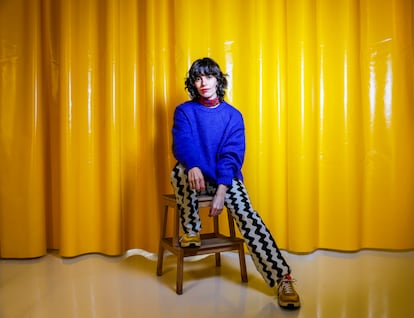
Valeria Palmeiro (Madrid, 36 years old) has been Coco Dávez since she was 15 (“I was amused by the idea of the pseudonym, of inventing a character”). He opens the door of his enormous studio that has just opened in Carabanchel (Madrid) this Wednesday of sub-zero temperatures. Fascinating and magnetic artist, she is the creator of Facelessa collection that has just turned 10 years old, recognizable faces without features.
Ask. He grew up in the south of Madrid.
Answer. My paternal grandfather had a perfume shop in Usera. It started as a soap factory that later became a drugstore. And I lived in the neighborhood since I was seven years old. My parents had me very young, at 19 and 20. My grandparents had lived in Viveiro (Lugo), and then almost the entire family moved to Madrid.
P. Happy town, Viveiro.
R. My grandparents had a hotel, the Hotel Venecia, which was right on the estuary. Today it is the current conservatory. I have some relatives left there, but since the hotel was also the place where they lived, when they sold it they left.
P. His parents.
R. My mother is a hospitality salesperson and my father, after running my grandfather’s store for many years, transferred it last year. And now he dedicates himself to living and returning to theater, which he is passionate about. He is writing a play.
P. And you paint from…
R. Always. I remember painting at any time.
P. And she was not a good student.
R. I repeated three times. Third year of ESO, first and second year of Baccalaureate. I was the so-called academic failure, which is a terrible term.
P. How did your parents handle it?
R. Fatal. I have spent my entire adolescence punished. My father was desperate because he told me: “If you came with all of them failed, well look, something happens. But I don’t understand that you come to me with three notables and the rest fail.” He thought I was lazy.
P. And what was happening?
R. That I was very bored in class. And he painted all the time, everywhere, he didn’t answer.
P. Complicated future.
R. I spent my entire childhood hearing that I had to study Fine Arts. And I thought: “How lucky, I have found my calling.” And yet adolescence arrived and what I heard was that no one made a living from art, that Fine Arts had no way out. The teachers made me see that this was not a clear destiny, that I should focus once and for all. High school for me was very complicated. The age difference was already noticeable. I felt like the mother of others. I entered through the door in September and it was like “ah, repeater, go to the last row, it’s clear that this doesn’t interest you.” It was very unfair.
P. What saved you?
R. Teenage rebellion. When I’m interested in something, I’m very interested. And I felt that in studies memory was rewarded a lot and interest was little.
P. I understand that Drawing was one of the notable subjects.
R. I ended up failing Drawing. In the fourth year of ESO the drawing activity changed. It became a little more professional and the class was divided into two: artistic drawing and technical drawing. And they told me that I was very good as a technician. I said: I like art. Yeah, but you’re good at technology. And I failed. But it didn’t go through the hoop.
P. What did you do when you finished?
R. My father proposed a year to myself. I really liked that about my father: he said that it was very rare that at 18, 19 or 20 years old you have a clear idea of what you want to do. “Then travel, live, meet people and then you start doing whatever you want.” And since I heard that languages open doors, I went to London.
P. In 2010.
R. A very gray climate in Spain, full crisis. My entire generation was told “study and you will have a guaranteed life.” Suddenly all those people did not have a guaranteed life, and they had studied for nothing. There was no job or future. In London I feel for the first time the possibility of an artistic life. I arrived with the idea of working as a waitress, whatever, but I was very lucky: the first person I met was a photographer, Daniel Gil, and I started with him as a photo assistant. He asked me how much money I had to pay for school. I had 4,000 bucks in my pocket and I thought I was rich. He told me: “This is what tuition costs almost a month, in a good school.” And he suggested I work with him: “I can’t pay you, but I can teach you.”
P. Did you like photography?
R. I thought so, but I realized it wasn’t what I expected. It was a fashion photo and all. What did I miss? Paint. Then I paint again. The first portrait I took was to the photographer in gratitude. And then he posts it on Facebook.
P. And the dice begin to move.
R. A very funny thing happened: a friend of hers who lives in Stockholm told her: “Hey, I want to do an interview with this girl who took your portrait.” We meet on Skype. I thought it was a job interview. Then I log in and he says: “How did you start your career?” I had to think very quickly about the answer. There were two ways: either say that everything was a mistake and clarify the misunderstanding, or throw me the wrong way.
P. He threw it at her.
R. With the whole face. I told him about my career as an illustrator and such. But of course, at the end of the interview he tells me: “Hey, send me a few illustrations to include in the article.” And I: “Yes, yes, of course, give me three days to choose the best from my portfolio and I will send it to you.” I talked about my non-existent career and that’s where my career began. I spent day and night painting, painting, painting.
P. Marvelous. He created the work to justify the artist.
R. Completely. I then sent the work to her and posted it on Facebook.
P. And the dice kept moving.
R. I don’t know how these things happen, but they happen. A friend writes to me and says: “Hey, a friend’s father wants to give you an order.” I thought: “Well, you must have seen the portraits and it is my first commission.” Okay. And this friend’s father turned out to be Rodrigo Sánchez, art director of The World. He told me: “Hey, I want you to start collaborating with the newspaper.” It was a hell of a rush. Not even a month had passed and they were already offering me a job. And it had six illustrations.
P. How was it?
R. They agreed to call me in a month. And when a week passed I started to get scared. Because of course: the lie was going too far. Then I wrote to Rodrigo again: “Hey, Rodrigo, thanks for the opportunity, but I haven’t really studied illustration, I don’t have any studies. What you’ve seen on Facebook is all I have, it’s my entire portfolio.”
P. Tremendous attack of honesty.
R. Then he wrote me the best answer I’ve ever gotten. “Do you think I haven’t realized that you lack technique, confidence in your lines,” and I don’t know what else. “But I see something that I don’t see as much: the desire you have.” And there I spent five years at the newspaper, which for me was the great school.
P. Did you share a flat in London?
R. She lived in a nuns’ residence sharing a room. It was quite an experience. Over the years I think that in my house I missed, I don’t know if it was certain rules or a certain discipline. I liked living in a residence where I had schedules and I had to go to certain masses or things like that, since my parents are not believers or anything. It was a very good price in a great neighborhood that is Kensington, 85 euros a week. And I said to myself: “Well, I’ll stay here even if I have to return home at ten.”
P. Did you know about the mass?
R. Half. But there was a lot of life in Spanish there, many nuns were Spanish.
P. What did your family say when the triplet started illustrating in a national newspaper?
R. I combined it with all kinds of jobs. Many catering, for example. And when I told them that I was going to make a cover for Metropolismy mother told me “very good, but how many catering services do you have this month?” That is to say: give me security, don’t talk to me about this. AND Faceless That’s when they started to see that this was serious.
P. Faceless has turned ten years old.
R. The first was Patti Smith. I had just read we were childrena book that fascinated me. And I made a portrait of him, with his features and everything. I really wanted to get back to the brushes. And with acrylic, which I had never painted before. I paint, paint, paint, but the result is catastrophic. I had never used that technique. And I said, “I’m going to delete everything.” And erasing, erasing, erasing I kept seeing Patti. There something lit up and at the same time it amused me. I think what I was missing was fun in what I did. During all those first years I was very happy to dedicate myself to painting and make a living from this, but at the same time everything was an assignment. I was thinking about my portfolio and I wouldn’t hang anything in my house because they are all, what I know, politicians, cosmetics, I mean, I didn’t have time to paint for myself.
P. By Patti Smith.
R. I thought maybe only I saw her without her face. The second one I did was David Lynch. The third was Picasso. Then came Cher. And what I did was post a portrait on Instagram and play to see if they guess it. And somehow I was creating this contemporary who’s who. And creating a collection.
P. How are you now?
R. I have come from some difficult years and I feel that I have now started to feel well for a few months. I have the feeling that a cycle has closed and that it is good that it has closed, and another begins in which I can focus on projects that I am very excited about. Bringing the entire collection home has reconnected me. Maybe it sounds a little silly, but having a client come and I receive them in the studio and get to know a little about that person, and know where my work is going to live, excites me a lot. I sent paintings to London, for example, and they sold, but I didn’t know where they went. There was something a little strange that began to make me sad without realizing it.
P. Do you understand yourself better through your work?
R. This is a bit strange, but I have understood the work of Faceless this summer. What has happened to me all my life is that everything was very difficult for me. It was difficult for me to work, it was difficult for me to socialize. And then I started to worry because I said, let’s see if I live depressed and I don’t know. Because I frequently have periods of a lot of social phobia, a lot of doubts, a lot of rumination. I went to a clinic with psychologists and neurologists so they could tell me what was happening. So after many tests they told me I had ADHD and high abilities. I always thought: “Now everyone has ADHD and I don’t know what” and they go and diagnose it to me. and I understood Faceless. These works give me a tremendous boost of energy.