
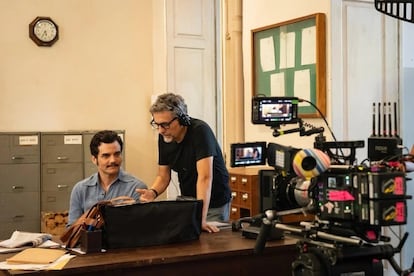
Brazil dreams of winning this Sunday in Los Angeles a second Oscar, even a third… It would be a colossal triumph just one year after entering the Hollywood Olympus by winning the first statuette for this country that has eluded the last World Cups and that has never won the Nobel. Caress cinematic glory with The secret agentand thriller about the escape of a professor persecuted by the dictatorship to Recife during the 1977 Carnival, a film that director Kleber Mendonça Filho, 57, wrote expressly for actor Wagner Moura, 49. Awarded at Cannes, at the Golden Globes… and largely applauded by critics both at home and abroad, more than two million Brazilians have seen it in the cinema.
This success confirms the sweet moment of Brazilian cinema in the wake of I’m still herea drama also set in the military regime and consecrated with the Oscar that broke the curse.
Four candidacies The secret agentbest film, best international film, best lead actor (Wagner Moura) and best supporting director. Another Brazilian, Adolpho Veloso, competes as best director of photography with Train dreams.
The euphoria does not reach the levels of a year ago, but the enthusiasm is great. Brazilians are preparing to continue Sunday’s gala in style, in the atmosphere of the World Cup final. Almost four decades have passed since the last time a country, Denmark, managed to win the Oscar for best foreign film two years in a row.
For the writer Xico Sá, who lived in the vibrant Recife of the 1970s, the awards and Oscar nominations reflect “the consolidation of the importance of Brazilian cinema in the world, and a great incentive for young generations to make films in Pernambuco and throughout Brazil,” he explained this week at a café in São Paulo.
Both the director and the protagonist of The secret agent They have been carrying out an intense promotional campaign abroad for months. Both born in northeastern Brazil during the dictatorship (1964-1985), Mendonça Filho is the son of a historian; Moura, from a military man. Both have emphasized the political nature of the film and have openly expressed their opinions on the political role of cinema and festivals, the threat of authoritarianism—in their homeland and in the United States—and many other current issues.
“In Brazil, remembering is a political act,” Mendonça Filho stressed in his interventions. In his film, the oppression of the military regime is much less evident than in I’m still here. There are no tanks, no dungeons, but a heavy air that suffocates anyone who dares to raise their voice. And the villain is not a ruthless dictator, but a businessman protected by the generals who sends a couple of hitmen to kill Professor Armando Solimões, played by Moura. It is not difficult to find in the film some traces inherited from that time in the dark times for the culture of Jair Bolsonaro’s presidency.
“This film was born because of how Kleber and I felt during that kind of fascist government,” the protagonist told the magazine Variety.
Moura, who has lived in Los Angeles for years with his wife and three teenage children, achieved international fame as Pablo Escobar in Narcos. Abefore he already appeared abroad in elite troop, as a brutal captain of the Rio police, and cut his teeth in soap operas.
The actor has publicly celebrated that cinema is a source of national pride, that artists are admired in contrast to Bolsonaro’s four-year term, when the Government treated art as a source of waste of public money and cut subsidies, in addition to attacking it as a supposed nest of communist enemies. Moura himself received the attack in the form of a thousand obstacles to brand new Marighellahis directorial debut, a biography of the leader of the resistance against the dictatorship.
“You do not know what it is to live in a dictatorship,” he warned Americans in Variety“it happens little by little and, if you don’t react to the little things, they take over”,. In that and other interviews he has expressed his pride that, in the face of the insurrection, his country tried, convicted and imprisoned President Bolsonaro.
Reflecting the radical change that the change of Government in 2023 meant for culture, the film session organized by President Luiz Inácio Lula da Silva to watch Mendonça’s thriller at his residence with the cast and several ministers.
After it achieved four nominations for the Oscars, the president tweeted: “Brazilian cinema is experiencing one of the best moments in its history! The nomination of ‘The Secret Agent’ (…) is a recognition of our culture and Brazil’s ability to tell stories that move the world.”
Lula’s Government restored the Ministry of Culture, headed by singer Margareth Menezes, renewed public investments in cinema, and restored screen quotas. Last year more than 360 Brazilian films were shown. The sweet moment also translates into the opening of rooms. There have never been as many as there are now, more than 3,500 spread throughout the territory. Last year, 14 cities opened their first cinema. And the success of I’m still here contributed to the tripling of the audience for national films.
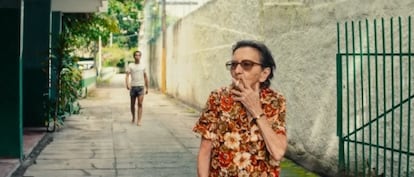
In the cast, Tânia Maria especially shines, who at 79 years old plays an anarcho-communist lady who runs the Recife shelter where the professor takes refuge with other dissidents. Her performance—the perennial cigarette, the hoarse voice—has elevated her to diva status among her compatriots.
The writer Sá remembers how “the Bolsonaro years (2019-2022) were deadly for Brazilian cinema due to the abrupt end of incentives for the industry. And the open hostility. “The secret agent It has resources from several countries. We have filmmakers who can survive without public funds, but those kids who started making films encouraged by Kleber need them.” He says that since the nineties, Pernambuco has had its own incentive program that, thanks to that, local filmmakers produce at least one great film annually.
Although it may go unnoticed from abroad, the film is a celebration of Recife, of Pernambuco, of northeastern Brazil. That is one of the hallmarks of Mendonça. There is the Recife carnival—so different from the Carioca one—or that frenetic dance called frevo. Also national emblems such as the Volkswagen beetle or the pay phone (orejón), the telephone booth.
“It is a very faithful portrait of the city, of the color, of the culture, of the local speech,” says Sá, who recalls that, already in the 1920s, Recife had a silent film industry. This film “is also a great showcase of the northeast and that contributes to a certain rebalance because the Rio-São Paulo axis has always been more favored by the cultural industry.”
For the northeasterners, traditionally seen by their compatriots from the rich southeast as poor people, victims of drought, driven to emigrate… that portrait of a modern Recife in the seventies, with a rich culture and majestic movie theaters like São Luiz, still open, is a priceless pride.