
For the first time, some of the main cultural institutions of Madrid and Barcelona have met in an event promoted by Turisme Barcelona and the Círculo de Bellas Artes (CBA). After a minute of silence for the victims of the train accident last Sunday night in Adamuz, this Tuesday a day was held with the objective of making Madrid aware of the cultural offerings of the capital of Catalonia. Renowned institutions such as the Palau de la Música Catalana, l’Auditori, the Gran Teatre del Liceu, the MACBA, the Fundació Joan Miró, the Picasso Museum, the Tàpies Museum, the Museu Nacional de Catalunya, La Pedrera and the College of Architects of Catalonia have participated in the dialogue, along with initiatives such as LOOP and the Barcelona Art Gallery Weekend. From Madrid, representatives from the Teatro Real, the Reina Sofía Music School, the Madrid Philharmonic, La Casa Encendida, Fundación MAPFRE and Arte Madrid attended.
Juan Miguel Hernández León, president of the Círculo de Bellas Artes, announced at around ten in the morning what would be the agenda: “We are going to talk about culture as the driving force of the city, about progress and reflection.” At the same time, he warned of the need to promote but also control tourism – a reflection shared by other speakers – which, in excess, can be “a poison.” Jordi Clos, president of Turisme de Barcelona, has highlighted the importance of the alliance between both cities and their cultural institutions to improve the profile of visitors, project themselves internationally, increase income and share cultural and tourism projects. In this way, two cities that could be seen as competition must “actively cooperate so that outsiders know the potential of both.”
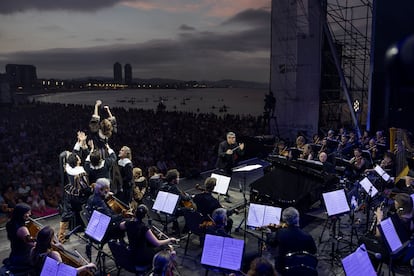
In the conversation around music, the three main Barcelona institutions – the Palau, the Liceu and l’Auditori – have presented their collaborative work in Barcelona Obertura, an alliance from which they coordinate the programming and communication of their activities to achieve coherence in their cultural offering. Ramón Agenjo, president of the initiative, recalled: “A few years ago we decided that Barcelona could be put on the world music map.” Valentí Oviedo, general director of the Liceu, has assured that there is no competition between the three institutions, but rather a spirit of collaboration. Proof of this are, for example, the two concerts they organized on July 9 and 10 on San Sebastián Beach in front of 30,000 people.
Joan Oller, general director of the Palau, has pointed out that Barcelona is not sufficiently recognized for music, which was fundamental when forming the collaboration: “Many visit the Palau for being a monument and not for the concerts.” In a moment of humor and complicity between the three directors, they joked that Rosalía has been at the Palau and the Auditorium, to which Oviedo responded: “Rosalía has not sung at the Liceu, I take this opportunity to call her.”
Joan Matabosch, artistic director of the Teatro Real, has reacted to the Barcelona intervention and has celebrated “the uninterrupted tradition of the Liceu, which no one else has in all of Spain.” Julia Sánchez Abeal, CEO of the Reina Sofía Higher School of Music, has joined in to value the alliances that the institution she directs has had with the Catalan capital, for example, when her students give concerts there. “It is not competition, it is collaboration,” he clarified, because “talent does not understand limits or borders,” and he has invited us to create a “joint narrative” towards abroad. In his speech, the artistic director of the CBA Chamber Circle, Antonio Moral, said that he envies Barcelona for having a joint story between cultural spaces and administrations, unlike Madrid: “Barcelona City Council is playing a fundamental role,” while in Madrid each institution goes its own way.
In the field of arts, the presentations have focused on author museums, architecture and contemporary art in Barcelona. Marko Daniel, director of the Miró Foundation, participated in the conversation; Emmanuel Guigon, director of the Picasso Museum of Barcelona; and Inma Prieto, director of the Tàpies Museum. Guim Costa, dean of the College of Architects of Catalonia, has highlighted that “Barcelona has always been an urban planning and architectural laboratory” and has valued private investment in the works that stand out in the city today. “People want to come to Barcelona for its architecture that has transcended Catalonia, Spain and Europe,” he said in the context of an important year, with the centenary of Gaudí’s death and the 150th anniversary of Cerdá’s, which coincide with the World Capital of Architecture 2026, which will be held in the city.
Marta Lacambra, General Director of the Catalunya La Pedrera Foundation, has opted for “the architecture of collaboration” and has called for Barcelona “to continue not looking at what Madrid is doing.” Pepe Serra, director of the Museu Nacional d’Art de Catalunya (MNAC), has acknowledged that they already maintain a great collaboration with the country’s great museums and has underlined the enthusiasm aroused in him by the museum’s expansion work, which, he regrets, has not managed to be valued appropriately in the Barcelona panorama. The manager has taken advantage of the occasion to also joke that Rosalía presented her album LUX in the vicinity of the MNAC.
Valerio Rocco, director of the Círculo de Bellas Artes, has also valued the intentions of the administrations of Barcelona – regional and local – to promote culture “in harmony”, which in Madrid “does not exist”: “I do not perceive a clear harmony, a common project, a guideline or clear objectives”, he said, between the popular governments of Almeida and Ayuso with the Madrid cultural institutions.
Towards the end of the day, different collaboration ideas emerged. For example, from La Casa Encendida they imagine an exchange of experience between workers from the Barcelona and Madrid centers, while Rocco, from the CBA, has proposed that initiatives such as the Festival of Ideas build bridges with projects such as the Biennial of Thought.
The closing was led by Mateu Hernández, director of Barcelona Tourism, who displayed the Barcelona Art Scene poster with the city’s cultural offer for the first half of this year, which includes 70 activities including exhibitions, concerts and festivals. 2026 will also be the year of the Grand Depart of the Tour de France and the end of the Tower of Jesus of the Sagrada Familia, which is expected to be inaugurated on June 10 with the visit of Pope Leo XIV. The invitation to the people of Madrid to comply was made by Hernández: “It should be common for Madrid and Barcelona to meet.” After regretting the years that have kept the two large cities separated, he assured that a wish has been fulfilled: “We dreamed of this happening.”