
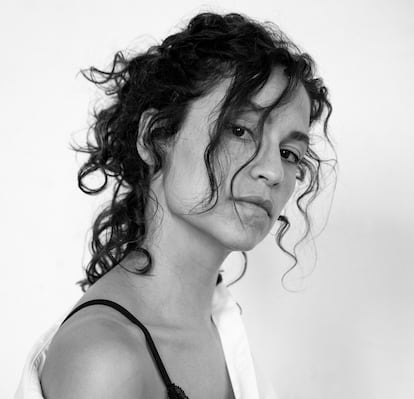
In 2021, Bàrbara Mestanza (Barcelona, 35 years old) went on stage and recounted the sexual assault she had suffered in 2015 by a masseuse. For more than four years, this actress, playwright and filmmaker has told her experience in different theaters in Spain. And while he did so, he compiled audiovisual material in which he narrated how he felt and the answers that experts gave him to help him navigate those emotions. During this time he also decided to denounce and embark on what he now calls “almost an adventure film.” This judicial process is the backbone DIRTYthe documentary that premieres this Saturday at the Malaga Festival, and which is almost a continuation of the play. That’s why they have the same name, because, Mestanza explains by phone: “Sometimes the stage is too small to be able to tell in detail the magnitude of what really happens to a body to which something like that has happened.”
Mestanza assumes this task in the first person as he already did with the play. She stars in the film in which she is accompanied by her mother, her partner, those experts who continue to help her and her friends to retell what happened to her, but above all, to explain the emotional and economic cost that a complaint for sexual assault entails. “Abuse has two parts: what you experience in the moment and how it worsens over time, the effects that appear over the years,” he says. “That’s why it seemed important to me to make visible what happens when I report. No one had told me everything I found, not even a trailer for a Netflix movie,” explains the actress, “I think it can be useful for other women.”
The judicial process has lasted for years, in which he has had to undergo hours of interrogations in which he spoke more about his private life than about what happened to him. “It was one of the hardest blows of the entire process, because I had to prove in five psychological reports that I was telling the truth,” he recalls. Mestanza experienced how his case was archived and reopened. He prepared thoroughly when he was given the trial dates. The prosecution almost stopped the hearing due to the state of anxiety in which he was during his statement. Finally, a conviction was issued that is still waiting to be carried out.
—Now that you’ve been through all this. What would you say to those who require women to report as a condition for believing them?
—Fuck them. A woman does not decide to be a victim, so no one can force her or force her to make a decision as important, as drastic and quick as this one.
And the actress recognizes that she has been very “lucky” throughout this journey. From the first day he entered a police station and met a mossa d’esquadra who heard her. “When I was in the trial, I felt cared for in a way that I couldn’t explain, it was as if there was an intangible force there, which I don’t know if it was the force of Justice, that of the State, that was with me. But I don’t want to speak for anyone because I know that I was lucky,” she clarifies.
DIRTY At times it works almost as a guide to unravel these processes, in the same way that it is articulated as an exercise in listening to a victim. “I would die of sadness if I couldn’t help make sure these types of things stop happening or make sure that the people who have suffered from it are not a little better,” confesses Mestanza. “At the same time, it is exhausting to come home with many fewer liters of blood in your body after each performance or each pass. You want to rest, to send everything to hell, to stop worrying, to have this issue no longer affect you, to not have to explain anything, to touch my pussy. But I also know that once you start, you can no longer stop seeing or knowing. And that can be a condemnation.”
The other penance that she and her team suffered came when they went to seek financing for the film. The topic, the type of aggression —“It is not archetypal, it is true, that is why it may be more useful to demonstrate the most common one,” he values— and his way of being were questioned in the offices. “They argued with Marc (Pujolar, co-director) that I didn’t cry enough, that I didn’t suffer enough to be a victim,” he recalls, “they told me to my face that they didn’t empathize with my character, as if I were a fiction.”
—And now that you have managed to have it premiere at a festival, how do you feel? Do you still use the dirty word to define yourself?
—I don’t want to see the movie because that would be inhumane. I think about it and I feel like running away. My body tells me: “Danger! Run away from here!” But I believe so much in what I’m doing that I want to keep going with it.
“So, what are you afraid of?”
—What they are going to ask me, how they are going to look at me and, above all, that in the end they see me marked. And there would come the question of whether I feel dirty. I guess I’m going to feel eternally dirty, but because I was born with a pussy.
This Saturday he will see the film with his friends, his family and his mother, one of the protagonists of DIRTY, with whom he has several very illuminating and loving conversations. “There is something very restorative about seeing a symbol, such as a mother or a mature woman, talking about her wound. Add the point of view that violence is everywhere,” he explains about the experiences they share.
—She repeats in the film that she needs to forgive herself. As if she were to blame for her aggression for not having done anything at that moment. Has it been possible to forgive?
—I am proud to have emerged from the cesspool of self-destruction, to have done something useful with this film, I feel closer to myself. I’m happy. So I guess I can say that I have forgiven myself or that I do it every day.