
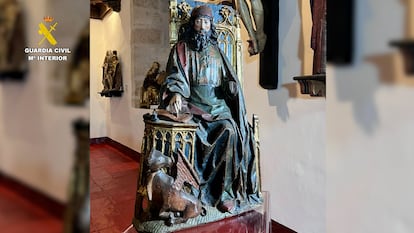
San Lucas has returned to Astudillo. The sculpture of the saint carved in the 15th century by the prestigious Diego de Siloé and stolen in 1979 has been recovered in Genoa (Italy) after several years of investigation and returned to Astudillo (Palencia, 1,000 inhabitants). The piece disappeared at a time of multiple heritage thefts in Spain and there was no record of it until July 2021 when some antique dealers who attended an art auction in Italy became interested in the sculpture and subsequently discovered that it had been stolen from its original location. The process has been carried out through the collaboration of the Spanish Civil Guard and the Italian Carabinieri in their heritage expert departments and allies with the Ministry of Culture. The work returned to Spain last summer and has been in storage since then in the National Museum of Sculpture in Valladolid until the celebration of a formal ceremony in which it was located in the Diocesan Museum of Palencia.
This Wednesday a wound that had been open in Astudillo since 1979 was closed. That year some thieves took various objects from the main altarpiece of the church of Santa Eugenia de Astudillo, from the 15th century, attributed to the prestigious sculptor Diego de Siloé, also an architect and responsible for the well-known golden staircase of the cathedral of Burgos, the city from which he came. The authorities were aware of the possible discovery when in July 2021 some antique dealers saw it in Genoa, ready to be sold at an art auction, and by researching this San Lucas they were able to verify its illicit origin. “It is a polychrome wooden sculpture, about 70 centimeters high, which was part of the main altarpiece of the church of Santa Eugenia de Astudillo (Palencia), from which six apostles, the four evangelists, a free sculpture and a cross were also stolen on the same day,” says the statement issued by the Government subdelegation in Palencia.
The notice reached the Historical Heritage section of the Central Operational Unit of the Civil Guard, which located in its archives “the complaint presented at the time by the parish priest of the church of Santa Eugenia de Astudillo” when the works disappeared in 1979. The images and old documents corroborated that it was that same sculpture, so that at the request of the Civil Guard, the Civil and Investigative Section of the Court of Instance of Palencia, a European investigation order was issued to Italy to intervene. precautionarily the work and try to return it to Spain.
The Civil Guard has collaborated with the command for the protection of the Cultural Heritage of the Carabinieri to recover the creation of Diego de Siloé in the so-called. Operation Predella. The institutional statement recalls the importance of this sculptor and architect as “one of the most outstanding figures of Spanish sculpture at the end of the 15th century, when the forms of late Gothic, hybridized by those of Mudejar art and flamenco influences of a flamboyant type, gave rise to what is known as ‘Elizabethan Gothic’, exclusive to Spain.”
The piece was repatriated in July, 45 years after the theft, and was kept for months in the National Museum of Sculpture until this Wednesday it was returned to the Diocesan Museum of Palencia before ecclesiastical, ministerial, regional and Italian Civil Guard and Carabinieri charges.