
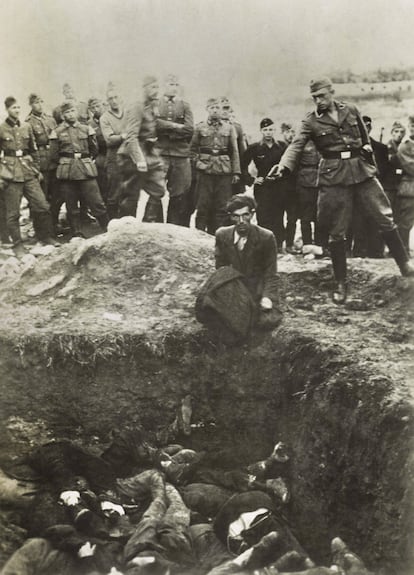
The image concentrates all the horror of the Shoah: A Nazi points at the head of a man, who looks at the camera with an almost defiant expression. Other German soldiers, including a civilian, watch the scene without seeming particularly impressed. It is an image of absolute evil. Before the person who is going to be murdered, the abyss of a mass grave full of corpses opens. This photograph, taken in Ukraine in 1941, summarizes the so-called Holocaust of bullets and is one of the best known of the genocide that the Jews suffered under Nazism. Until now the name of the murderer was not known. However, thanks to artificial intelligence and the collaboration of two family members, the German historian Jürgen Matthäus has managed to identify the perpetrator: Jakobus Onnen, who was 34 years old at the time of the events and who died in 1943 during an attack by Soviet partisans. The victim, however, remains unknown. Matthäus published his discovery in an article in the specialized magazine Journal of historical science (History Magazine).
The investigations of Matthäus, an expert Holocaust historian—who recently retired from the US Holocaust Memorial Museum, where he worked as a researcher—first made it possible to change the location of the image, universally known as The last Jew of Vinnitsa. The photograph was published for the first time in 1961 by the defunct United Press agency (UPI) during the trial of Adolf Eichmann, one of the main organizers of the Holocaust, detained by Israeli agents in Argentina, tried and hanged – Hannah Arendt wrote her famous book about this process. Eichmann in Jerusalem, in which he coins the concept of the “banality of evil”—.
The image had been found by a Holocaust survivor, Al Moss, who gave it to the UPI to show the world the crimes that the Nazis had committed. The information was very scarce and it was then thought that the photograph, of poor resolution, had been taken in the Ukrainian city of Vinnitsa and showed the soldiers in action. Task forcethe death squads that carried out open massacres of Jews in Poland and the former USSR during World War II.
It became one of the most atrocious documents of the Holocaust of bullets, the murder of millions of people, the vast majority of them Jews, but also gypsies, prisoners of war or resisters, shot next to ravines, in mass graves almost always dug by the victims, in forests or in open fields near urban centers.
By the end of the conflict, 1.5 million Jews had been exterminated in Ukraine, according to data collected by Raul Hilberg in its monumental The destruction of the Jews of Europe (Akal). Only after those massacres, at the end of 1941 and beginning of 1942, the Nazis set up extermination camps with gas chambers, where almost three million people, mostly Jews, were murdered.
A chance discovery allowed Jürgen Matthäus, 66, to answer many questions about the image, research that he published in 2023 in the journal Holocaust and Genocide Studies. “Very little was known about that photo,” he explains in an email interview. “That changed a few years ago, when the archive of the United States Holocaust Memorial Museum, where I worked as a historian until my retirement, received a donation containing the war diaries of a Wehrmacht captain. One of the diary volumes was about the German attack on the Soviet Union in June 1941. It contained not only a copy of the photo, of good quality, but also the diary entry written by the captain, which confirmed the crime scene.” On the back of the photo was written: “End of July 1941. Execution of Jews by the SS in the Berdychiv citadel. July 28, 1941.”
The Wehrmacht officer, Walter Materna, described in his diary that a massacre of Jews had taken place in that city, which would demonstrate that the members of the German regular Army were fully aware of the mass murders perpetrated by the SS and members of the death squads, although they did not directly participate in them.
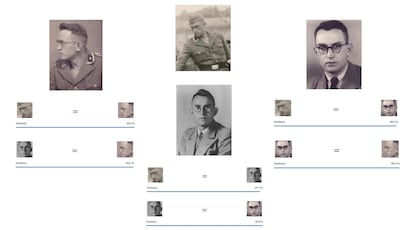
The next step came later when, after reading his article, a couple contacted the historian because they were convinced that a relative of theirs was the Nazi in the photo. It was an uncle of the woman—a brother of her mother—whom they suspected of having been part of the Task force. “The key factor in identifying the killer in the photo was the availability of comparable images. In this case, I was fortunate to be contacted by a reader of my previous publication on the subject who, along with his wife, suspected that the killer was a relative of hers. He provided photos of Jakobus Onnen that were chronologically close to the war and of sufficient quality to allow facial recognition. The experts involved used both traditional facial recognition techniques and artificial intelligence; the latter produced similarity indices between the 98.5% and 99.9%, very high for historical photographs.”
From there, he was able to draw a biographical profile of the perpetrator: Jakobus Onnen, born into a middle-class family in 1906 in the village of Tichelwarf, near the border with the Netherlands. He was a teacher, spoke French and English and was an early Nazi: first member of the SA since 1933, the year Hitler came to power, then of the SS and during the death squad war. “In the photo it is clear that the murderer was a member of the German Security Police and the SD, that is, the part of the police apparatus led by the head of the SS, Heinrich Himmler, who was part of the infamous Task Forces“, explains Matthäus. “These units followed the Wehrmacht as it advanced through the Soviet Union and killed hundreds of thousands of civilians, especially Jews. After the war, Allied and German prosecutors investigated these murderous units. Onnen’s name is among those identified as members of one of them, but since he died in combat in Ukraine in August 1943, he was never investigated.”
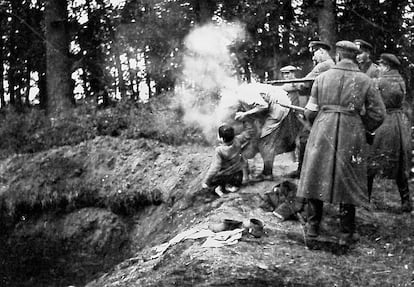
Although there are many images of the Holocaust, only a dozen moments of murder are preserved and all have been thoroughly investigated by historians. The Nazis occasionally took these photos as trophies, even though they are now disgusting and atrocious. For the Nazi genocidal mentality, these were not crimes, but the fulfillment of a mission of which they were proud. Many of them were destroyed after the war, others emerged as evidence of the greatest crime in history. Researcher Wendy Lower In 2021, he published a fascinating analysis of another piece of evidence: a photo of a massacre in Ukraine in 1941 in his book The pit (Confluences), which shows the murder of a mother and her son by Ukrainian collaborators. However, as with The last Jew of Vinnitsa, managed to identify the perpetrators, but not the victims.
Explains Matthäus: “My colleagues and I tried to locate references to the victim in wartime documents, post-war oral histories and other sources, but we found nothing substantial. Equally unsuccessful was the attempt to identify him in Soviet photographs taken before the German attack on June 22, 1941, in archives in Ukraine. The conditions for conducting such an investigation in a country that has been under attack by Russia for four years are not at all promising; however, “They helped us a lot. But, once again, the result was negative. I continue to hope that in the future solid clues can be found that will help answer the question of who was the man who was about to be shot.”
Yad Vashem, the Holocaust museum in Jerusalem that is also a research center, maintains a database with 4.7 million names of Holocaust victims. Shoah. There are still 1.3 million unidentified. One of them remains that Jew in Berdychiv who embodies humanity in the midst of one of the most horrible images in history.