
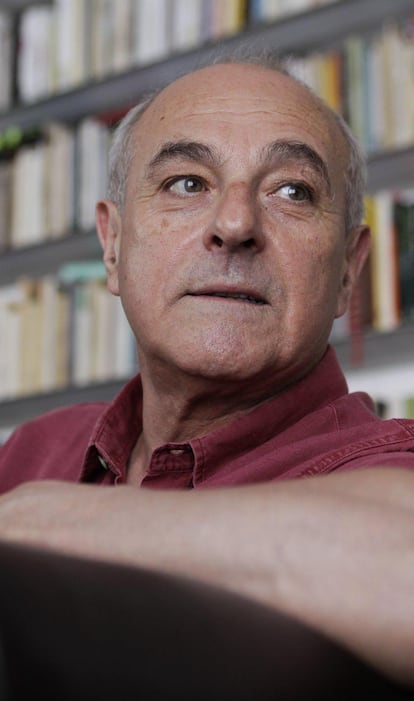
Antoni Marí, Ibiza (September 20, 1944), poet, writer, professor and editor once explained to me that, when he was very little, for some strange reason he decided not to say a single word until he was four years old. His childhood and youth took place between the Plaza de Vara de Rey, in Ibiza, and his grandfather’s farm in Cala Jondal. Death overtook him in Barcelona this Monday at the age of 81.
The island maintained a good part of its traditions, in addition to incorporating a stimulating presence of European modernity. That mix shocked him. Rock records were played sooner in his house than in others on the peninsula. It is impossible to understand his life without that island bond, without its customs and rituals, the creative engine of his work. Although some time later, his family decided that he was the most prepared of the three brothers to complete his studies. At the age of 15 he went to study in Palma de Mallorca and, once he completed high school, he moved to Barcelona to study Philosophy. In 1969 he returned to Ibiza where for a couple of years he worked as a high school teacher. But, except for the students, everything else seemed “terrifyingly squalid.”
The Barcelona cultural ecosystem suddenly became very present and intense upon its return to Barcelona. While his career as a teacher at the Autonomous University of Barcelona took off, he worked at the Teide publishing house. The same year he entered, 1979, he published a book of poems, The Preludewith his friend Jaume Vallcorba who had just founded the groundbreaking publishing house Quaderns Crema. These years were also those of his specialization in the study of aesthetic ideas and their translation into various essays. In his first two works published in 1979, Enthusiasm and stillness y Geni’s homethe Ibizan author clearly highlights one of his main objectives: to provide the academic essay with a literary entity that it did not have until then. The expressive will (1988) y Forms of Individualism (1994) underpin this narrative tendency.
Two important changes occurred in 1989. The rector of the Pompeu Fabra University, Enric Argullol, proposed that he become part of the select group of professors who will organize the Faculty of Humanities. Marí moved from the Autonomous University to the new University where she would end her academic life. This same year, he proposed to his friend Beatriz de Moura to launch a poetry collection. Faced with the reluctance of the owner of the Tusquets publishing house, Marí responded: “Until you have a poetry collection you will not have a prestigious publishing house.” This is how it was born New Sacred Texts, who has published more than 120 titles and has won several national poetry awards. In 2001, De Moura commissioned him with a new editorial project, the Catalan collection of Tusquets glass eyewhich inaugurated False clue de Henning Mankell.
His poetic work, widely translated and awarded, is nourished by the authors who make up his literary ascendancy, such as Dante Alighieri i Guido Cavalcanti, JV Foix, Carles Riba, Francesc Parcerises and Pere Gimferrer. But, above all, the landscapes and experiences of his native Ibiza. From his country house, oblivious to all the transformations of the 20th century (without electricity and running water), Antoni Marí tries to relive the Ibiza of his childhood and youth every summer: A winter trip (1989), The desert (1997), Triptych from Jondal (2003), Some friends have comes(2010). His last literary contribution, the poem in verse four sides (2025) is once again a nod to childhood inspired by Four quartets by TS Eliot, another of his reference authors. In his narrative work the autobiographical character is imposed in two of them, The silver vase (1991) y Spring (2000). Instead, The Vincennes road (2005) is a novel of ideas or philosophy. A walk between Jean-Jacques Rousseau and Denis Diderot that recalls those that take place around the sanatorium of The magic mountain by Thomas Man.
Marí filled her classes with a combination of physical and intellectual strength. Everything about him was both cognitively brilliant and materially direct and adrenaline-inducing. For his students, and also for those of other great professors, his legacy has to do with that special way of understanding teaching as a vibrant exchange of ideas whose objective, romantic and utopian, is the search for the connections that exist between all of them. We left classes upset, moved, shocked by the complexity of the issues we had discussed. This memory lasts like the work and means that these days, in addition to leafing through his books, the phone rings often between us. Although, as happened to him himself until he was four, it is now difficult for us to say a word.